
KS3 Physics · Energy
Power and energy bills
- Power in watts and kilowatts, and typical power ratings
- Energy = power × time, in joules and in kilowatt-hours
- Working out an electricity bill at today's capped price
- Comparing the energy in foods from their labels
- 4 min read
- 5 quick questions
- Free homework sheet
- Years 7 to 9
Revision notes
Power is how fast energy is transferred, measured in watts (W): 1 watt is 1 joule every second. The energy an appliance transfers depends on its power and how long it is on: energy = power × time.
What is power?
Power is the energy transferred each second. Its unit is the watt (W): 1 W means 1 joule every second. Big powers are given in kilowatts (kW): 1 kW = 1,000 W. Every appliance has a power rating on its label. Typical ratings:
| Appliance | Typical power |
|---|---|
| LED bulb | 5 to 10 W |
| Laptop | About 50 W |
| Television | About 100 W |
| Toaster | About 1 kW (1,000 W) |
| Hair dryer | About 2 kW |
| Kettle | About 3 kW |
| Electric shower | About 9 kW |
The appliances that heat things have the biggest power ratings.
How do you work out the energy an appliance transfers?
With power in watts (W) and time in seconds (s), the energy is in joules (J). With power in kilowatts (kW) and time in hours (h), it is in kilowatt-hours (kWh). One kilowatt-hour is the energy a 1 kW appliance transfers in 1 hour: 1,000 W × 3,600 s = 3,600,000 J.
A 2,000 W hair dryer is on for 5 minutes. How much energy does it transfer?
time = 5 × 60 = 300 s
energy = 2,000 W × 300 s = 600,000 J (600 kJ)
A 2 kW electric heater is on for 3 hours. How much energy does it transfer?
energy = 2 kW × 3 h = 6 kWh
How do you work out an electricity bill?
An electricity meter counts kilowatt-hours, often called units. The bill is:
Ofgem, the energy regulator, sets a price cap: the most that suppliers may charge for each kWh and for the standing charge. It is reset every three months. For October to December 2026 the cap was an average of 26.32p per kWh, plus a standing charge of 54.83p a day for being connected (Great Britain, paying by direct debit). At that price, the heater in worked example 2 costs 6 × 26.32p = 158p, about £1.58.
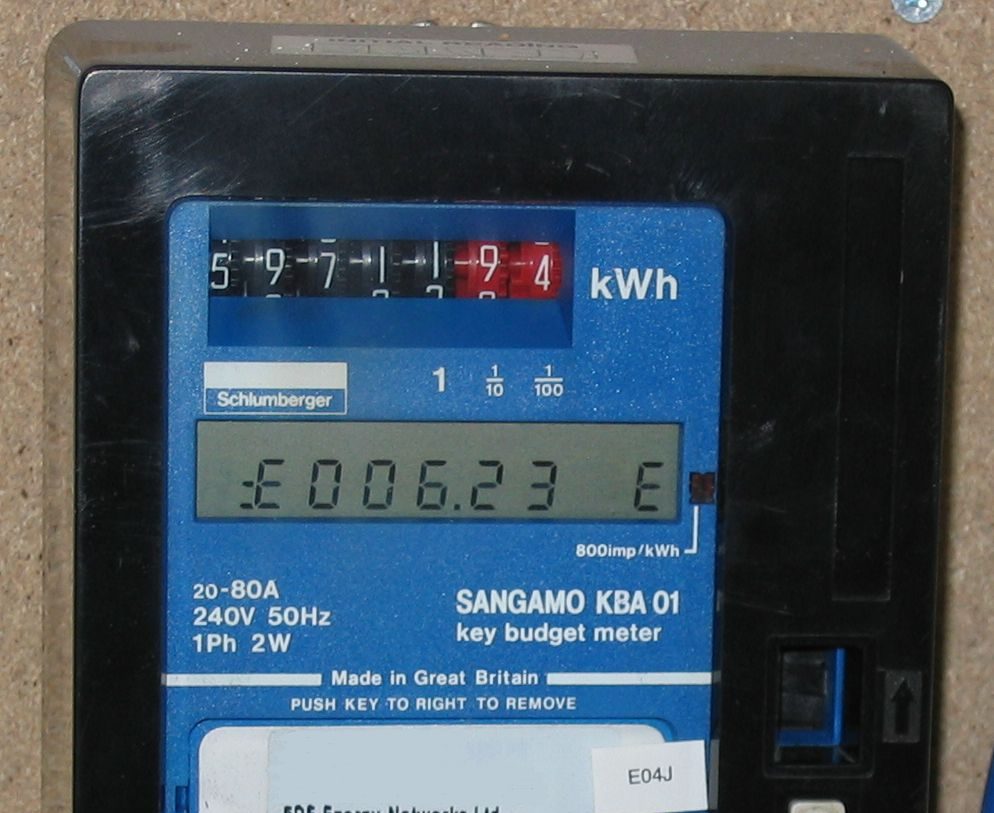
Over 30 days a meter reading goes from 45,210 to 45,460. Electricity costs 26.32p per kWh and the standing charge is 54.83p a day. What is the bill?
energy = 45,460 − 45,210 = 250 kWh
cost of energy = 250 kWh × 26.32p = 6,580p = £65.80
standing charge = 30 × 54.83p = 1,644.9p = £16.45
bill = £65.80 + £16.45 = £82.25
Gas is sold by the kWh too, at 7.97p under the same cap: less than a third of the price of electricity, which is one reason most UK homes are heated by gas boilers.
How much energy is in food?
Food has energy in its chemical store, which your body releases by respiration. Food labels give it in kilojoules (kJ), and also in kilocalories (kcal): 1 kcal is about 4.2 kJ. From real UK labels:
| Food | One pack or portion | Every 100 g |
|---|---|---|
| Crisps | 542 kJ in a 25 g bag | 2,167 kJ |
| Milk chocolate | 1,004 kJ in a 45 g bar | 2,232 kJ |
| Baked beans | 703 kJ in half a 415 g can | 339 kJ |
To compare foods fairly, use the "per 100 g" column, because portions are different sizes. Gram for gram, chocolate has more than six times the energy of baked beans. Labels also compare a portion with the reference intake, a guide to the energy an average adult needs in a day: 8,400 kJ.
Stretch Your body works like an appliance too. An adult taking in 8,400 kJ a day transfers 8,400,000 J in 86,400 seconds: power = energy ÷ time = 8,400,000 ÷ 86,400 ≈ 97 W, about the same as a television.
Written to the KS3 national curriculum. Last changed 15 November 2026.
Key words
Say them, spell them, use them in an answer.
- power
- watt
- kilowatt
- power rating
- kilowatt-hour
- standing charge
- price cap
- kilocalorie
- reference intake
Common misconception
Often said“A kettle always uses more electricity than a TV, because it is more powerful.”
In factThe energy depends on the power and on how long it is on. A 3 kW kettle on for 4 minutes transfers 0.2 kWh, but a 100 W TV on for 5 hours transfers 0.5 kWh: more than twice as much.
Did you know?
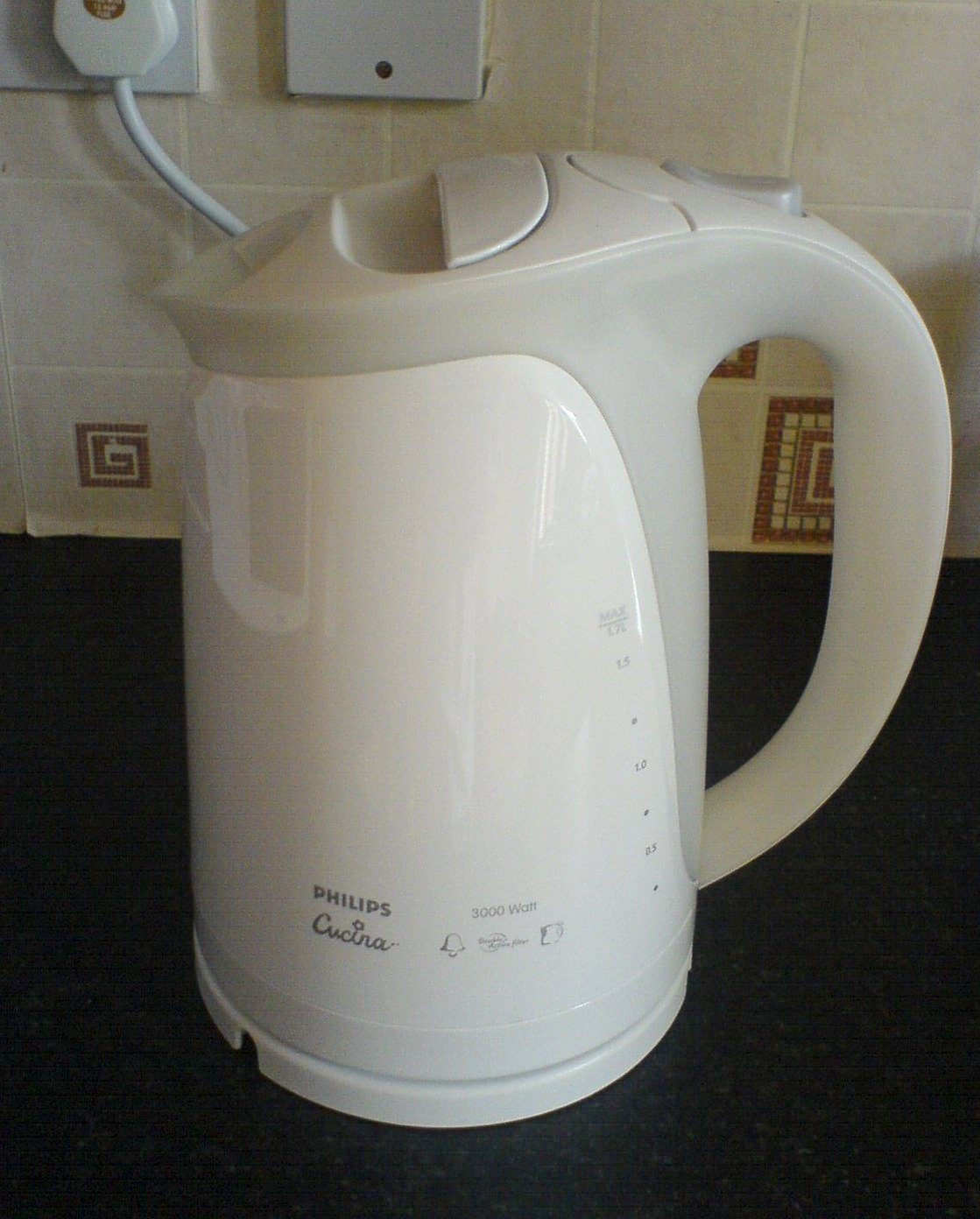
The great kettle surge
On 4 July 1990, when England's World Cup semi-final against West Germany ended in a penalty shoot-out, so many people switched on kettles at once that demand on Britain's grid jumped by 2,800 MW, the biggest TV surge on record.
Photo: Rafa, Public domain, via Wikimedia Commons
Try 5 questions
Quick questions on power and energy bills, marked as you go. Each one explains the answer.
Question 1 of 5
A 3 kW kettle is on for 0.1 hours. How much energy does it transfer?
Choose an answer. Each question explains itself.
The homework sheet
About twenty minutes. Everything on it is in the notes above; the answers are on the last page.
Free homework sheet
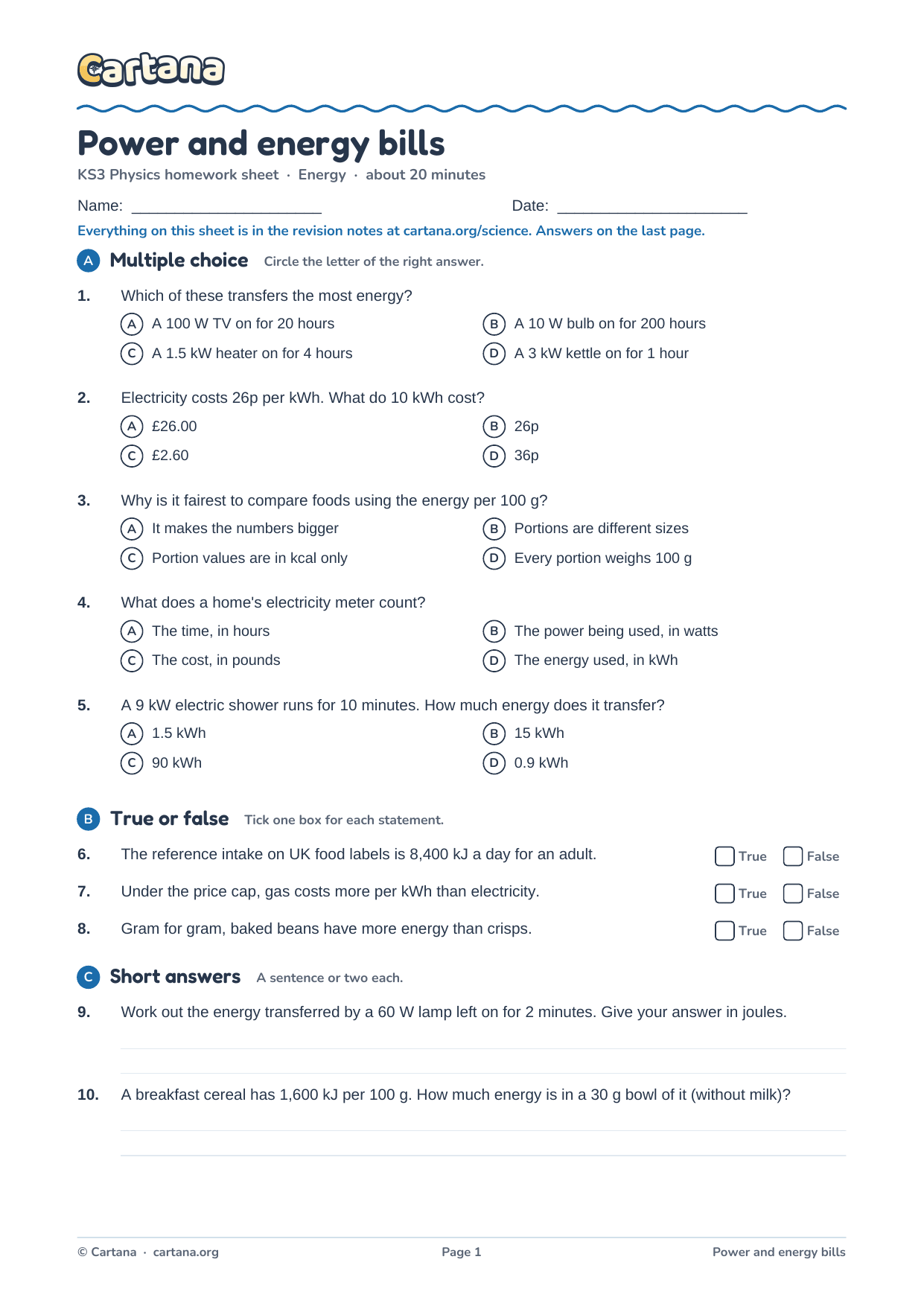
Power and energy bills homework sheet
17 questions, about twenty minutes, with the answers on the last page: multiple choice, true or false, short answers, key words to define and one to explain in full.
KS3 Energy
Revised the whole unit?
When every topic in energy is done, two different papers test the whole unit, each with its own mark scheme.


 Watch the trailer · 1:06
New from Cartana · Beta test 1–31 December
Revision that feels like an adventure
Cartana is our KS3 learning adventure: sail between islands, answer quick-fire questions and battle bosses. It starts with science, with maths on the way, and launches in 2027. This December a small group of testers gets to play it first.
In the Cartana adventure, every science unit is an island to explore. The island for energy is being built.
- Play the game before its official release
- Help us build it with your feedback
- Earn exclusive in-game items in return
More in this unit
Energy
- 1Energy stores and transfersThe energy stores, the four ways energy is transferred, and describing a change by its start and end
- 2Conservation of energyEnergy is never made or destroyed; useful and wasted energy, dissipation, Sankey diagrams and efficiency
- 3Heating and coolingTemperature and thermal energy, hot to cold until thermal equilibrium, conduction, convection, radiation and insulators
- 4Energy resourcesFossil fuels, nuclear fuel and renewables, how a power station works, the UK's electricity and comparing resources fairly
- 6Work and machinesNextWork done = force × distance; levers, ramps and pulleys trade force for distance; no machine gives out more energy than goes in