
KS3 Physics · Electricity & magnetism
Static electricity
- Protons, electrons and why most objects are neutral
- Charging by rubbing: electrons move, and charge is never made
- Like charges repel, unlike charges attract, and electric fields
- Insulators, conductors, earthing and lightning
- 1 min read
- 5 quick questions
- Free homework sheet
- Years 7 to 9
Revision notes
Atoms contain protons (positive), electrons (negative) and neutrons (no charge). Normally there are equal numbers of protons and electrons, so the charges cancel and the object is neutral.
Charging by rubbing. Rubbing two insulators together moves electrons from one to the other. Charge is never made or destroyed, only moved, and protons never move.
- Gains electrons → negative.
- Loses electrons → positive.
| Rubbed | With | Electrons move | Result |
|---|---|---|---|
| Balloon | Woolly jumper | Jumper → balloon | Balloon −, jumper + |
| Polythene rod | Cloth | Cloth → rod | Rod − |
| Acetate rod | Cloth | Rod → cloth | Rod + |
Like charges repel. Unlike charges attract. A charged object also attracts small uncharged things, like paper or your hair.
A charged object has an electric field around it. Other charges in the field feel a force without touching: a non-contact force. It is strongest close to the object.
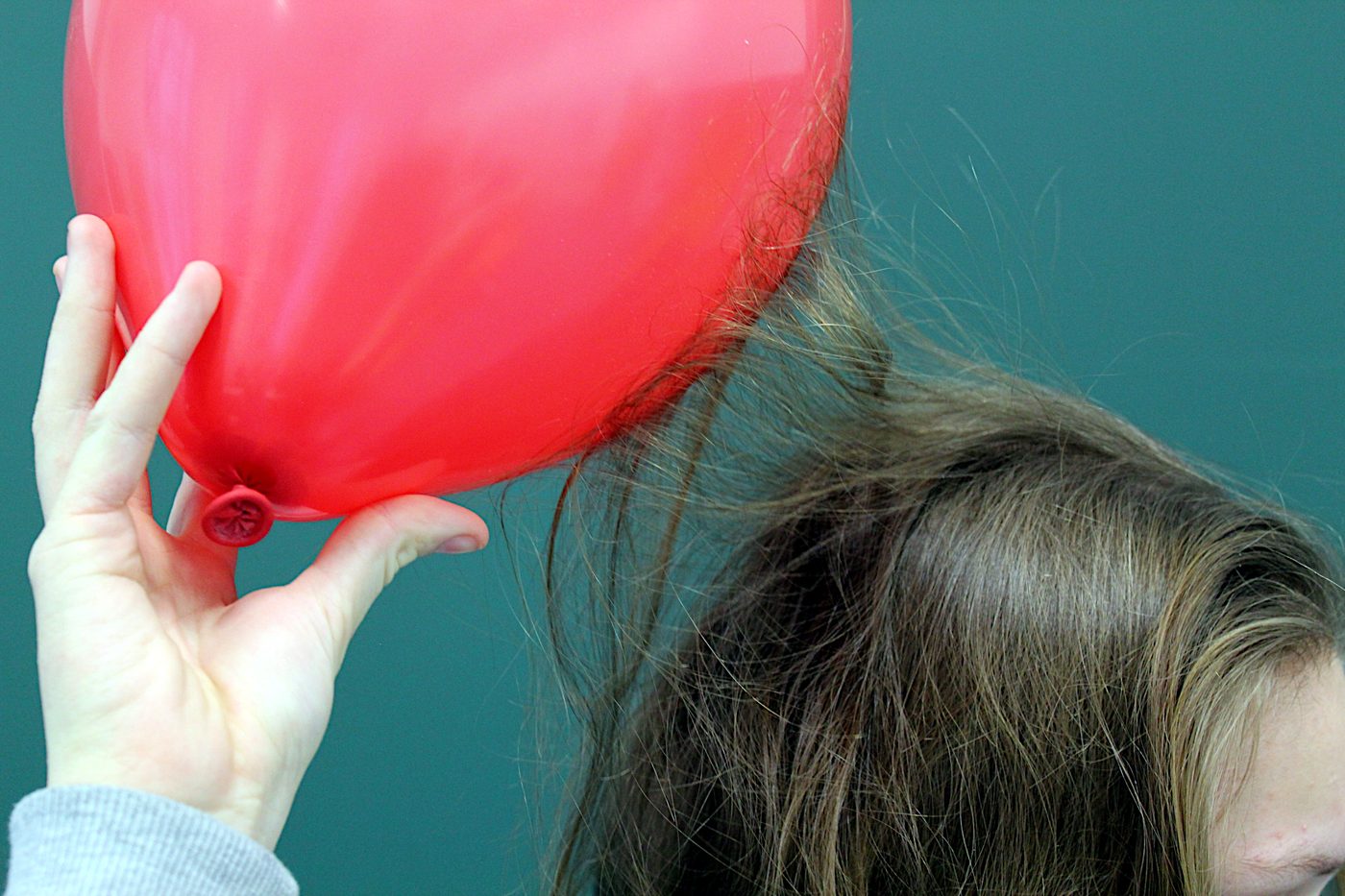
Where static builds up. On insulators (plastic, rubber, wool) charge stays where it is. On conductors (metals) it flows away, through you or through an earth wire. That is why fuel tankers and aircraft are earthed when refuelling.
In everyday life: lightning (charge separated in storm clouds jumps as a giant spark), shocks from car doors and trampolines, hair standing on end, dust on screens.

Written to the KS3 national curriculum. Last changed 8 November 2026.
Key words
Say them, spell them, use them in an answer.
- static electricity
- protons
- electrons
- neutral
- attract
- repel
- electric field
- non-contact force
- insulators
- conductors
Common misconception
Often said“Rubbing a balloon makes new charge.”
In factCharge is never made. Rubbing moves electrons from one material to the other.
Try 5 questions
Quick questions on static electricity, marked as you go. Each one explains the answer.
Question 1 of 5
A negative balloon is pulled towards a positive rod. What force does the rod feel?
Choose an answer. Each question explains itself.
The homework sheet
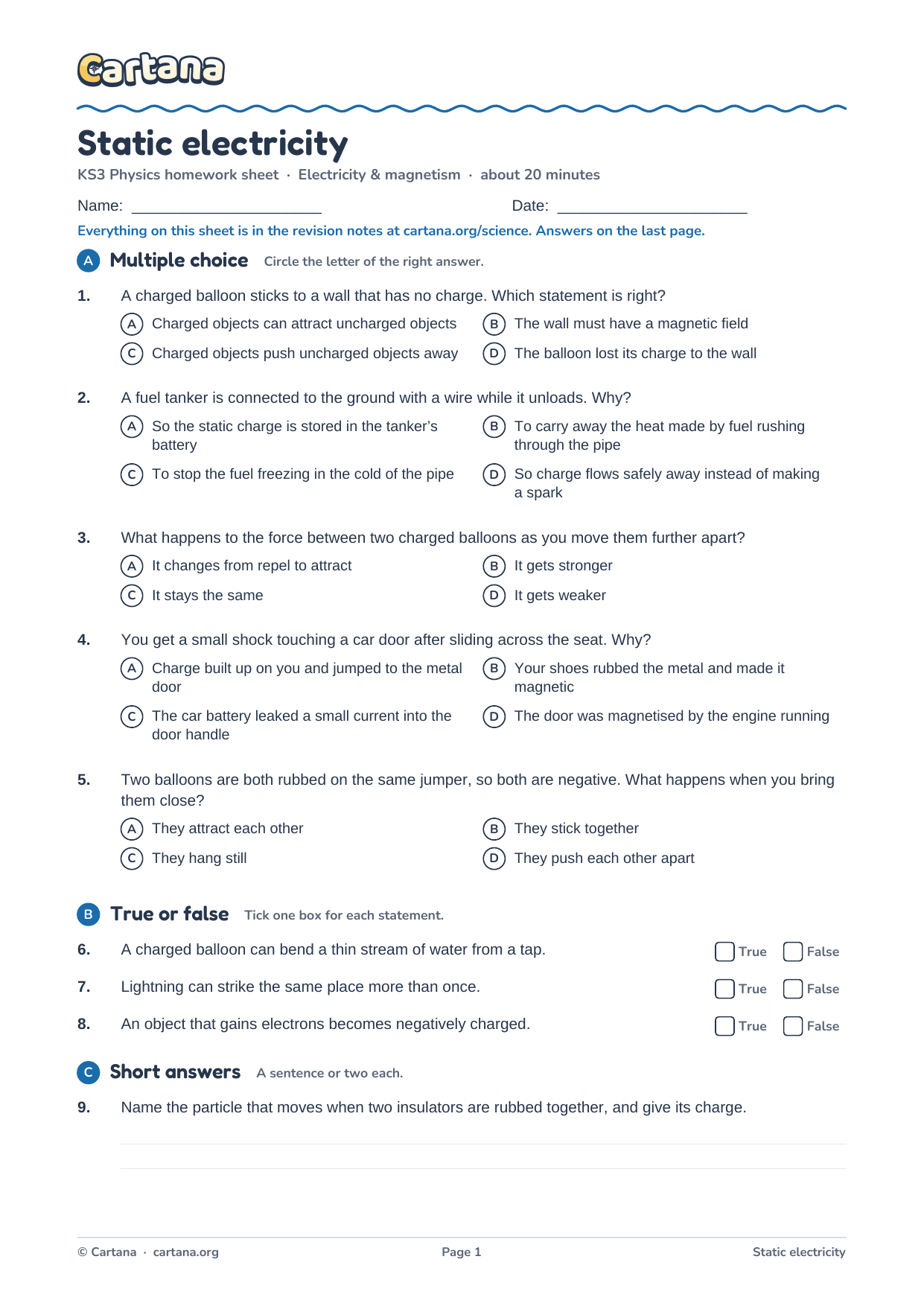
About twenty minutes. Everything on it is in the notes above; the answers are on the last page.
Free homework sheet
Static electricity homework sheet
17 questions, about twenty minutes, with the answers on the last page: multiple choice, true or false, short answers, key words to define and one to explain in full.
KS3 Electricity & magnetism
Revised the whole unit?
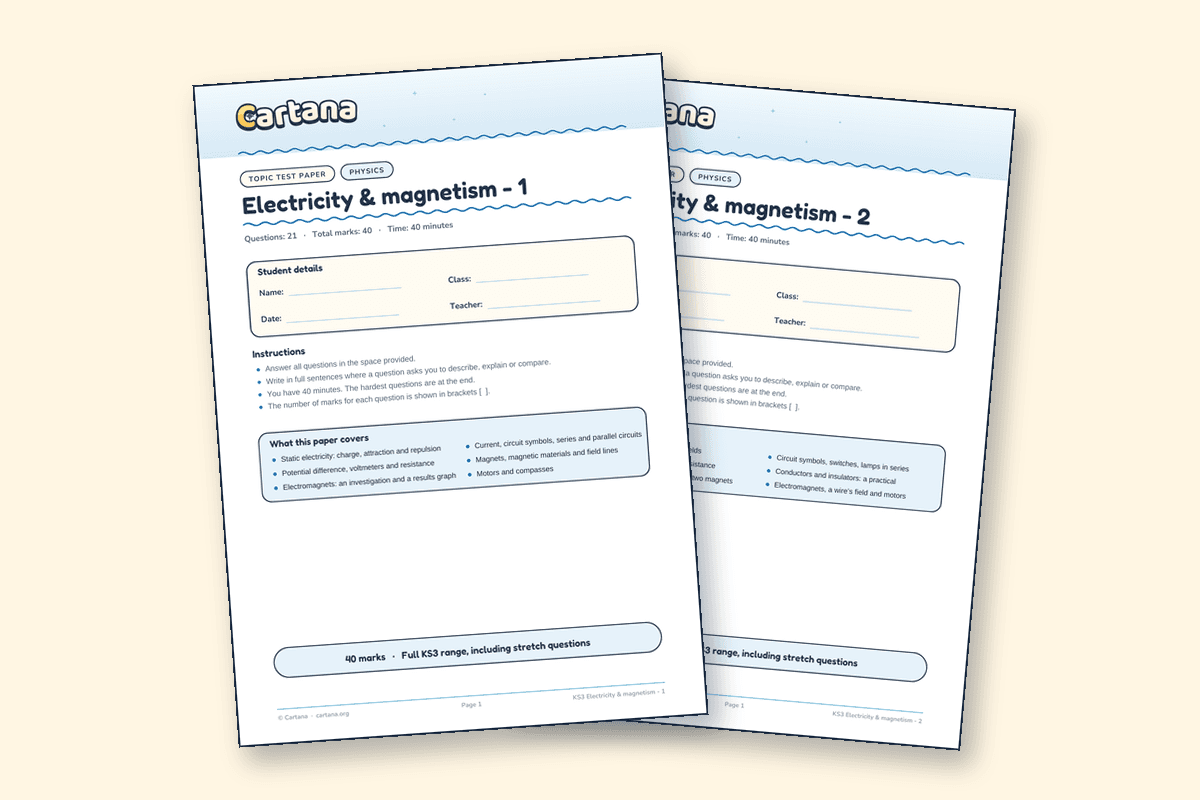
When every topic in electricity & magnetism is done, two different papers test the whole unit, each with its own mark scheme.


 Watch the trailer · 1:06
New from Cartana · Beta test 1–31 December
Revision that feels like an adventure
Cartana is our KS3 learning adventure: sail between islands, answer quick-fire questions and battle bosses. It starts with science, with maths on the way, and launches in 2027. This December a small group of testers gets to play it first.
In the Cartana adventure, static electricity is Balloon Pier, a district of the Isle of Ohm.
- Play the game before its official release
- Help us build it with your feedback
- Earn exclusive in-game items in return
More in this unit