
KS3 Physics · Motion & pressure
Pressure on solids
- Pressure = force ÷ area, and what “normal to a surface” means
- Units: N/m² (pascals) and N/cm², and why 1 m² is 10,000 cm²
- Snowshoes, tractors and drawing pins: big and small areas
- Calculations, including rearranging for the force or the area
- 5 min read
- 5 quick questions
- Free homework sheet
- Years 7 to 9
Revision notes
Pressure on a solid surface is how concentrated a force is on it: the force pushing on each square metre, or square centimetre, of the surface. Pressure = force ÷ area, so the same force makes a bigger pressure on a smaller area.
What is pressure?
Press your palm on a balloon and nothing happens; press a pin on it with the same force and it bursts, because the force is concentrated on a tiny area (the size of the surface it pushes on). Pressure depends on two things:
- the force, the push in newtons: a bigger force makes a bigger pressure
- the area it acts on: a smaller area makes a bigger pressure
The force that causes pressure acts at right angles to the surface it presses on. Scientists call this direction normal to the surface.
How do you calculate pressure?
With the force in newtons (N) and the area in square metres (m2), the pressure is in newtons per square metre (N/m2). One newton per square metre is also called one pascal (Pa). For small areas it is handier to use square centimetres (cm2), which gives the pressure in newtons per square centimetre (N/cm2).
A crate weighs 600 N and rests on a floor on a base of area 1.5 m2. What pressure does it put on the floor?
pressure = force ÷ area
pressure = 600 N ÷ 1.5 m2 = 400 N/m2
A square metre is 100 cm long and 100 cm wide, so it holds 100 × 100 = 10,000 cm2, not 100. To change cm2 into m2, divide by 10,000.
A box weighing 40 N stands on a base 20 cm by 10 cm. What is the pressure in N/cm2, and in N/m2?
area = 20 × 10 = 200 cm2
pressure = 40 N ÷ 200 cm2 = 0.2 N/cm2
area in m2 = 200 ÷ 10,000 = 0.02 m2
pressure = 40 N ÷ 0.02 m2 = 2000 N/m2
Turned round, the equation gives the force: force = pressure × area. A pressure of 5 N/cm2 on an area of 30 cm2 means a force of 5 × 30 = 150 N. It also gives the area: area = force ÷ pressure.
Does the same object always make the same pressure?
No: it depends which face it stands on. A brick weighing 20 N, 20 cm × 10 cm × 5 cm, can rest three ways. Stand it on soft foam or sand each way and the dent shows the pressure: the smaller the face, the deeper the dent.
In the same way, you press harder on the floor standing on one foot than on two: your weight is the same, but the area is halved, so the pressure doubles.
Why are some things wide and others sharp?
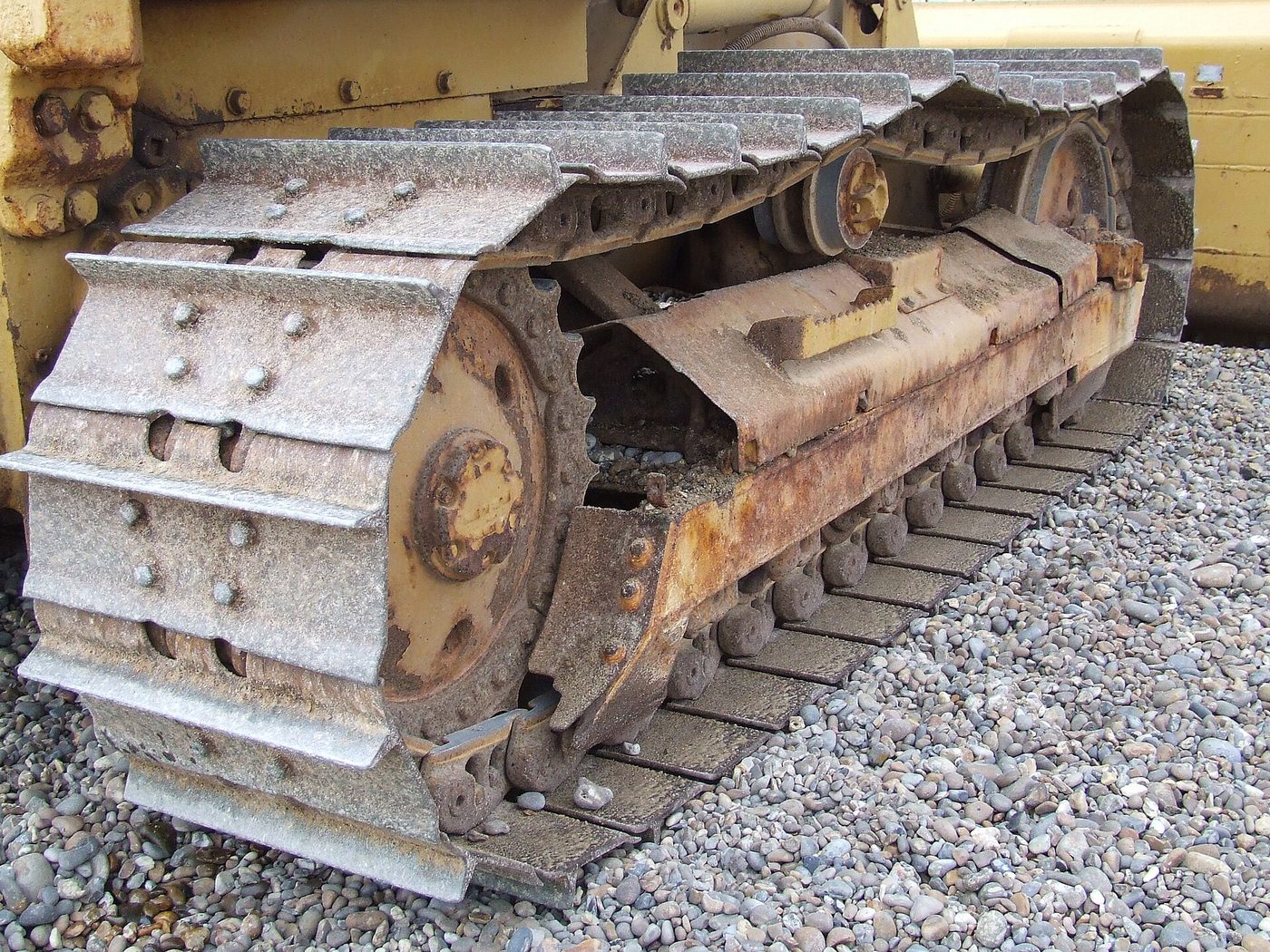
Snowshoes and skis stop you sinking into snow. Tractors have wide tyres, and diggers have caterpillar tracks, so they do not sink into mud. Wide straps on a heavy rucksack do not dig into your shoulders.
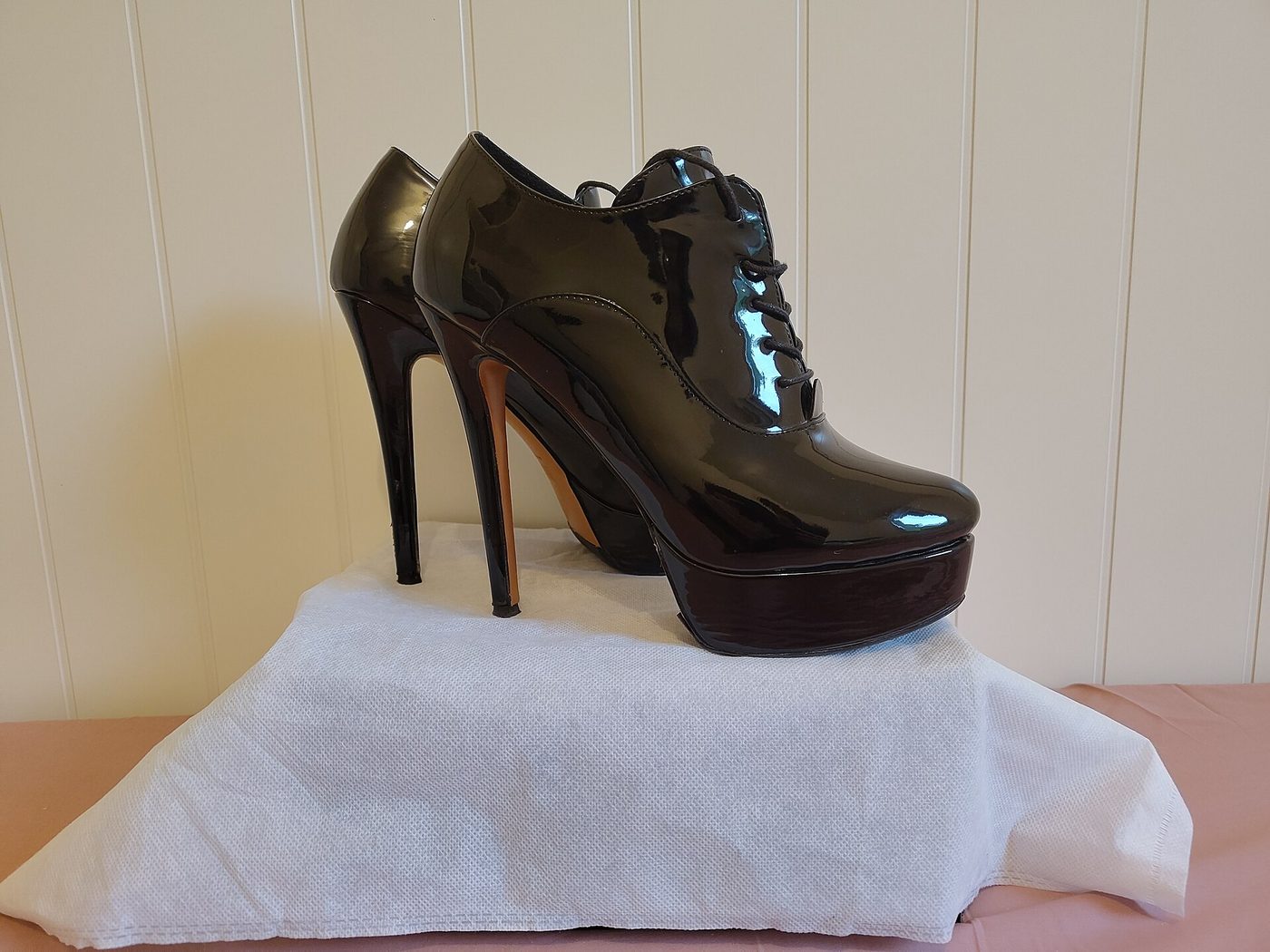
A drawing pin’s point, a nail and a needle push in easily. A sharp knife has a thin edge, so it cuts with less force than a blunt one. Studs on football boots and the blades of ice skates press hard into the ground or the ice.

A drawing pin uses both ideas at once. Its wide head spreads the push over your thumb, so it does not hurt; its point concentrates the same push into a pressure big enough to go into the board.
Stretch A car weighing 12,000 N has its tyres pumped to a pressure of about 200,000 N/m2. The tyres flatten against the road until the air inside holds the car up: area = force ÷ pressure = 12,000 ÷ 200,000 = 0.06 m2 in all. That is 600 cm2, or about 150 cm2 under each of the four tyres: roughly the size of a postcard.
Written to the KS3 national curriculum. Last changed 15 November 2026.
Key words
Say them, spell them, use them in an answer.
- pressure
- force
- area
- normal
- newtons per square metre
- pascal
- newtons per square centimetre
- square metre
Common misconception
Often said“Pressure and force are the same thing.”
In factA force is a push or a pull, measured in newtons. Pressure is how much of that force acts on each square metre or square centimetre. The same force can make a tiny pressure or a huge one, depending on the area it acts on.
Try 5 questions
Quick questions on pressure on solids, marked as you go. Each one explains the answer.
Question 1 of 5
Why does a drawing pin go into a board but not into your thumb?
Choose an answer. Each question explains itself.
The homework sheet
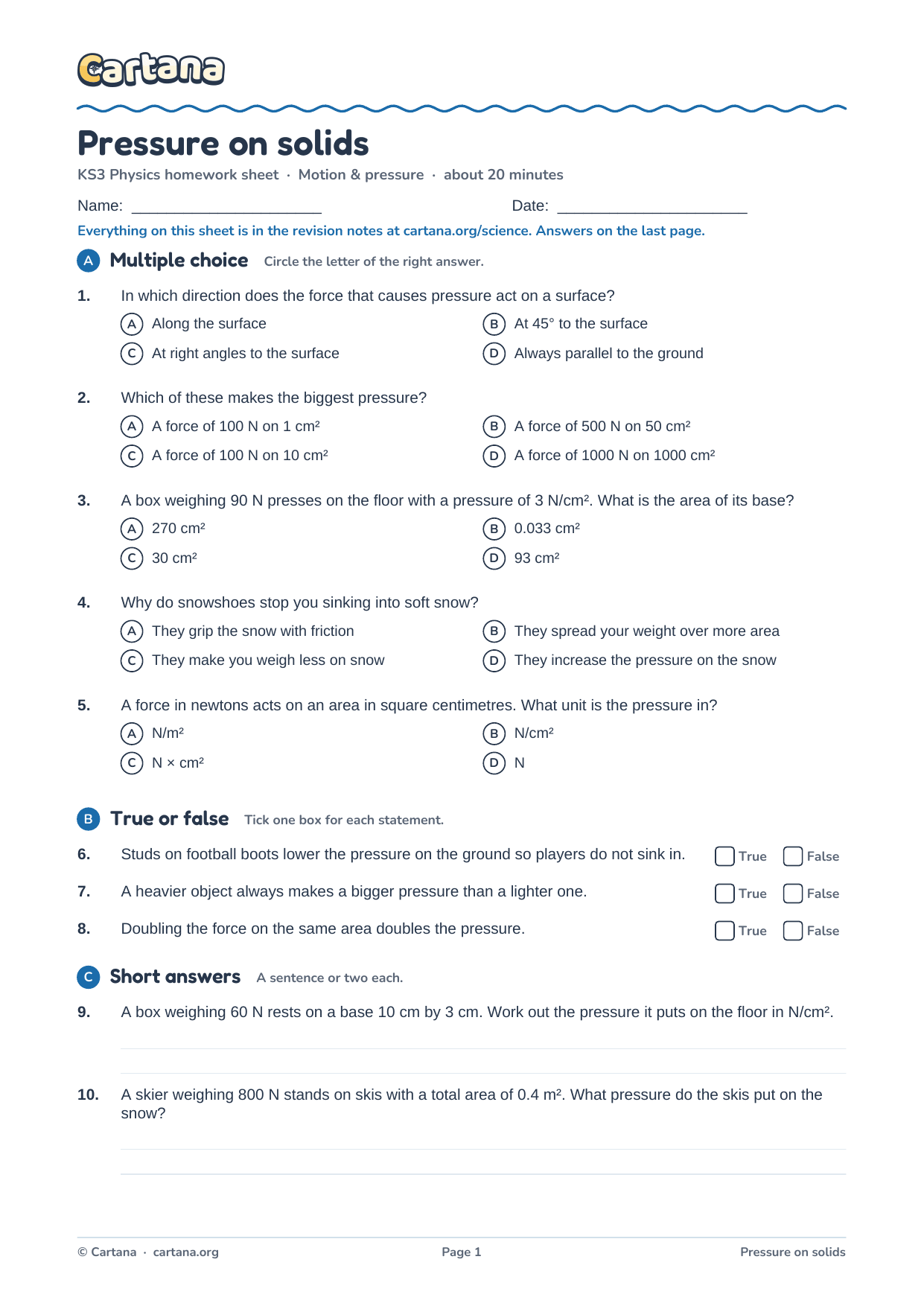
About twenty minutes. Everything on it is in the notes above; the answers are on the last page.
Free homework sheet
Pressure on solids homework sheet
17 questions, about twenty minutes, with the answers on the last page: multiple choice, true or false, short answers, key words to define and one to explain in full.
KS3 Motion & pressure
Revised the whole unit?
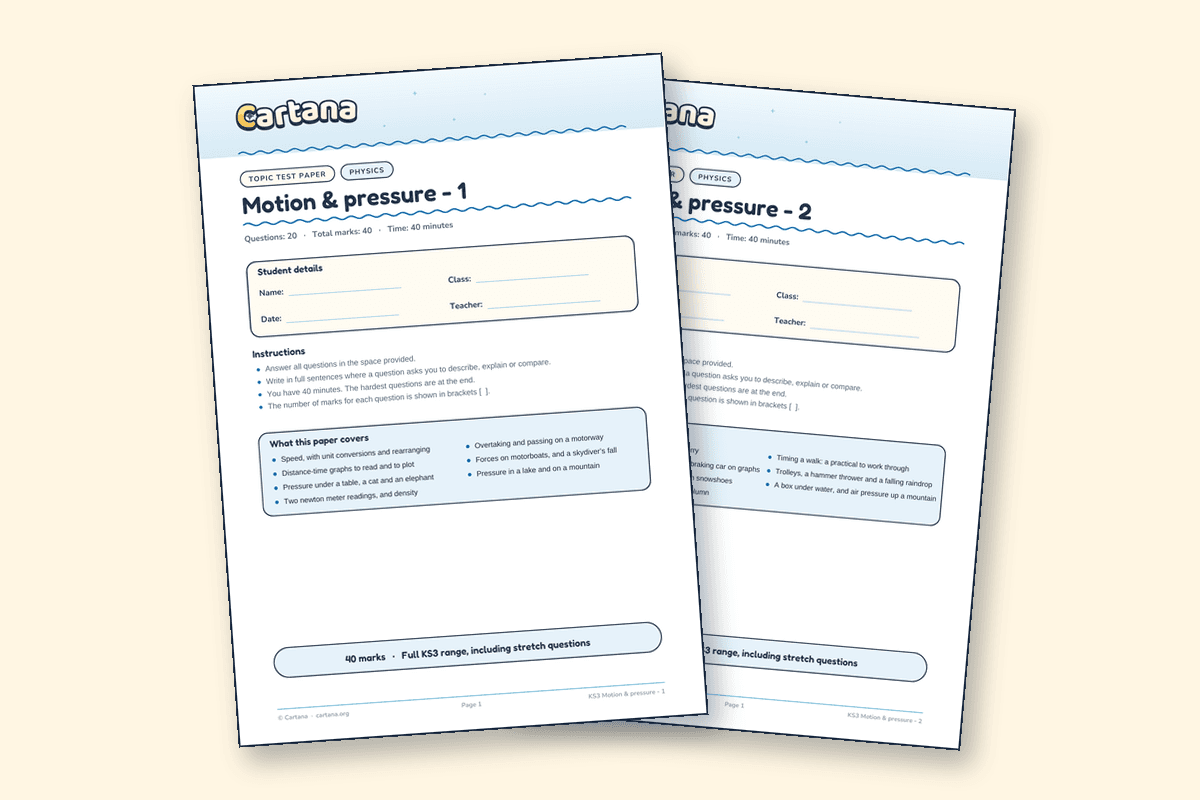
When every topic in motion & pressure is done, two different papers test the whole unit, each with its own mark scheme.


 Watch the trailer · 1:06
New from Cartana · Beta test 1–31 December
Revision that feels like an adventure
Cartana is our KS3 learning adventure: sail between islands, answer quick-fire questions and battle bosses. It starts with science, with maths on the way, and launches in 2027. This December a small group of testers gets to play it first.
In the Cartana adventure, every science unit is an island to explore. The island for motion & pressure is being built.
- Play the game before its official release
- Help us build it with your feedback
- Earn exclusive in-game items in return
More in this unit
Motion & pressure
- 1SpeedSpeed = distance ÷ time, units and converting them, average speed and relative motion
- 2Distance-time graphsReading and drawing distance-time graphs, and working out speed from the gradient
- 3Forces and motionHow a resultant force starts, stops, speeds up, slows down or turns an object, and what happens as things fall
- 5Pressure in liquids and gasesNextPressure in fluids acts in all directions and increases with depth; dams, divers and atmospheric pressure
- 6Floating and sinkingUpthrust, floating when upthrust equals weight, density, ships and submarines