
KS3 Physics · Motion & pressure
Pressure in liquids and gases
- Why pressure in a liquid increases with depth
- Fluids push in all directions, at right angles to every surface
- Dams, divers and calculations in N/m² and N/cm²
- Atmospheric pressure and why it falls the higher you go
- 5 min read
- 5 quick questions
- Free homework sheet
- Years 7 to 9
Revision notes
Pressure in liquids and gases is the push they make on every surface they touch. It acts in all directions, it increases the deeper you go in a liquid, and the air’s pressure falls the higher you climb.
Why does pressure in a liquid increase with depth?
Liquids and gases are both fluids: they can flow. A liquid has weight, and everything under the surface has the weight of the liquid above pressing down on it. The deeper you go (the bigger the depth, the distance below the surface), the more liquid there is above, so the bigger the pressure.
The spurting can: make three holes, one above another, in the side of a tall can and keep it topped up with water. Water spurts out of every hole, fastest from the lowest one, where the water is deepest.
- In water, every 10 m of depth adds about 100,000 N/m2: as much again as the air pressing on the surface.
- For a given liquid, only the depth matters, not how much of it there is. 5 m down in a narrow well and 5 m down in a wide lake, the pressure is the same.
- A denser liquid, one with more mass in each cubic centimetre, presses harder: at the same depth the pressure is a little higher in sea water than in fresh water.
Which way does pressure in a fluid push?
A fluid pushes in all directions: down on the bottom of its container, out on the sides, and up on anything underneath its surface. On every surface it touches, the push acts at right angles to that surface: normal to it. That is why the jets leave the can at right angles to its side.
In a gas, the pressure comes from its particles hitting surfaces as they move in every direction (see gas pressure).
How do dams and divers cope with water pressure?
A dam must hold back the greatest pressure at the bottom, so it is built much thicker there than at the top. The Hoover Dam in the USA is about 200 m thick at its base but only 14 m at the top.
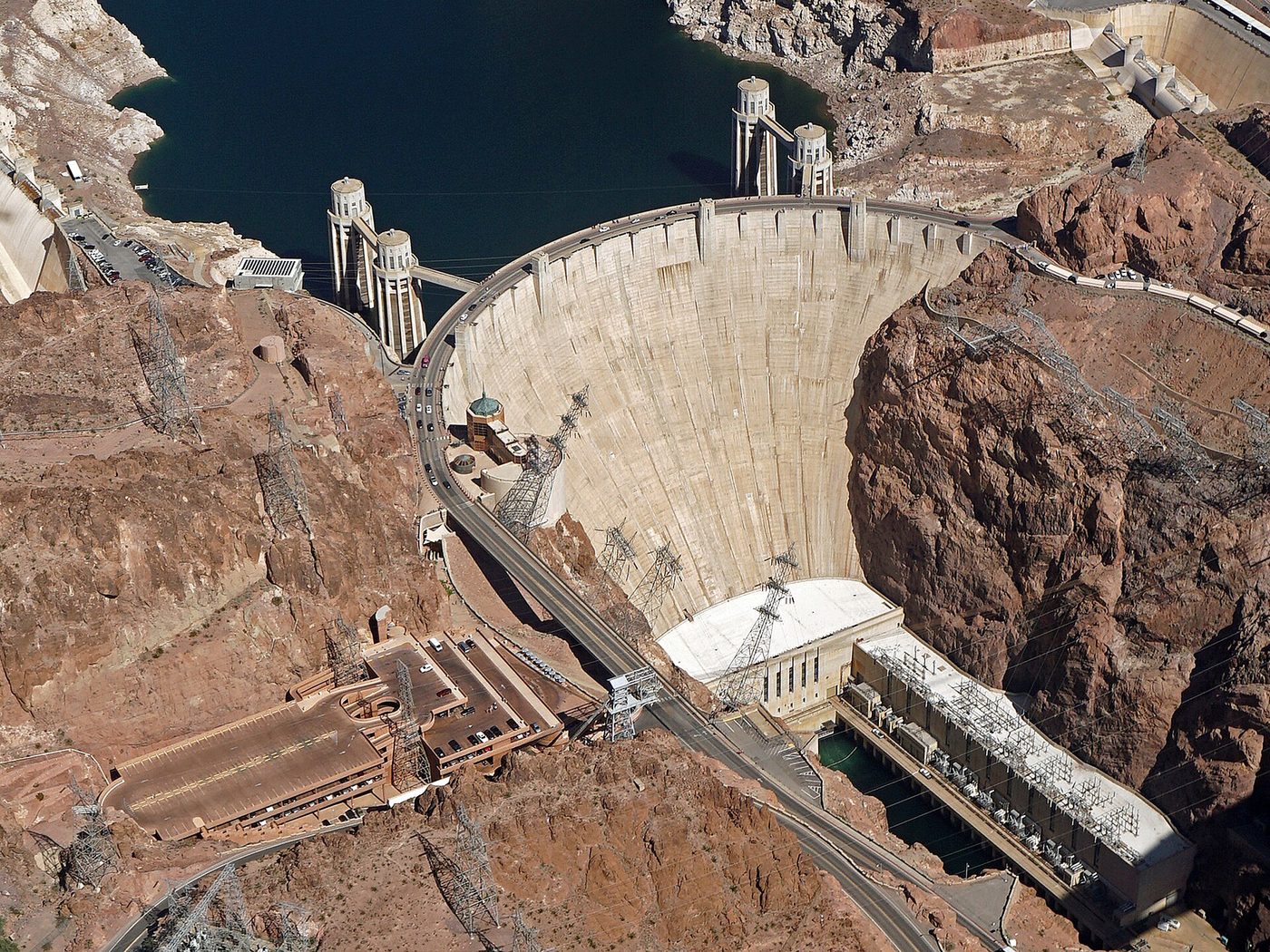
A diver feels the pressure on her ears after only a couple of metres. Deep-sea submarines need very thick, strong hulls.
10 m under the sea the total pressure is about 200,000 N/m2. What is that in N/cm2?
1 m2 = 10,000 cm2, so divide by 10,000.
200,000 ÷ 10,000 = 20 N/cm2
A diver’s mask has a glass window of area 100 cm2. What force does the water push on it with, 10 m down?
force = pressure × area
force = 20 N/cm2 × 100 cm2 = 2000 N
What is atmospheric pressure, and why does it fall with height?
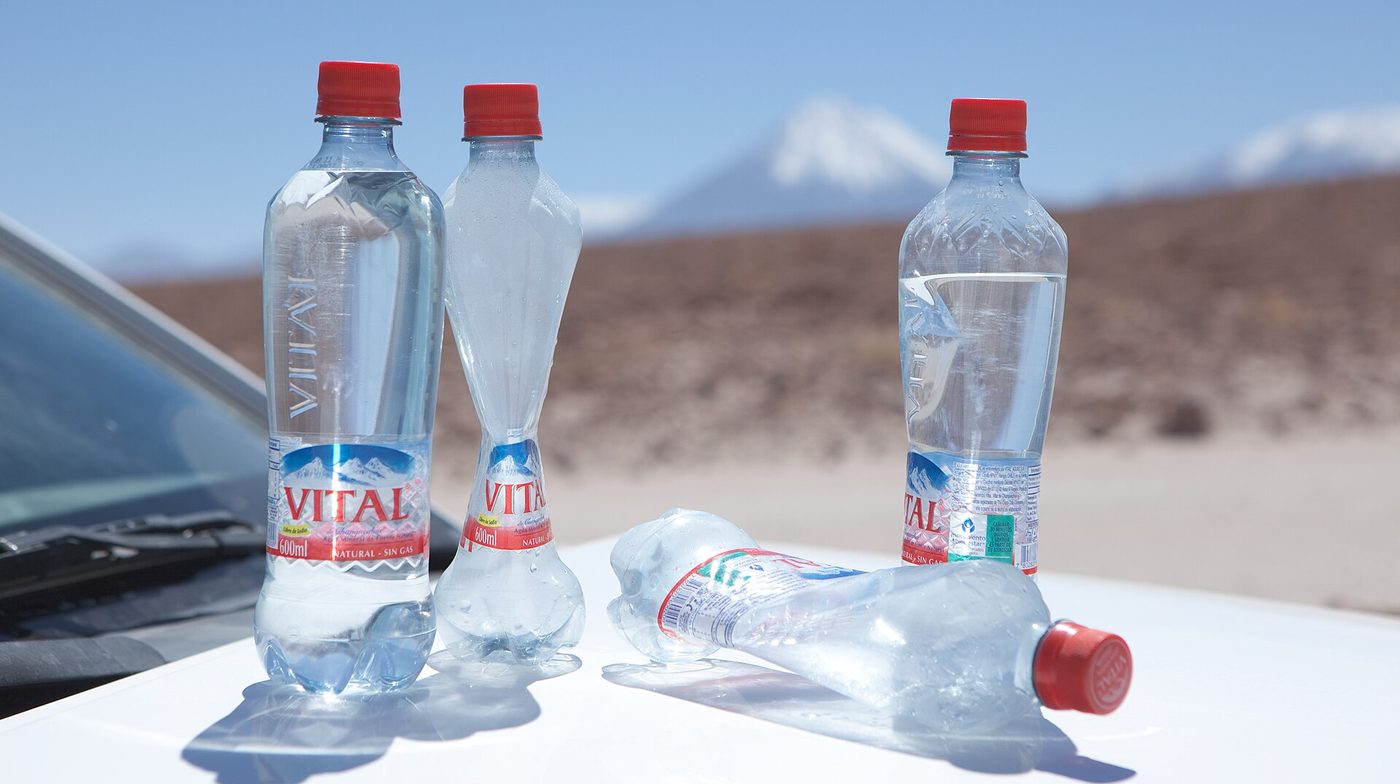
The air is a fluid too. The whole weight of the air above us presses down, and its particles push on everything they touch. This atmospheric pressure is about 100,000 N/m2 at sea level (the height of the sea’s surface, from which heights are measured), which is 10 N on every square centimetre. We are not crushed because the air and fluids inside our bodies push out just as hard.
Climb a mountain or take off in a plane, gaining altitude (height above sea level), and there is less air above you, so its weight is smaller and the pressure falls.
- A sealed crisp packet carried up a mountain puffs up: the air inside now pushes harder than the air outside.
- Your ears “pop” in a plane or a fast lift as the air pressure outside changes.
- When you suck on a straw, you lower the pressure inside it, and the air pressing on the drink pushes it up the straw.
Stretch The pressure caused by a liquid is depth × density × g, with the depth in m, the density in kg/m3 and g = 10 N/kg. For 10 m of water (density 1000 kg/m3): 10 × 1000 × 10 = 100,000 N/m2. Add the 100,000 N/m2 of the air above and the total is 200,000 N/m2, the value used in the worked examples.
Written to the KS3 national curriculum. Last changed 15 November 2026.
Key words
Say them, spell them, use them in an answer.
- fluid
- depth
- pressure
- normal
- atmospheric pressure
- sea level
- altitude
- all directions
Common misconception
Often said“Water pressure only pushes down, because it comes from the weight of the water above.”
In factPressure in a liquid pushes in every direction, at right angles to every surface it touches: sideways on the walls of a dam and up on the bottom of a boat. That upward push is the upthrust that lets things float.
Did you know?
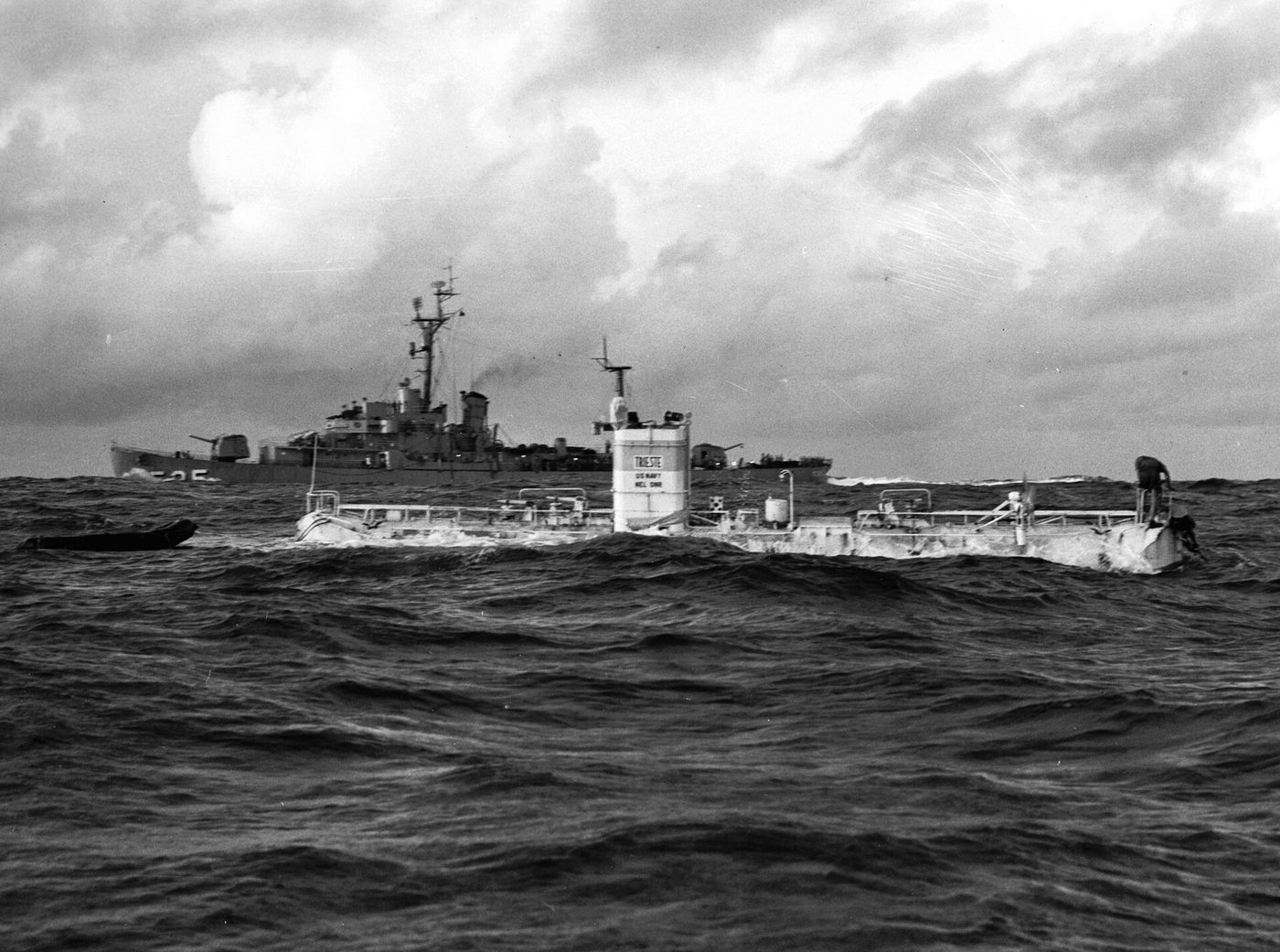
The Challenger Deep
In 1960 Jacques Piccard and Don Walsh took the bathyscaphe Trieste nearly 11,000 m down to the deepest point of the ocean, where the water pressure is more than 1,000 times the air pressure at sea level.
Photo: U.S. Navy, Public domain, via Wikimedia Commons
Try 5 questions
Quick questions on pressure in liquids and gases, marked as you go. Each one explains the answer.
Question 1 of 5
Liquids and gases are both fluids, because they can flow.
Choose an answer. Each question explains itself.
The homework sheet
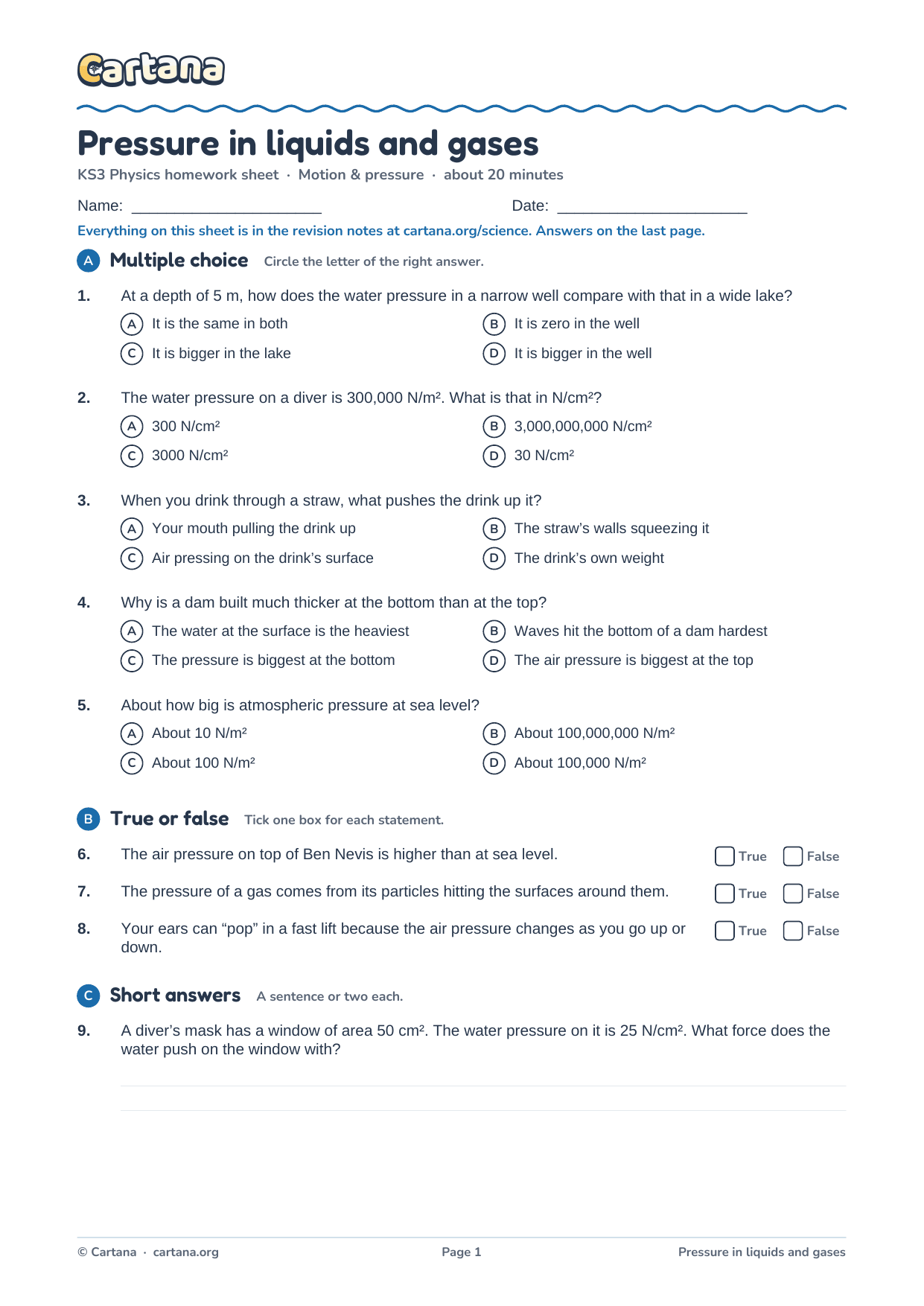
About twenty minutes. Everything on it is in the notes above; the answers are on the last page.
Free homework sheet
Pressure in liquids and gases homework sheet
17 questions, about twenty minutes, with the answers on the last page: multiple choice, true or false, short answers, key words to define and one to explain in full.
KS3 Motion & pressure
Revised the whole unit?
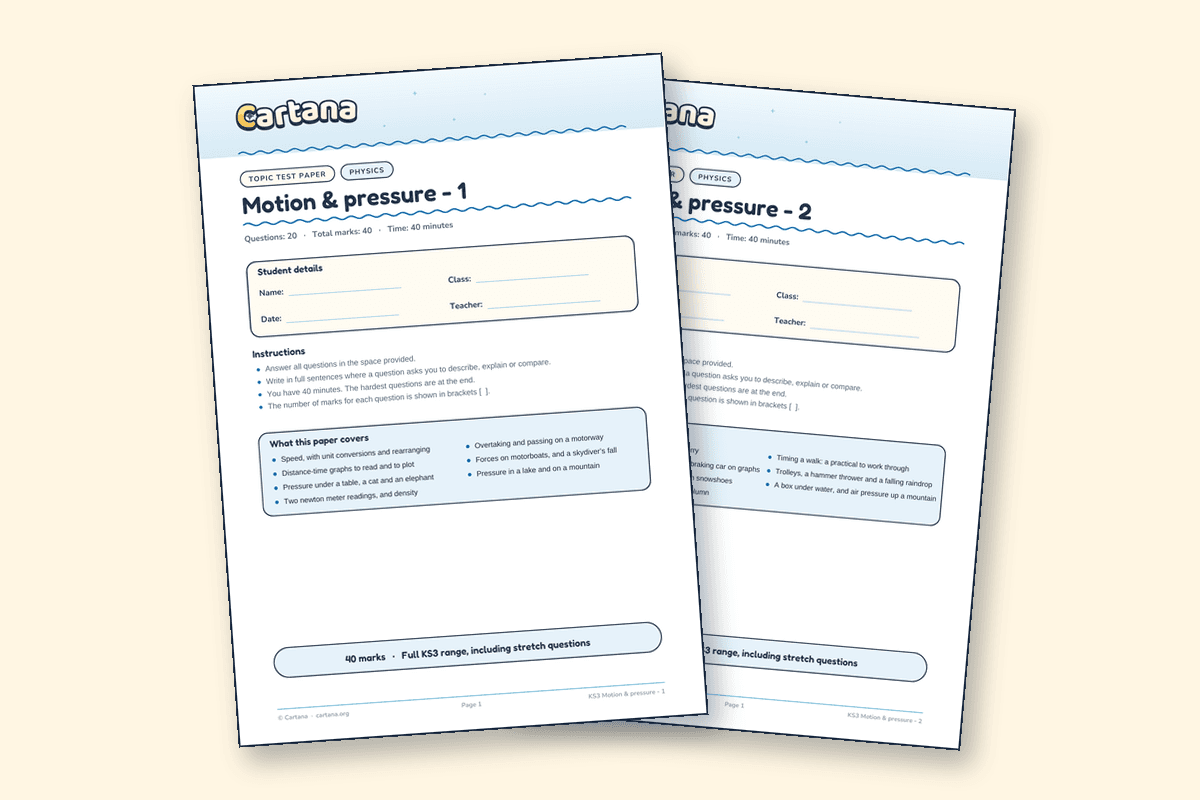
When every topic in motion & pressure is done, two different papers test the whole unit, each with its own mark scheme.


 Watch the trailer · 1:06
New from Cartana · Beta test 1–31 December
Revision that feels like an adventure
Cartana is our KS3 learning adventure: sail between islands, answer quick-fire questions and battle bosses. It starts with science, with maths on the way, and launches in 2027. This December a small group of testers gets to play it first.
In the Cartana adventure, every science unit is an island to explore. The island for motion & pressure is being built.
- Play the game before its official release
- Help us build it with your feedback
- Earn exclusive in-game items in return
More in this unit
Motion & pressure
- 1SpeedSpeed = distance ÷ time, units and converting them, average speed and relative motion
- 2Distance-time graphsReading and drawing distance-time graphs, and working out speed from the gradient
- 3Forces and motionHow a resultant force starts, stops, speeds up, slows down or turns an object, and what happens as things fall
- 4Pressure on solidsPressure = force ÷ area, in N/m² and N/cm², with snowshoes, drawing pins and calculations
- 6Floating and sinkingNextUpthrust, floating when upthrust equals weight, density, ships and submarines