
KS3 Physics · Motion & pressure
Forces and motion
- A resultant force starts, stops, speeds up, slows down or turns an object
- A bigger force makes a bigger, quicker change; a bigger mass a smaller one
- Why moving in a curve needs a sideways force
- Falling objects, air resistance and terminal speed, and the coin and feather tube
- 5 min read
- 5 quick questions
- Free homework sheet
- Years 7 to 9
Revision notes
Forces and motion are linked by one rule: an object’s movement changes only when a resultant force acts on it. A force is needed to start or stop an object, to speed it up or slow it down, or to change its direction.
What can a force do to a moving object?
When the forces on an object are balanced, its movement does not change: a still object stays still, and a moving one carries on at the same speed in a straight line. To change the movement there must be an unbalanced force: a resultant force, the single force left over when all the forces on the object are added up. Which change you get depends on the direction of the resultant force:
| Resultant force | What happens | Example |
|---|---|---|
| Forwards | It starts moving or speeds up | A kick sets a still football rolling |
| Backwards | It slows down or stops | A goalkeeper’s hands stop the ball |
| Sideways | It changes direction | A header sends the ball off a new way |
| None | Nothing changes | A space probe coasts on for years |

Things do not stop by themselves: a ball rolling across the grass slows down because friction (the force between surfaces that rub) and air resistance act against its motion.
Does a bigger force make a bigger change?
Yes. The bigger the resultant force, the bigger the change in speed or direction, and the more quickly it happens:
- Kick a ball harder and it leaves your foot faster.
- Braking hard stops a bike in a shorter time than braking gently.
The mass of the object, the amount of matter in it, matters too. The same push changes the speed of a big mass less than a small one: an empty shopping trolley shoots off when you push it, while a full one barely gets going.
Why does a turning object need a force?
Changing direction is a change in movement, even at a steady speed, so it needs a resultant force pushing sideways, towards the inside of the curve.
- A car on a bend is turned by friction between its tyres and the road, pushing it towards the inside of the bend. On ice there is almost no friction, so the car slides straight on.
- A ball whirled round on a string is pulled in by the string. Let go, and it flies off in a straight line, the way it was heading at that moment.
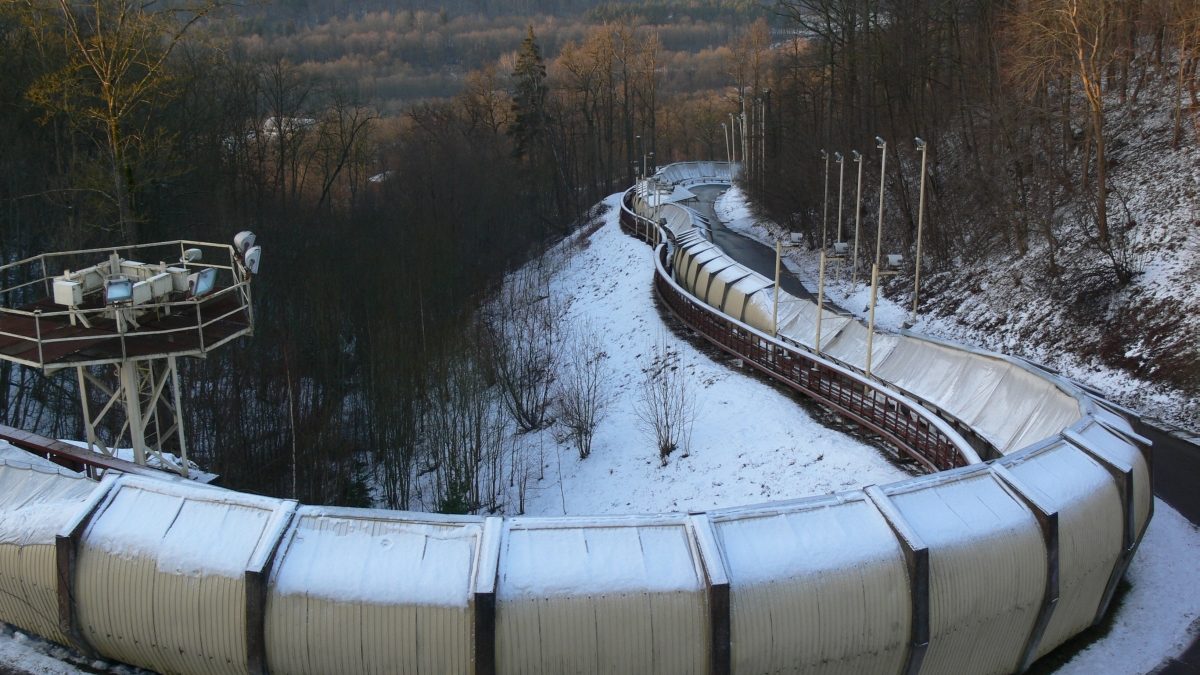
- The Moon is kept in its curved path round the Earth by the Earth’s gravity, the pull that every mass has on every other.
What happens to a falling object?
Drop a ball and its weight pulls it down, so it speeds up. As it goes faster, air resistance (the push of the air against a moving object) gets bigger. A light, spread-out object, such as a feather, soon has enough air resistance to match its weight; then the forces are balanced and it falls at a steady speed, its terminal speed. A heavier, more compact object, such as a ball, has to fall much faster before its air resistance grows that big, but dropped from high enough it too reaches a terminal speed.

Two sheets of paper: drop a flat sheet of paper and an identical sheet screwed into a ball, from the same height at the same moment. The ball lands first. Both have the same weight, but the flat sheet has a much bigger area pushing against the air, so a bigger air resistance holds it back.
The coin and the feather: a coin and a feather are sealed in a long glass tube. With air inside, turn it over and the coin drops while the feather drifts down. Pump the air out, leaving a vacuum (a space with no air in it), and turn it over again: the two fall side by side and land together. Without air resistance, heavy and light objects fall in the same way.
Stretch A car’s stopping distance is the thinking distance (how far it goes before the driver reacts) plus the braking distance (how far it goes while the brakes’ friction slows it). The Highway Code gives 12 m at 20 mph (6 m + 6 m) but 36 m at 40 mph (12 m + 24 m). Doubling the speed doubles the thinking distance but makes the braking distance four times as long.
Written to the KS3 national curriculum. Last changed 15 November 2026.
Key words
Say them, spell them, use them in an answer.
- resultant force
- balanced forces
- mass
- friction
- gravity
- air resistance
- terminal speed
- vacuum
Common misconception
Often said“Heavy things always fall faster than light things.”
In factWithout air, everything falls in the same way: in a tube with the air pumped out, a coin and a feather land together. In air, a feather falls slowly because its air resistance is large compared with its weight, not just because it is light.
Did you know?
Faster than sound in free fall
In October 2012 Felix Baumgartner jumped from a balloon 39 km above New Mexico. The air up there is so thin that there was hardly any air resistance, and he reached about 1,358 km/h, faster than sound, before the thicker air lower down slowed him.
Try 5 questions
Quick questions on forces and motion, marked as you go. Each one explains the answer.
Question 1 of 5
A parked car starts to move. What must act on it?
Choose an answer. Each question explains itself.
The homework sheet
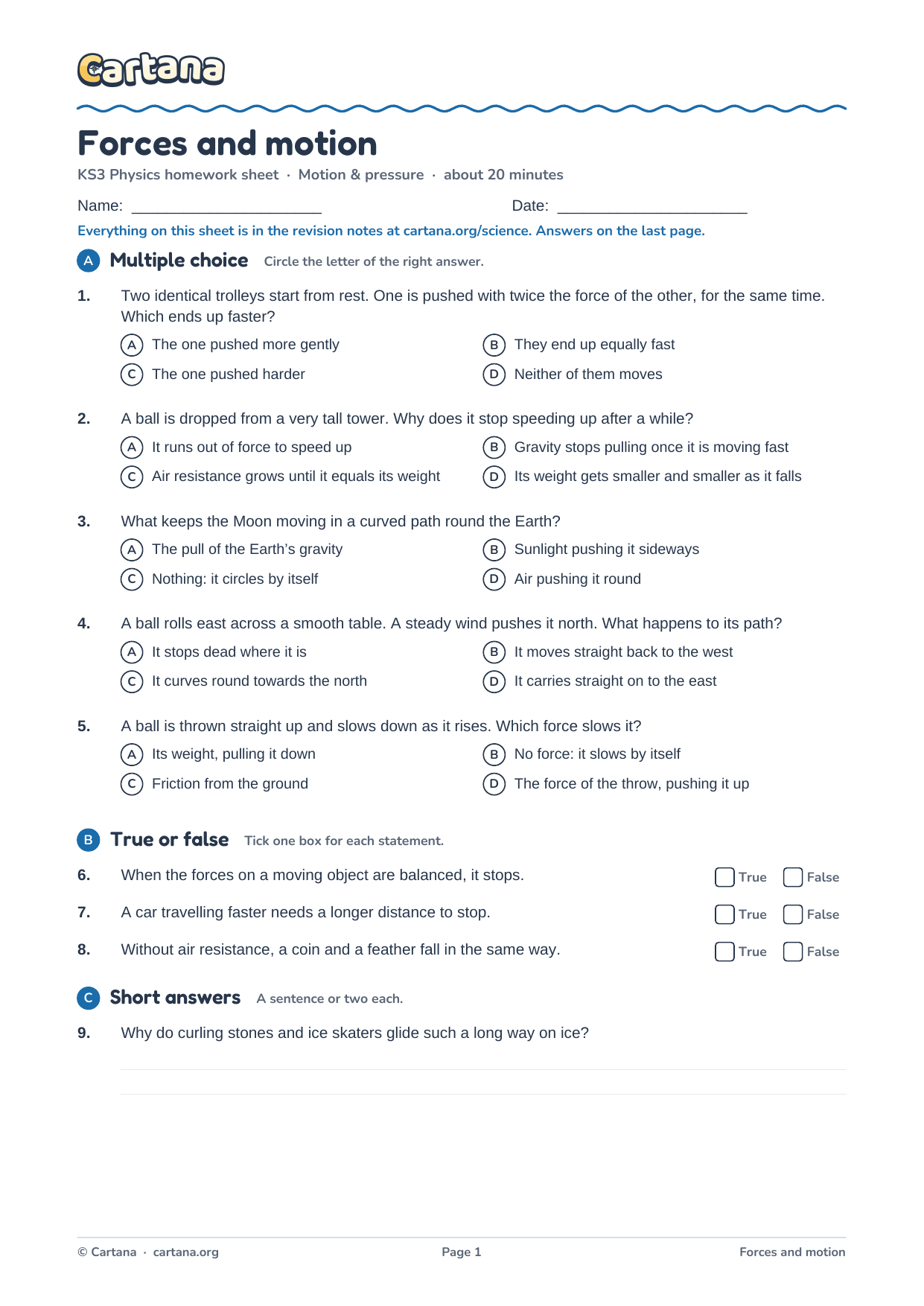
About twenty minutes. Everything on it is in the notes above; the answers are on the last page.
Free homework sheet
Forces and motion homework sheet
17 questions, about twenty minutes, with the answers on the last page: multiple choice, true or false, short answers, key words to define and one to explain in full.
KS3 Motion & pressure
Revised the whole unit?
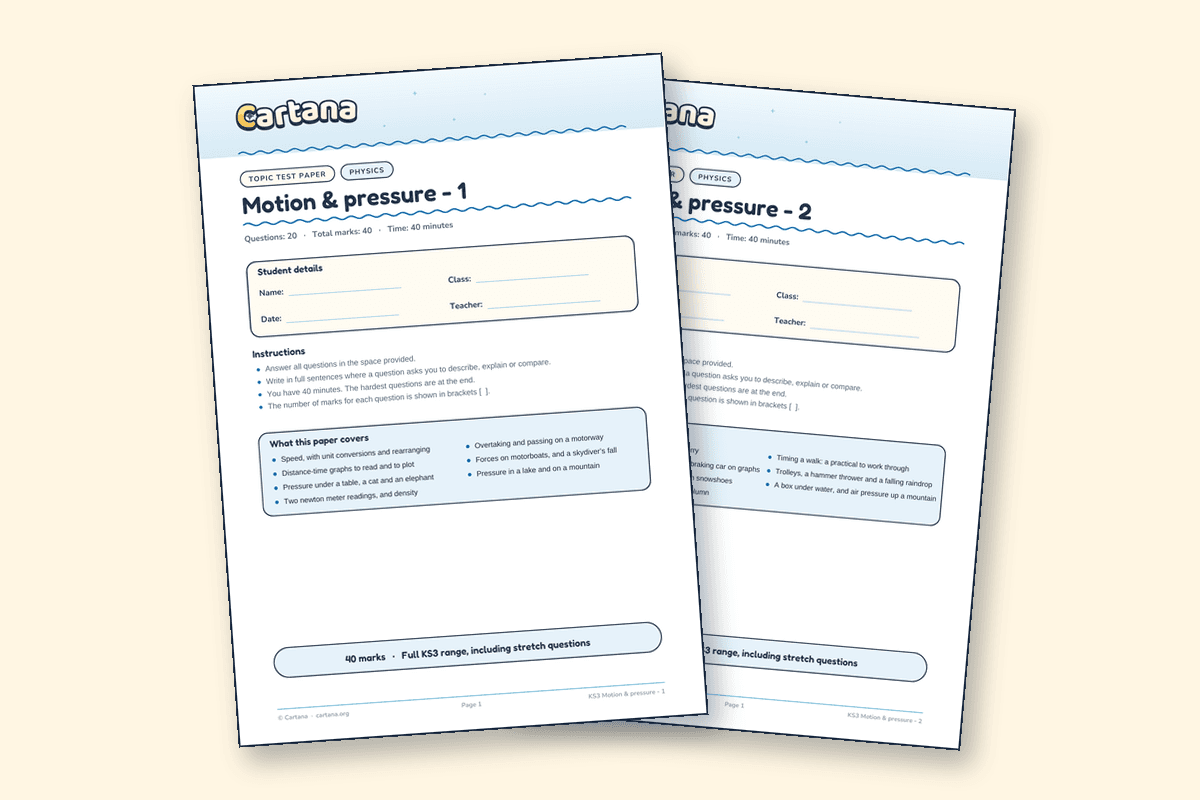
When every topic in motion & pressure is done, two different papers test the whole unit, each with its own mark scheme.


 Watch the trailer · 1:06
New from Cartana · Beta test 1–31 December
Revision that feels like an adventure
Cartana is our KS3 learning adventure: sail between islands, answer quick-fire questions and battle bosses. It starts with science, with maths on the way, and launches in 2027. This December a small group of testers gets to play it first.
In the Cartana adventure, every science unit is an island to explore. The island for motion & pressure is being built.
- Play the game before its official release
- Help us build it with your feedback
- Earn exclusive in-game items in return
More in this unit
Motion & pressure
- 1SpeedSpeed = distance ÷ time, units and converting them, average speed and relative motion
- 2Distance-time graphsReading and drawing distance-time graphs, and working out speed from the gradient
- 4Pressure on solidsNextPressure = force ÷ area, in N/m² and N/cm², with snowshoes, drawing pins and calculations
- 5Pressure in liquids and gasesPressure in fluids acts in all directions and increases with depth; dams, divers and atmospheric pressure
- 6Floating and sinkingUpthrust, floating when upthrust equals weight, density, ships and submarines