
KS3 Physics · Sound & waves
Echoes and ultrasound
- How sound is reflected by hard surfaces and absorbed by soft ones
- Working out a distance from an echo (the sound goes there and back)
- Ultrasound for scans, cleaning and physiotherapy
- Echolocation in bats and dolphins, and sonar on ships
- 5 min read
- 5 quick questions
- Free homework sheet
- Years 7 to 9
Revision notes
An echo is a sound heard again after it bounces back from a surface such as a cliff or a wall. Timing an echo tells you how far away the surface is, because the sound has travelled there and back.
What happens when sound hits a surface?
When sound reaches a surface, some bounces back, which is reflection; some is taken in by the material, which is absorption; and some passes through. Absorbed sound ends up warming the material a tiny amount.
Hard, smooth surfaces: tiled walls, glass, stone, bare floors, a cliff.
Soft surfaces, or ones full of tiny holes: curtains, carpets, cushions, foam.
An empty room with bare walls sounds echoey; with carpets, curtains and furniture it sounds quieter, because soft things absorb sound. Recording studios line their walls with soft panels for the same reason.
How do you work out distance from an echo?
With the speed in m/s and the time in seconds (s), the distance is in metres (m). The sound goes to the surface and back again at the same speed, so it travels twice the distance to the surface. Work out the whole distance, then halve it.
Maya shouts towards a cliff and hears the echo 1.5 s later. Sound travels at 340 m/s in air. How far away is the cliff?
distance travelled = speed × time = 340 m/s × 1.5 s = 510 m
The sound went there and back, so distance to the cliff = 510 m ÷ 2 = 255 m
A ship sends a pulse of sound down to the seabed, and the echo returns 0.8 s later. Sound travels at 1,500 m/s in seawater. How deep is the sea?
distance travelled = 1,500 m/s × 0.8 s = 1,200 m
depth = 1,200 m ÷ 2 = 600 m
Measuring the speed of sound with echoes:
- Stand 85 m from a large flat wall.
- Clap steadily, timing each clap to land just as the echo of the one before comes back.
- A partner starts a stopwatch on one clap and stops it 20 claps later: about 10 s.
Each gap between claps is the time for the sound to reach the wall and return: 10 s ÷ 20 = 0.5 s to travel 170 m, so the speed of sound = 170 m ÷ 0.5 s = 340 m/s. Timing 20 gaps instead of one makes the result more accurate, because your reaction time is then only a small part of the time measured.
What is ultrasound used for?
Ultrasound is sound with a frequency above 20,000 Hz, too high for people to hear. Like all sound, it is a pressure wave that carries energy.
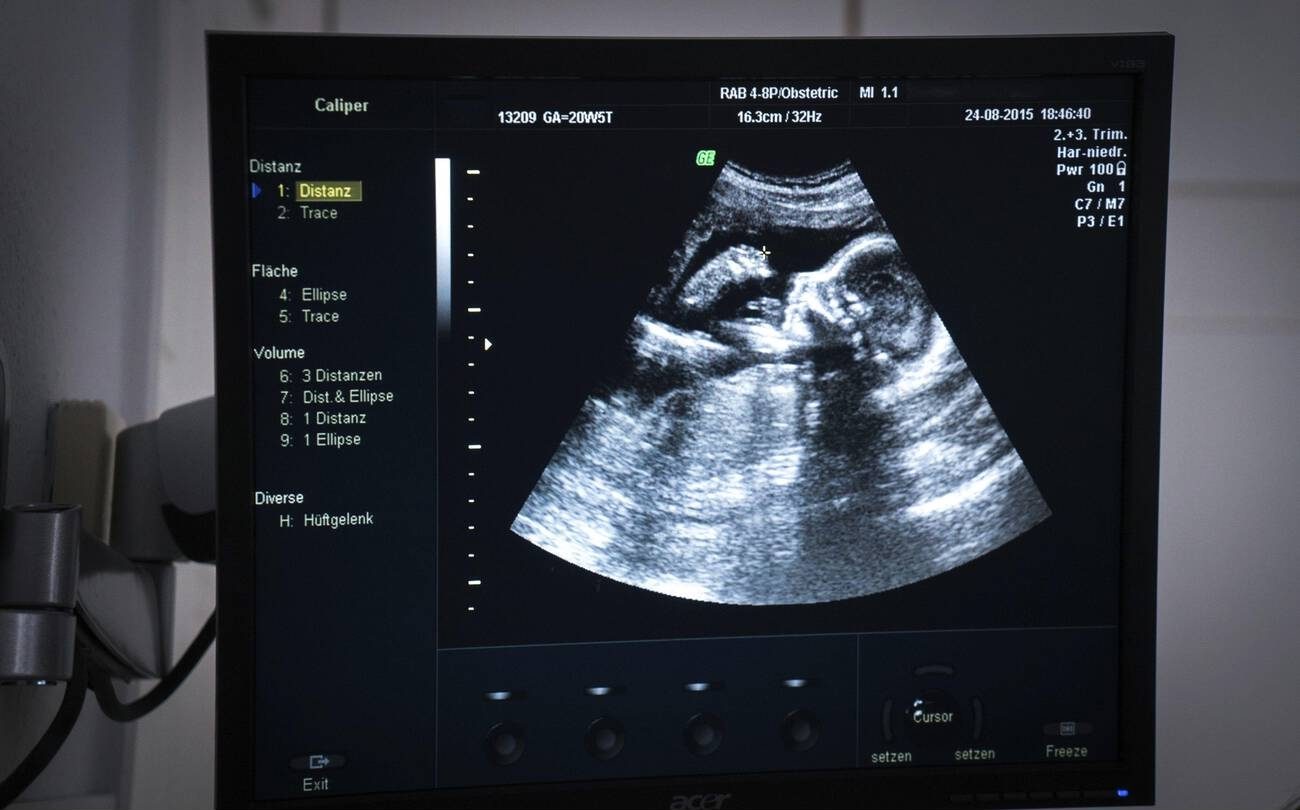
- Scans. In an ultrasound scan, a probe on the skin sends short bursts of ultrasound into the body. Some of each burst reflects from every boundary between tissues, and a computer uses the echo times to build a picture. Scans check on babies before they are born: ultrasound does not damage cells the way X-rays can.
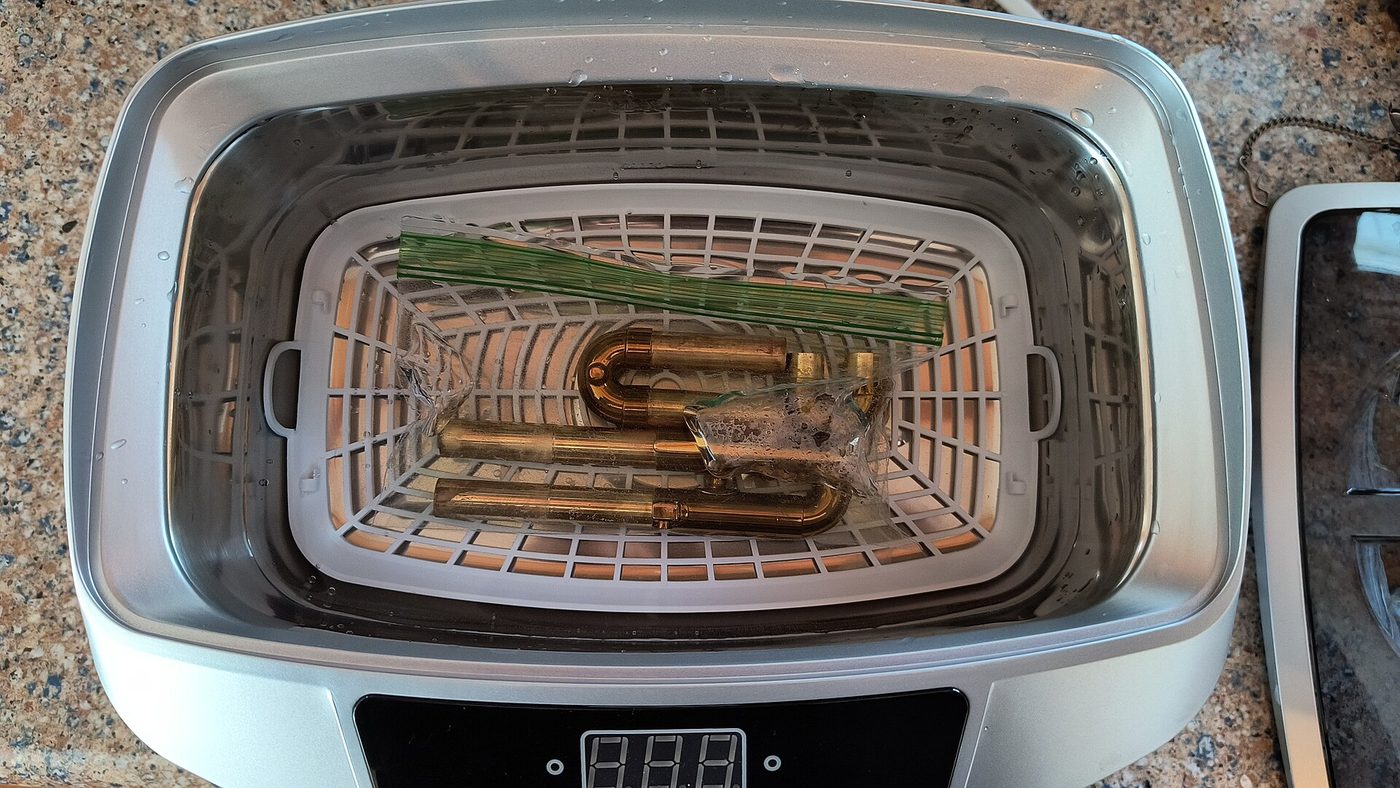
- Cleaning. An ultrasonic cleaning bath shakes the liquid so hard that dirt comes off jewellery, glasses and dentists’ tools, even from gaps a brush cannot reach.
- Physiotherapy. Physiotherapists use ultrasound to carry energy deep into muscles and joints, gently warming the tissue to ease pain and help injuries heal.
How do bats and ships use echoes?
Bats hunt in the dark by echolocation: they make short, high ultrasound calls and listen for the echoes from insects. The delay tells a bat how far away its prey is. Dolphins find fish the same way. Ships use sonar: they send a pulse (a short burst) of sound down through the water and time its echo to find the depth of the sea, as in worked example 2, or to find shoals of fish.
Stretch Why do bats use ultrasound? A sound reflects clearly only from an object at least about as big as its wavelength. Using wave speed = frequency × wavelength, a 50,000 Hz call in air has a wavelength of 340 ÷ 50,000 = 0.0068 m, about 7 mm: small enough to bounce off a moth.
Written to the KS3 national curriculum. Last changed 14 November 2026.
Key words
Say them, spell them, use them in an answer.
- echo
- reflection
- absorption
- ultrasound
- ultrasound scan
- echolocation
- sonar
- pulse
Common misconception
Often said“If the echo comes back after 2 seconds, the wall is 2 × 340 = 680 m away.”
In fact680 m is how far the sound travelled, there and back. The wall is half that distance away: 340 m. Always halve the distance worked out from an echo.

Did you know?
The Whispering Gallery
A whisper against the wall of the Whispering Gallery in St Paul’s Cathedral, London, can be heard on the far side, more than 30 m away. The smooth, curved stone wall reflects the sound again and again, so it hugs the wall all the way round.
Photo: JackPeasePhotography, CC BY 2.0, via Wikimedia Commons
Try 5 questions
Quick questions on echoes and ultrasound, marked as you go. Each one explains the answer.
Question 1 of 5
Measuring the speed of sound by clapping at a wall, why time 20 gaps between claps instead of one?
Choose an answer. Each question explains itself.
The homework sheet
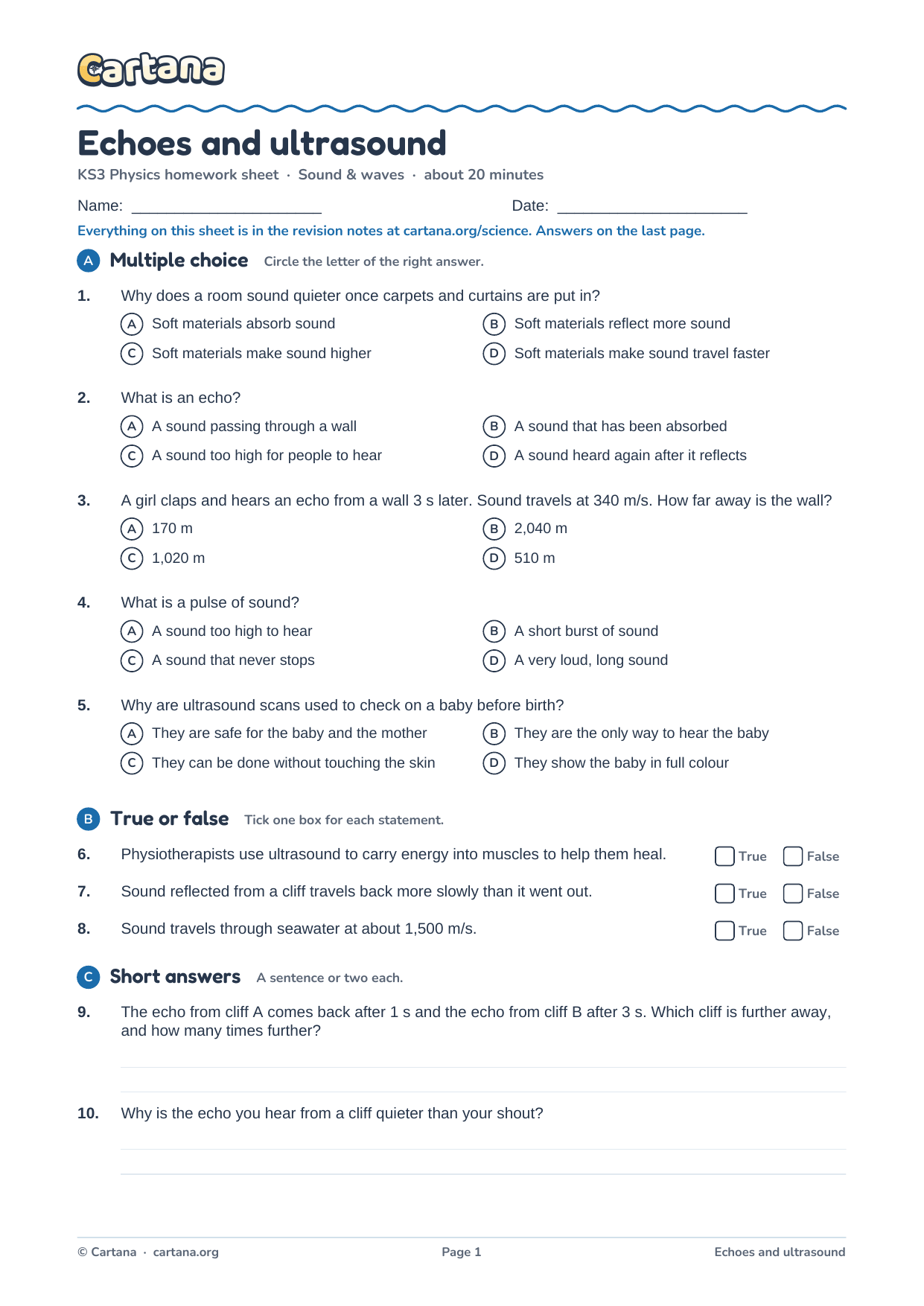
About twenty minutes. Everything on it is in the notes above; the answers are on the last page.
Free homework sheet
Echoes and ultrasound homework sheet
17 questions, about twenty minutes, with the answers on the last page: multiple choice, true or false, short answers, key words to define and one to explain in full.
KS3 Sound & waves
Revised the whole unit?
When every topic in sound & waves is done, two different papers test the whole unit, each with its own mark scheme.


 Watch the trailer · 1:06
New from Cartana · Beta test 1–31 December
Revision that feels like an adventure
Cartana is our KS3 learning adventure: sail between islands, answer quick-fire questions and battle bosses. It starts with science, with maths on the way, and launches in 2027. This December a small group of testers gets to play it first.
In the Cartana adventure, every science unit is an island to explore. The island for sound & waves is being built.
- Play the game before its official release
- Help us build it with your feedback
- Earn exclusive in-game items in return
More in this unit
Sound & waves
- 1WavesWaves carrying energy, transverse and longitudinal waves, amplitude, wavelength and frequency, and water waves reflecting and adding (superposition)
- 2Sound wavesSound made by vibrations, longitudinal sound waves, the need for a medium and the bell-jar experiment, the speed of sound in solids, liquids and gases, and sound against light
- 3Pitch and loudnessFrequency and pitch in hertz, amplitude and loudness, reading oscilloscope traces, and loudness in decibels
- 4HearingHow the ear works from pinna to auditory nerve, the hearing range of people and other animals, how hearing is damaged, and microphones and loudspeakers