
KS3 Physics · Sound & waves
Hearing
- The ear from the pinna to the auditory nerve, and what each part does
- The hearing range of people (20 Hz to 20,000 Hz) and of other animals
- How loud sound, age and blockages damage hearing
- How microphones and loudspeakers turn sound into signals and back
- 5 min read
- 5 quick questions
- Free homework sheet
- Years 7 to 9
Revision notes
Hearing is the sense that turns sound waves reaching the ear into electrical signals for the brain. Young people hear frequencies from about 20 Hz to 20,000 Hz; many animals hear higher or lower sounds than we can.
How does the ear work?
- The pinna, the outer flap of the ear, collects sound waves and funnels them into the ear canal, the tube that leads into the head.
- The sound waves make the eardrum, a thin, tight sheet of skin across the end of the ear canal, vibrate.
- Three tiny bones in the middle ear, the ossicles (the hammer, the anvil and the stirrup), pass the vibrations on to the inner ear and make them stronger.
- The cochlea is a coiled tube full of liquid, lined with thousands of tiny hair cells. The vibrations make the liquid move and the hairs bend, and the hair cells turn the vibrations into electrical signals.
- The auditory nerve carries these signals to the brain, which makes sense of them as sound.
The inner ear also holds the semicircular canals, three looped tubes that help you keep your balance. They play no part in hearing.
What frequencies can people and animals hear?
The range of frequencies a person or animal can hear is its hearing range. A young person hears from about 20 Hz to 20,000 Hz. Sound below 20 Hz, too low for us to hear, is infrasound; sound above 20,000 Hz, too high for us to hear, is ultrasound.
- Dogs hear up to about 45,000 Hz, so a dog whistle can call a dog without people hearing it.
- Bats hear up to about 110,000 Hz, and use ultrasound to find insects in the dark.
- Elephants hear down to about 16 Hz, but only up to about 12,000 Hz. They call to each other with deep rumbles, partly below our hearing range, that carry for kilometres.

The top of a person’s range falls with age, so a high whine that a teenager hears clearly can be silent to their grandparents.
How can hearing be damaged?
- Loud sound over time. Hours of sound above about 85 dB, from noisy machines or headphones turned right up, damage the hair cells in the cochlea. They never grow back, so the hearing loss is permanent. Ringing in the ears after a concert is a warning sign.
- A sudden, very loud bang close by, such as an explosion, can tear the eardrum.
- Age. Hair cells wear out over a lifetime, the ones for high frequencies first.
- Blockages. Ear wax or an infection can stop vibrations reaching the inner ear. This loss usually gets better once it is treated.
Ear defenders or earplugs protect your hearing in loud places, and so does keeping the volume of headphones down.
How do microphones and loudspeakers work?
A microphone works like an eardrum. Sound waves make its diaphragm, a thin sheet that can flex, vibrate. The microphone turns these vibrations into an electrical signal that changes in the same pattern as the sound. The signal carries the sound’s information, so it can be recorded, sent through a phone network or made louder.
A loudspeaker does the opposite job. The changing electrical signal makes its cone vibrate in the same pattern, and the cone pushes on the air to make sound waves.
Stretch In many microphones the diaphragm is fixed to a small coil of wire that sits around a magnet. As the coil moves back and forth near the magnet, a tiny electric current is made in the wire, changing in step with the sound. A loudspeaker uses the same parts the other way round: the current in its coil makes it an electromagnet, which is pushed and pulled by the magnet and moves the cone.
Written to the KS3 national curriculum. Last changed 14 November 2026.
Key words
Say them, spell them, use them in an answer.
- pinna
- ear canal
- eardrum
- ossicles
- cochlea
- auditory nerve
- hearing range
- infrasound
- ultrasound
- microphone
- diaphragm
Common misconception
Often said“You can only damage your hearing with a really loud bang. Music through headphones is fine.”
In factHours of sound above about 85 dB, such as music played loudly through headphones, slowly kill the hair cells in the cochlea. They never grow back, so the damage builds up without you noticing until it is permanent.
Did you know?
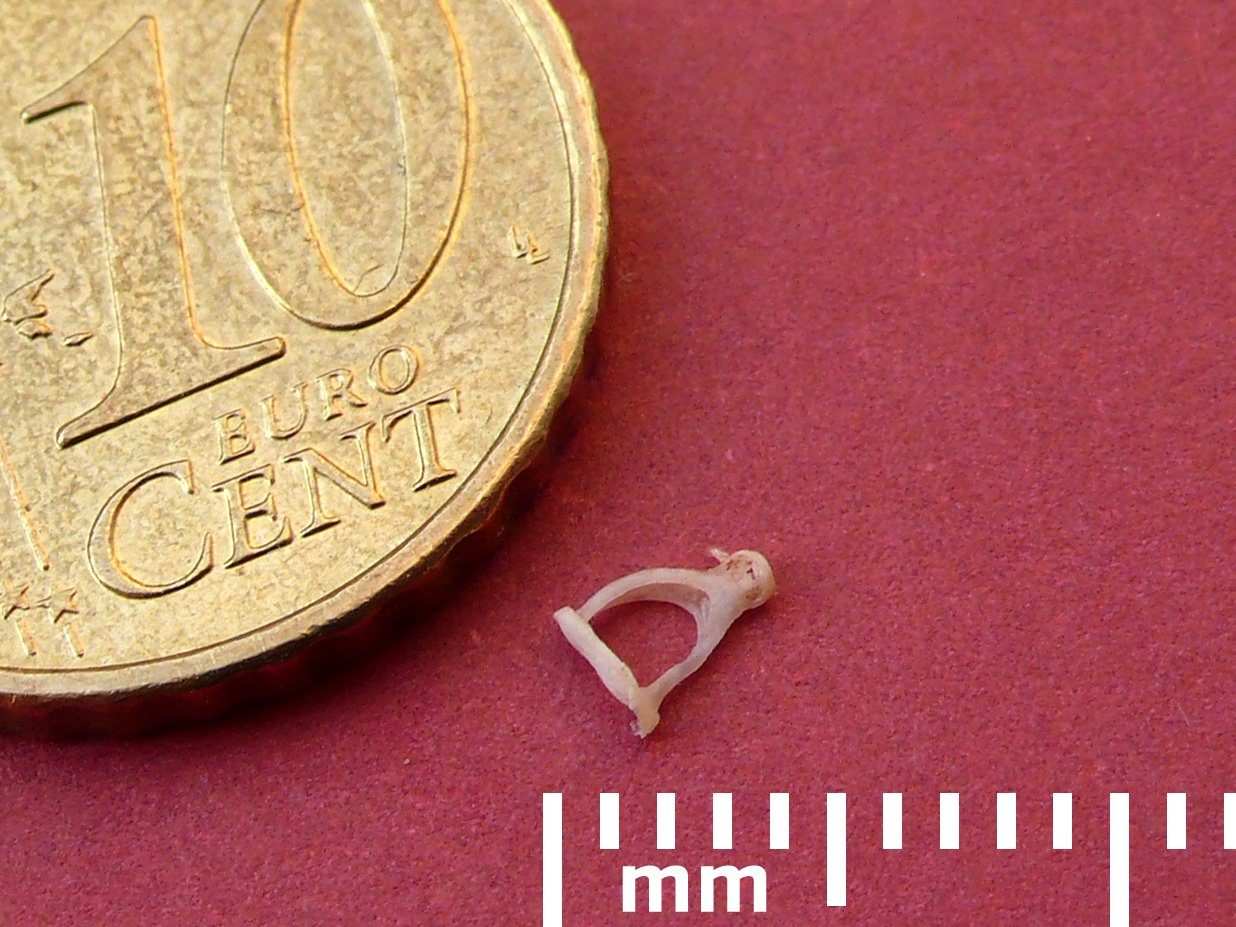
The stirrup
The stirrup, one of the three ossicles, is the smallest bone in the human body: about 3 mm long, smaller than a grain of rice. It presses on the inner ear like a tiny piston.
Photo: Welleschik, CC BY-SA 3.0, via Wikimedia Commons
Try 5 questions
Quick questions on hearing, marked as you go. Each one explains the answer.
Question 1 of 5
What does the auditory nerve do?
Choose an answer. Each question explains itself.
The homework sheet
About twenty minutes. Everything on it is in the notes above; the answers are on the last page.
Free homework sheet
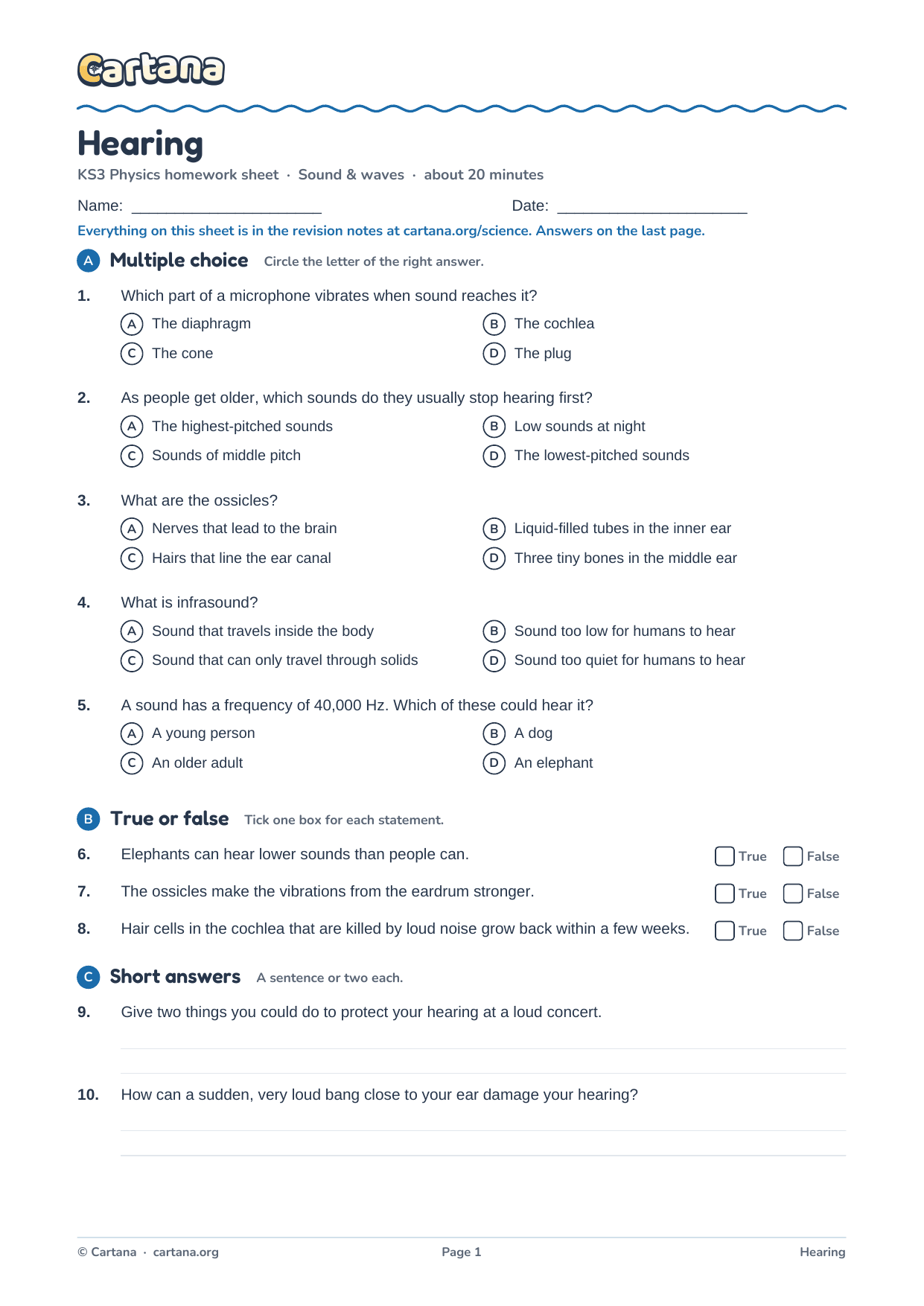
Hearing homework sheet
17 questions, about twenty minutes, with the answers on the last page: multiple choice, true or false, short answers, key words to define and one to explain in full.
KS3 Sound & waves
Revised the whole unit?
When every topic in sound & waves is done, two different papers test the whole unit, each with its own mark scheme.


 Watch the trailer · 1:06
New from Cartana · Beta test 1–31 December
Revision that feels like an adventure
Cartana is our KS3 learning adventure: sail between islands, answer quick-fire questions and battle bosses. It starts with science, with maths on the way, and launches in 2027. This December a small group of testers gets to play it first.
In the Cartana adventure, every science unit is an island to explore. The island for sound & waves is being built.
- Play the game before its official release
- Help us build it with your feedback
- Earn exclusive in-game items in return
More in this unit
Sound & waves
- 1WavesWaves carrying energy, transverse and longitudinal waves, amplitude, wavelength and frequency, and water waves reflecting and adding (superposition)
- 2Sound wavesSound made by vibrations, longitudinal sound waves, the need for a medium and the bell-jar experiment, the speed of sound in solids, liquids and gases, and sound against light
- 3Pitch and loudnessFrequency and pitch in hertz, amplitude and loudness, reading oscilloscope traces, and loudness in decibels
- 5Echoes and ultrasoundNextReflection and absorption of sound, distance from an echo, ultrasound for scans, cleaning and physiotherapy, and echolocation and sonar