
KS3 Physics · Sound & waves
Waves
- What a wave carries, and what it leaves behind
- Transverse and longitudinal waves, with compressions and rarefactions
- Amplitude, wavelength and frequency in hertz
- Water waves reflecting and adding up or cancelling (superposition)
- 5 min read
- 5 quick questions
- Free homework sheet
- Years 7 to 9
Revision notes
A wave is a vibration that carries energy from one place to another without carrying matter along with it. Water waves, sound and light all travel as waves.
What does a wave carry?
Drop a stone into a still pond and ripples spread out in rings. A leaf floating on the pond bobs up and down as each ripple passes, but it is not carried to the edge. The water does the same: each bit of it vibrates, moving to and fro about one place, while the wave moves on. What travels outwards is energy, not water.
All waves work this way: sea waves carry energy from distant storms to the beach, and sound carries energy from a drum to your ear.
What are transverse and longitudinal waves?
Waves come in two kinds, depending on which way the vibrations go.
- In a transverse wave the vibrations are at right angles to the direction the wave travels. Water waves, light and a rope shaken up and down are all transverse.
- In a longitudinal wave the vibrations are along the direction the wave travels. Sound is longitudinal. The wave is a row of compressions, where the particles are squashed together, and rarefactions, where they are spread out.
| Transverse | Longitudinal | |
|---|---|---|
| Vibrations | At right angles to the direction of travel | Along the direction of travel |
| Pattern | Crests and troughs | Compressions and rarefactions |
| Examples | Water waves, light, a shaken rope | Sound, a slinky pushed and pulled |
How do you describe a wave?
The top of a transverse wave is a crest (or peak) and the bottom is a trough. Three measurements describe any wave:
- The amplitude is the height from the middle line (the rest position, where still water would be) up to a crest. A bigger amplitude means the wave carries more energy.
- The wavelength is the distance from one crest to the next, or from any point on one wave to the same point on the next. It is measured in metres (m).
- The frequency is the number of waves passing a point each second. It is measured in hertz (Hz): 1 Hz means one wave a second.
With the time in seconds (s), the frequency is in hertz (Hz).
In a ripple tank, a shallow tank of water used to study waves, 30 ripples pass a mark in 6 s. What is their frequency?
frequency = number of waves ÷ time
frequency = 30 ÷ 6 s = 5 Hz
What happens when water waves meet a wall or each other?
Water waves bounce off a barrier: this is reflection. Waves reflect from a harbour wall and travel back out to sea. Straight ripples that hit a straight wall at a slant leave it at the same angle, like a ball bouncing off a wall.
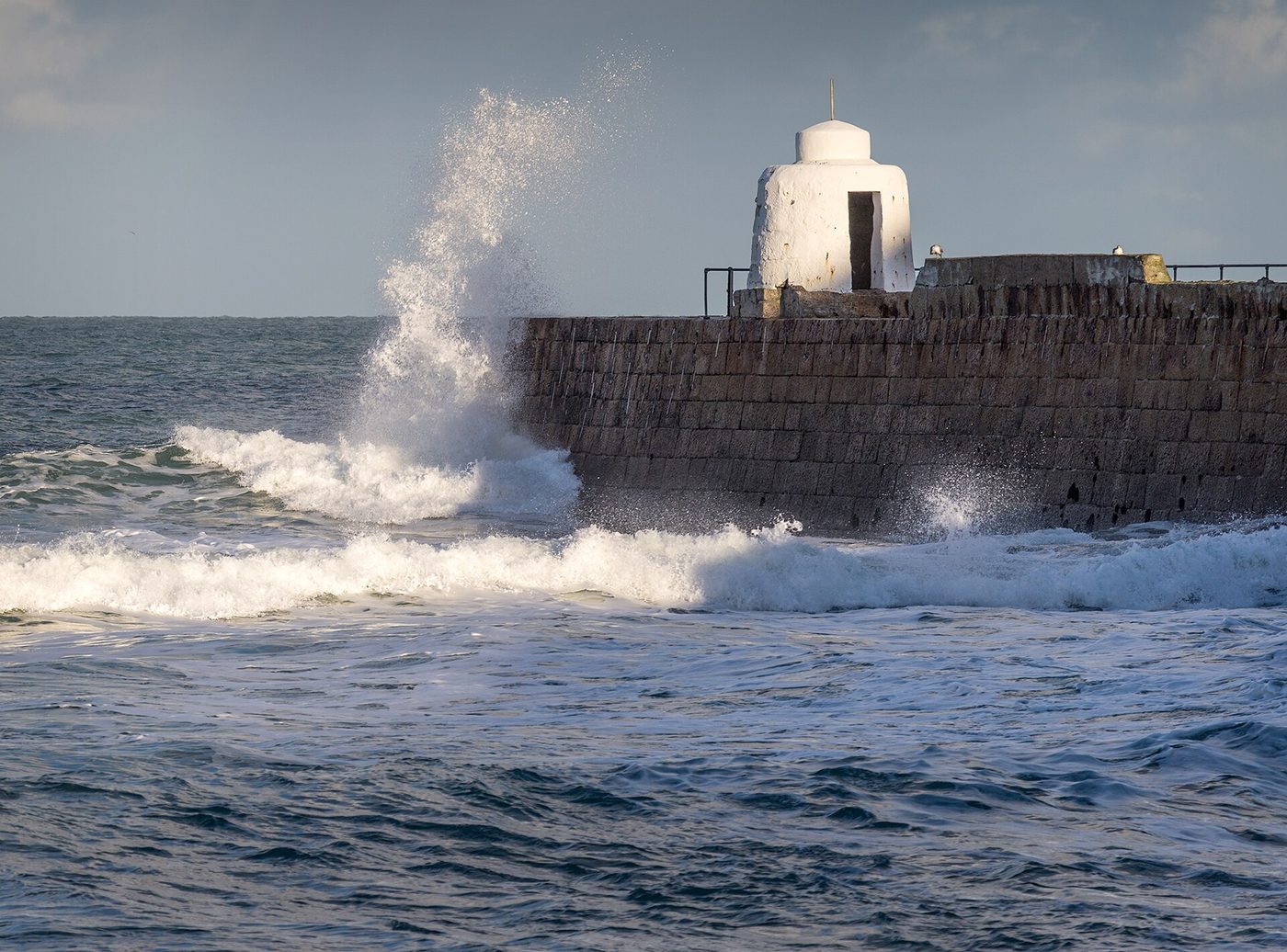
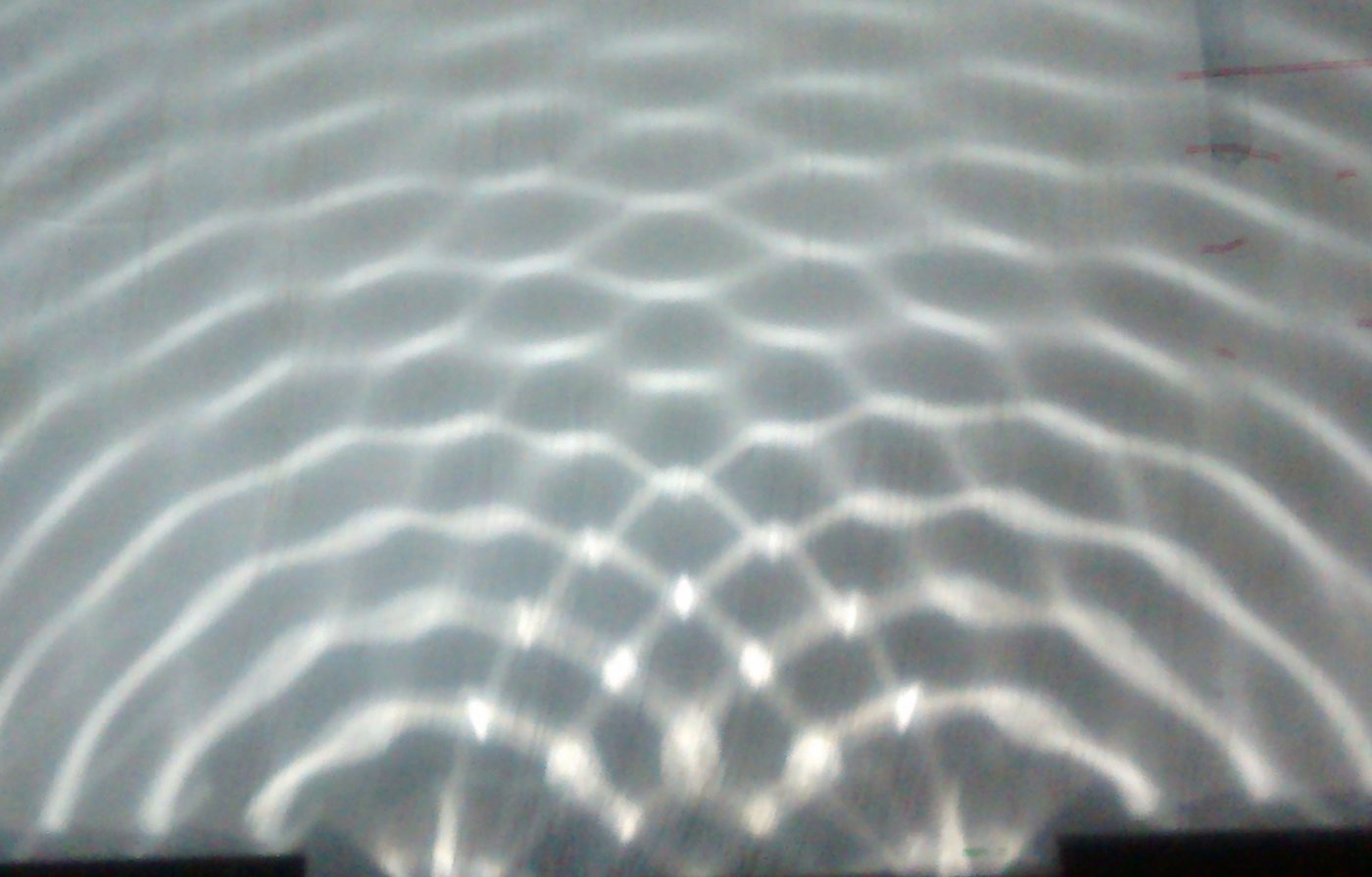
When two waves meet, they pass through each other, and where they overlap their heights add together. This is superposition:
- Crest meets crest (the waves are in step): they add up to a bigger crest.
- Crest meets trough (the waves are out of step): they cancel, and the water there is flat.
Seeing it in a ripple tank:
- Pour water into a shallow tank with a glass bottom and shine a lamp down through it onto a white sheet underneath.
- Fix two dippers to one bar that a motor moves up and down, so they make two sets of circular ripples in step.
- Watch the shadows on the sheet where the two sets of ripples overlap.
You see lines of large ripples fanning out from the dippers, with lines of almost still water between them, where crests from one dipper meet troughs from the other and cancel. Noise-cancelling headphones use the same idea with sound: they play a sound wave that is out of step with the noise, so the two cancel.
Stretch A wave’s speed is linked to its frequency and wavelength: wave speed = frequency × wavelength, with the speed in m/s, the frequency in Hz and the wavelength in m. Ripples with a frequency of 5 Hz and a wavelength of 0.04 m travel at 5 × 0.04 = 0.2 m/s: each second, five waves each 4 cm long pass the mark, so the wave moves on 20 cm.
Written to the KS3 national curriculum. Last changed 14 November 2026.
Key words
Say them, spell them, use them in an answer.
- wave
- vibrate
- transverse wave
- longitudinal wave
- compression
- rarefaction
- crest
- trough
- amplitude
- wavelength
- frequency
- superposition
Common misconception
Often said“A wave carries the water along with it, all the way to the beach.”
In factThe water mostly moves up and down where it is; only the energy travels across the sea. Watch a gull floating beyond the breakers: it bobs up and down as each wave passes but stays in about the same place.
Did you know?
Tsunamis
In the deep ocean a tsunami can travel at about 800 km/h, as fast as a jet airliner, yet be less than a metre high, so ships hardly notice it pass. Near the coast it slows down and its energy piles up into a wall of water.
Try 5 questions
Quick questions on waves, marked as you go. Each one explains the answer.
Question 1 of 5
Wave A has a bigger amplitude than wave B. What does that tell you about wave A?
Choose an answer. Each question explains itself.
The homework sheet
About twenty minutes. Everything on it is in the notes above; the answers are on the last page.
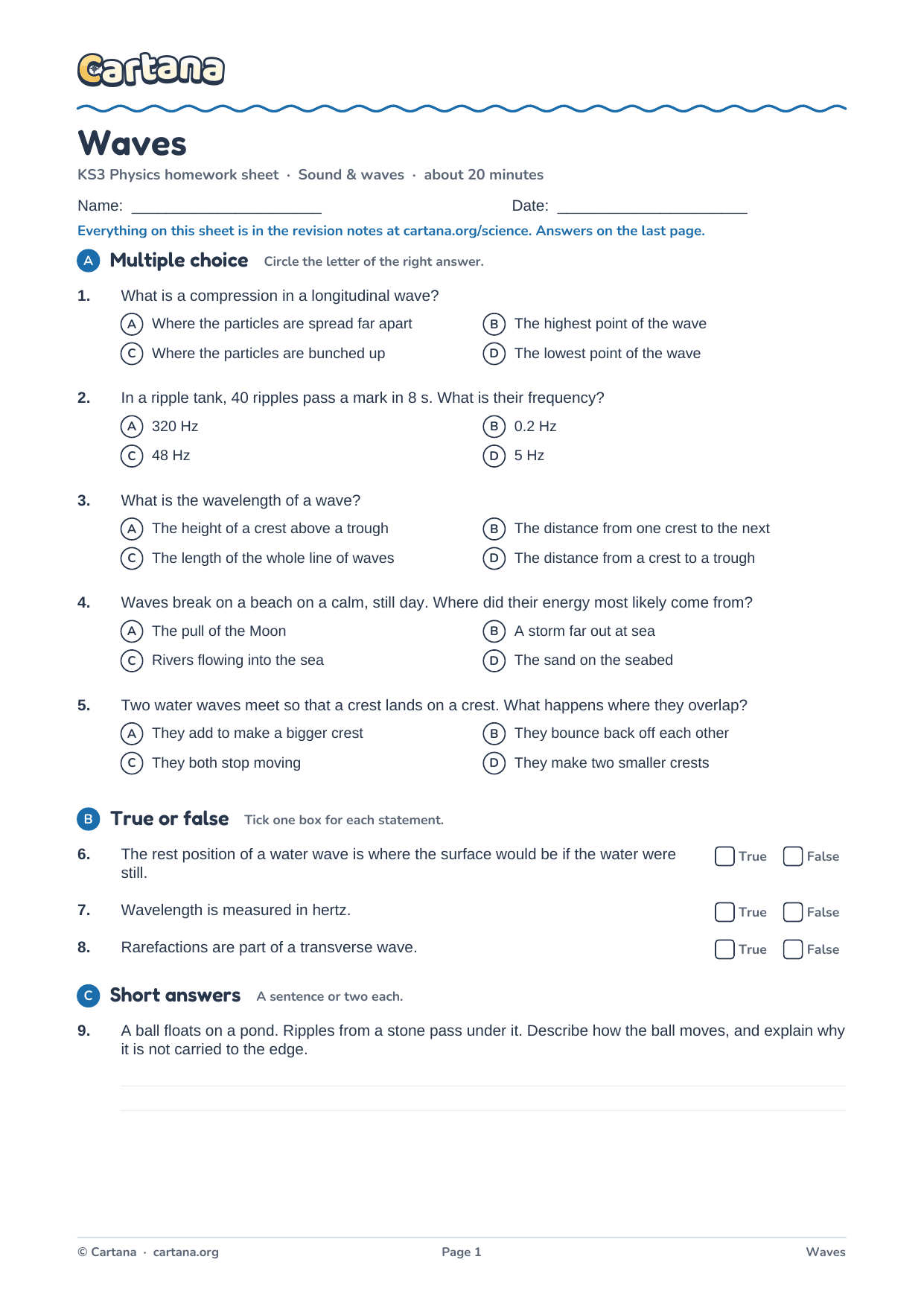
Free homework sheet
Waves homework sheet
17 questions, about twenty minutes, with the answers on the last page: multiple choice, true or false, short answers, key words to define and one to explain in full.
KS3 Sound & waves
Revised the whole unit?
When every topic in sound & waves is done, two different papers test the whole unit, each with its own mark scheme.


 Watch the trailer · 1:06
New from Cartana · Beta test 1–31 December
Revision that feels like an adventure
Cartana is our KS3 learning adventure: sail between islands, answer quick-fire questions and battle bosses. It starts with science, with maths on the way, and launches in 2027. This December a small group of testers gets to play it first.
In the Cartana adventure, every science unit is an island to explore. The island for sound & waves is being built.
- Play the game before its official release
- Help us build it with your feedback
- Earn exclusive in-game items in return
More in this unit
Sound & waves
- 2Sound wavesNextSound made by vibrations, longitudinal sound waves, the need for a medium and the bell-jar experiment, the speed of sound in solids, liquids and gases, and sound against light
- 3Pitch and loudnessFrequency and pitch in hertz, amplitude and loudness, reading oscilloscope traces, and loudness in decibels
- 4HearingHow the ear works from pinna to auditory nerve, the hearing range of people and other animals, how hearing is damaged, and microphones and loudspeakers
- 5Echoes and ultrasoundReflection and absorption of sound, distance from an echo, ultrasound for scans, cleaning and physiotherapy, and echolocation and sonar