
KS3 Chemistry · Atoms, elements & compounds
Chemical formulae
- What the symbols and the small numbers in a formula mean
- Counting the atoms in formulae such as CaCO₃ and H₂SO₄
- Nine formulae to know, from water to sulfuric acid
- Writing a formula from a molecule diagram
- 3 min read
- 5 quick questions
- Free homework sheet
- Years 7 to 9
Revision notes
A chemical formula uses symbols and small numbers to show which elements are in a substance and how many atoms of each there are. H2O means two hydrogen atoms joined to one oxygen atom.
What does a chemical formula tell you?
Each symbol stands for an element. A small number written low after a symbol, a subscript, tells you how many atoms of that element there are. It counts only the symbol just before it. No number means one atom.
- H2O: two hydrogen atoms and one oxygen atom.
- CO2: one carbon atom and two oxygen atoms.
- NaCl: one sodium atom for every chlorine atom.
Elements have formulae too. Oxygen gas is O2, because its molecules are two oxygen atoms joined; helium is just He, because its atoms are on their own. A formula is shorter than a name, and chemists everywhere read it the same way.
How do you count the atoms in a formula?
Go through the formula one symbol at a time, and read the number after each symbol.
How many atoms are in CaCO3, calcium carbonate?
Ca: 1 calcium atom
C: 1 carbon atom
O3: 3 oxygen atoms
Total: 1 + 1 + 3 = 5 atoms, of 3 elements.
How many atoms are in H2SO4, sulfuric acid?
H2: 2 hydrogen atoms; S: 1 sulfur atom; O4: 4 oxygen atoms
Total: 2 + 1 + 4 = 7 atoms, of 3 elements.
A big number written in front of a formula counts whole molecules. 2H2O means two water molecules: 4 hydrogen atoms and 2 oxygen atoms, 6 atoms in all. You will use this when you write equations for reactions.
Which formulae should you know?
| Substance | Formula | Atoms |
|---|---|---|
| Water | H2O | 2 H, 1 O |
| Carbon dioxide | CO2 | 1 C, 2 O |
| Oxygen | O2 | 2 O |
| Sodium chloride | NaCl | 1 Na, 1 Cl |
| Methane | CH4 | 1 C, 4 H |
| Hydrochloric acid | HCl | 1 H, 1 Cl |
| Sodium hydroxide | NaOH | 1 Na, 1 O, 1 H |
| Calcium carbonate | CaCO3 | 1 Ca, 1 C, 3 O |
| Sulfuric acid | H2SO4 | 2 H, 1 S, 4 O |
You meet them all the time: methane is most of the natural gas burned in cookers, calcium carbonate is chalk, limestone and marble, and hydrochloric acid is in your stomach.

How do you write a formula from a diagram?
- Use the key to find which elements are in one molecule.
- Count the atoms of each element in that one molecule.
- Write each symbol with its number after it as a subscript. Leave out any 1.
A molecule of one carbon atom joined to four hydrogen atoms is CH4. A molecule of two chlorine atoms is Cl2.
Stretch Some formulae have brackets. A number after a bracket multiplies everything inside it. Calcium hydroxide, the chemical in limewater, is Ca(OH)2: 1 calcium atom, 2 oxygen atoms and 2 hydrogen atoms, 5 atoms in all. Written without the bracket, as CaOH2, it would say there is only one oxygen atom, which is wrong.
Written to the KS3 national curriculum. Last changed 13 November 2026.
Key words
Say them, spell them, use them in an answer.
- chemical formula
- symbol
- subscript
- molecule
- atom
- element
- compound
Common misconception
Often said“In CO₂, the 2 means there are two carbon atoms.”
In factA small number counts only the atoms of the element just before it. In CO₂ it belongs to the O, so there is one carbon atom and two oxygen atoms. A molecule with two carbon atoms would have C₂ in its formula.
Did you know?
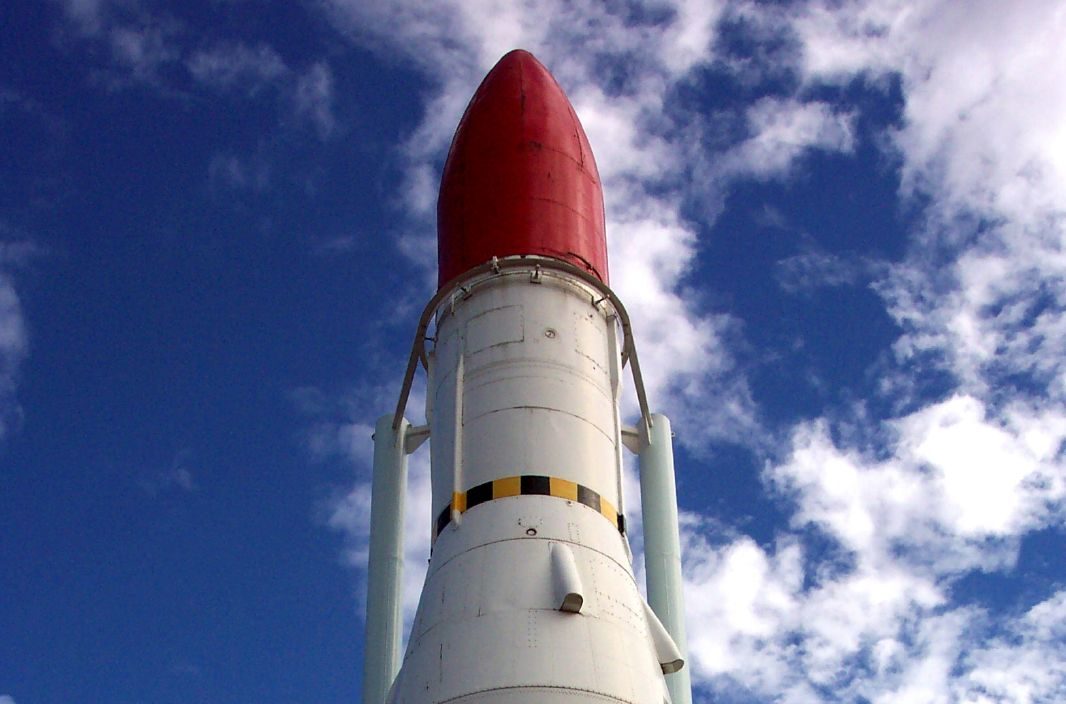
Black Arrow
Add one more oxygen atom to H₂O and you get hydrogen peroxide, H₂O₂: a bleach, and when concentrated, a rocket propellant. Black Arrow, the only British rocket to put a satellite into orbit, in 1971, burned kerosene with concentrated hydrogen peroxide.
Photo: artq55, CC BY-SA 2.0, via Wikimedia Commons
Try 5 questions
Quick questions on chemical formulae, marked as you go. Each one explains the answer.
Question 1 of 5
What is the formula for methane?
Choose an answer. Each question explains itself.
The homework sheet
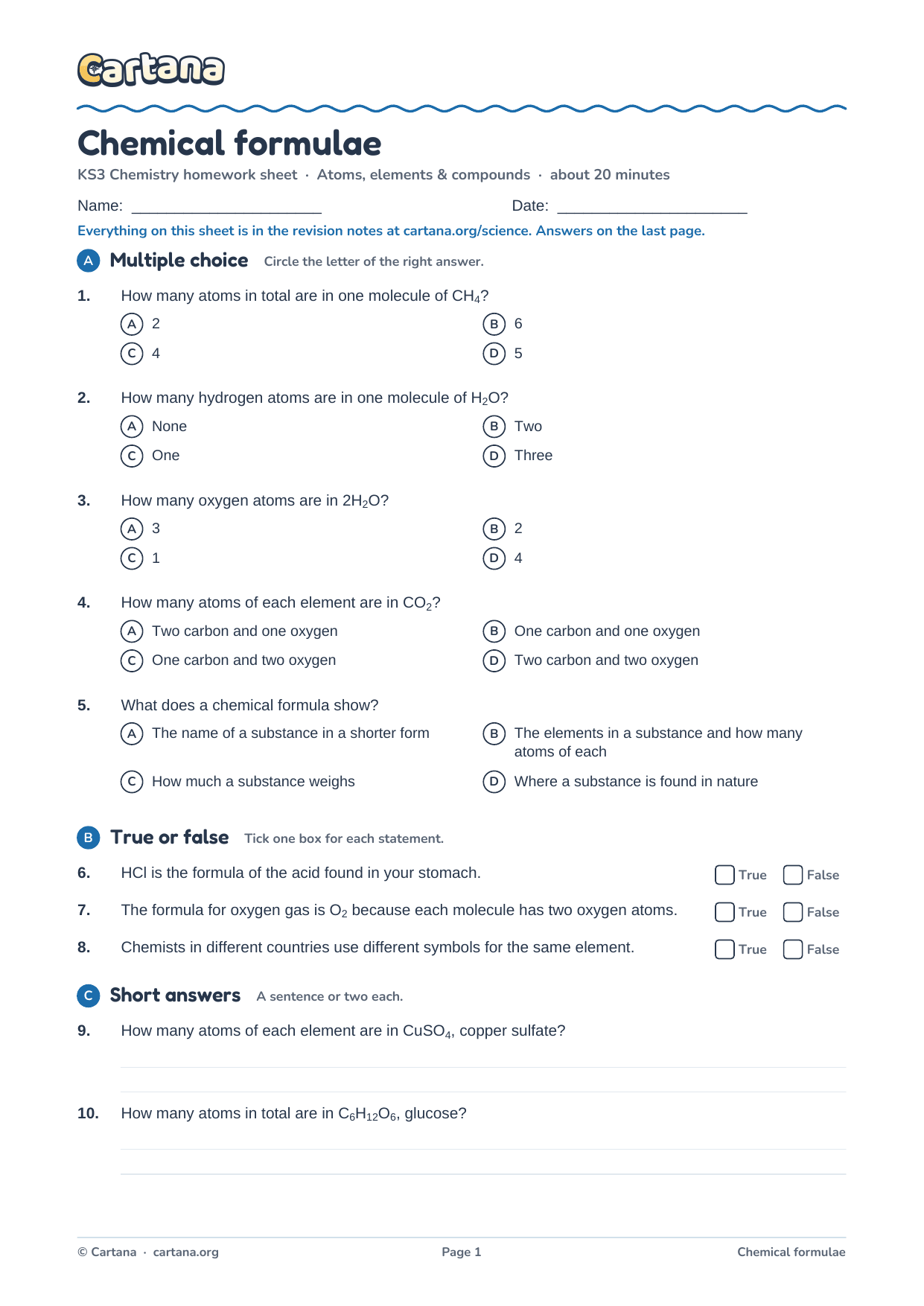
About twenty minutes. Everything on it is in the notes above; the answers are on the last page.
Free homework sheet
Chemical formulae homework sheet
17 questions, about twenty minutes, with the answers on the last page: multiple choice, true or false, short answers, key words to define and one to explain in full.
KS3 Atoms, elements & compounds
Revised the whole unit?
When every topic in atoms, elements & compounds is done, two different papers test the whole unit, each with its own mark scheme.


 Watch the trailer · 1:06
New from Cartana · Beta test 1–31 December
Revision that feels like an adventure
Cartana is our KS3 learning adventure: sail between islands, answer quick-fire questions and battle bosses. It starts with science, with maths on the way, and launches in 2027. This December a small group of testers gets to play it first.
In the Cartana adventure, every science unit is an island to explore. The island for atoms, elements & compounds is being built.
- Play the game before its official release
- Help us build it with your feedback
- Earn exclusive in-game items in return
More in this unit