
KS3 Chemistry · Atoms, elements & compounds
Elements and symbols
- What an element is, and why it cannot be broken down
- Writing chemical symbols: the capital and small letter rule
- Elements made of single atoms or of molecules, such as O₂
- Where to find every element: the periodic table
- 4 min read
- 5 quick questions
- Free homework sheet
- Years 7 to 9
Revision notes
An element is a substance made of only one kind of atom, so no chemical reaction can break it down into anything simpler. There are 118 known elements, each with its own chemical symbol.
What is an element?
Every atom in an element is the same kind of atom. A bar of pure gold is made of gold atoms and nothing else; the oxygen in the air is made of oxygen atoms. Because there is only one kind of atom in it, an element cannot be split into simpler substances by heating it or reacting it. Water can be split into hydrogen and oxygen, so water is not an element: it is a compound.
Scientists know of 118 elements. About 90 are found in nature; the rest have been made in laboratories, often only a few atoms at a time. At room temperature most elements are solids, eleven are gases, and just two are liquids: mercury and bromine. Most elements are metals.
How do you write chemical symbols?
Every element has a symbol of one or two letters, used by scientists in every country. The rules are strict:
- The first letter is always a capital: O for oxygen, C for carbon.
- A second letter is always small. It is needed because many names start with the same letter: C carbon, Ca calcium, Cl chlorine, Co cobalt and Cu copper.
- A few symbols come from older names, mostly Latin: Na sodium (natrium), Fe iron (ferrum), Cu copper (cuprum). The periodic table page lists seven of them.
A capital in the wrong place changes the meaning. Co is the element cobalt, but CO is carbon monoxide, a poisonous compound of carbon and oxygen.
| Element | Symbol | Comes from |
|---|---|---|
| Hydrogen | H | first letter |
| Helium | He | first two letters |
| Carbon | C | first letter |
| Calcium | Ca | first two letters |
| Chlorine | Cl | first and third letters |
| Nitrogen | N | first letter |
| Oxygen | O | first letter |
| Magnesium | Mg | first and third letters |
| Sulfur | S | first letter |
| Zinc | Zn | first and third letters |
| Sodium | Na | old name natrium |
| Potassium | K | old name kalium |
| Iron | Fe | Latin ferrum |
| Copper | Cu | Latin cuprum |
Is an element made of atoms or molecules?
It depends on the element. In the noble gases, such as helium and neon, the atoms are on their own. In metals, and in carbon, the atoms are packed together in huge regular structures.
In other elements the atoms are joined in small groups. A group of two or more atoms chemically joined together is a molecule. Oxygen gas is made of oxygen molecules, each two oxygen atoms joined, so its formula is O2. Hydrogen (H2), nitrogen (N2) and chlorine (Cl2) are the same. A molecule of an element is still an element: all its atoms are the same kind. The small number is explained in chemical formulae.
Where are all the elements listed?
Every element has its own square on the periodic table, in order of atomic number, from hydrogen (1) to oganesson (118). Elements in the same column, or group, behave in similar ways. The periodic table unit explains how it is laid out and why.
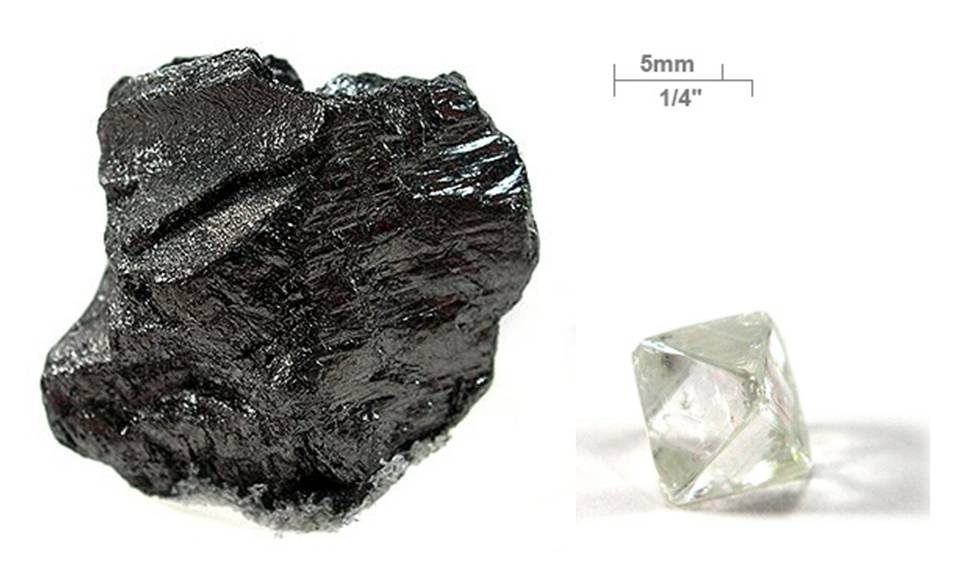
Stretch One element can come in more than one form. Diamond and graphite are both pure carbon: every atom in them is a carbon atom. In diamond each atom is joined to four others in a rigid network, which makes it the hardest natural substance. In graphite the atoms are joined in flat layers that slide over each other, so it is soft enough to write with: it is the "lead" in a pencil. Different forms of the same element are called allotropes.
Written to the KS3 national curriculum. Last changed 13 November 2026.
Key words
Say them, spell them, use them in an answer.
- element
- atom
- chemical symbol
- molecule
- periodic table
- atomic number
- metal
- allotrope
Common misconception
Often said“Water is an element.”
In factWater is a compound. Each water molecule is two hydrogen atoms joined to one oxygen atom, and passing electricity through water splits it into hydrogen and oxygen gases. Long ago people did call water an element, along with earth, air and fire, but none of the four is an element.
Did you know?
Ytterby
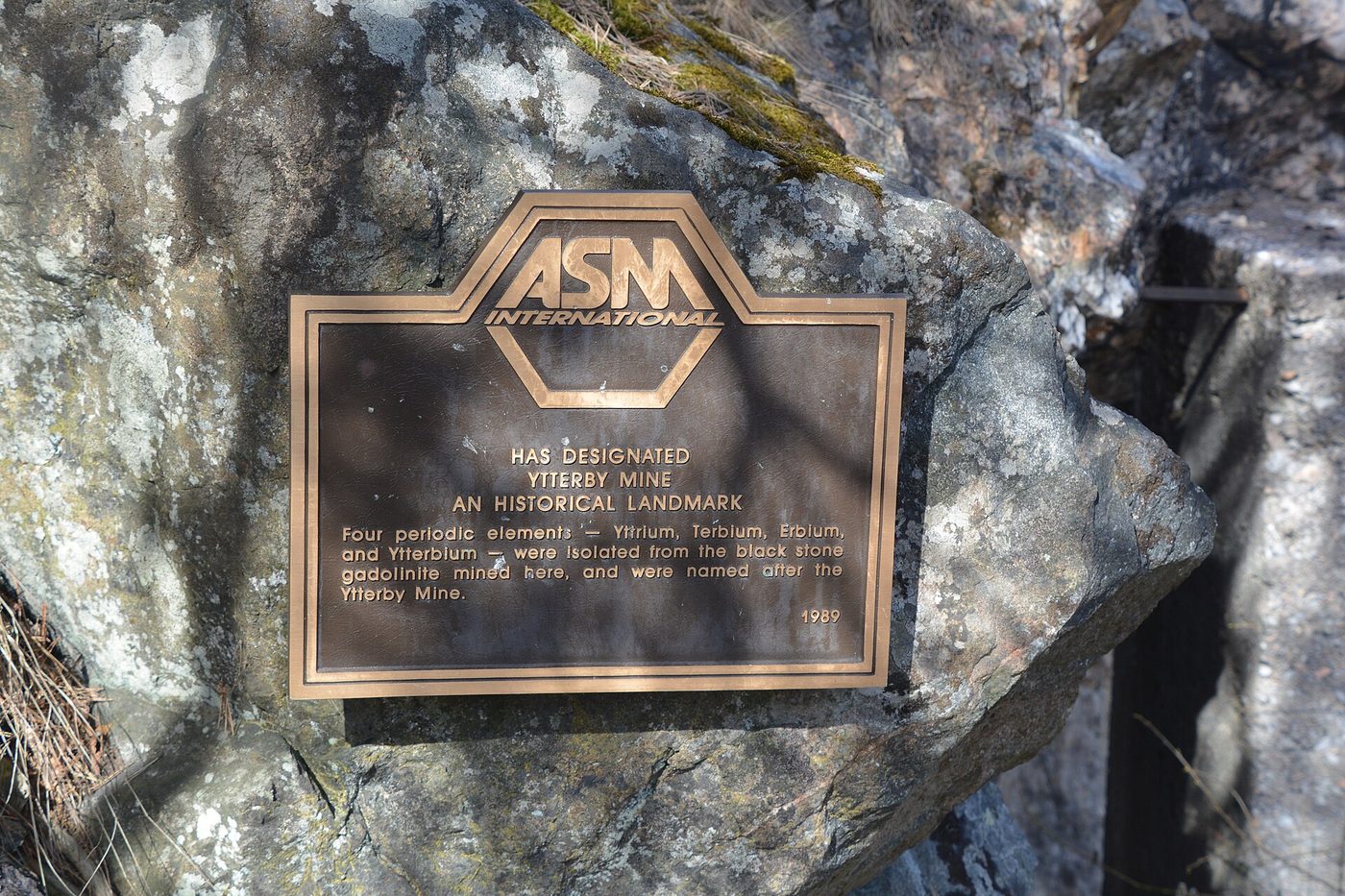
Four elements are named after one small village in Sweden, Ytterby, where an old quarry gave up unusual minerals: yttrium, ytterbium, terbium and erbium. No other place on Earth has given its name to so many.
Photo: Bengt Oberger, CC BY-SA 4.0, via Wikimedia Commons
Try 5 questions
Quick questions on elements and symbols, marked as you go. Each one explains the answer.
Question 1 of 5
Diamond and graphite are both made of only carbon atoms. What are they?
Choose an answer. Each question explains itself.
The homework sheet
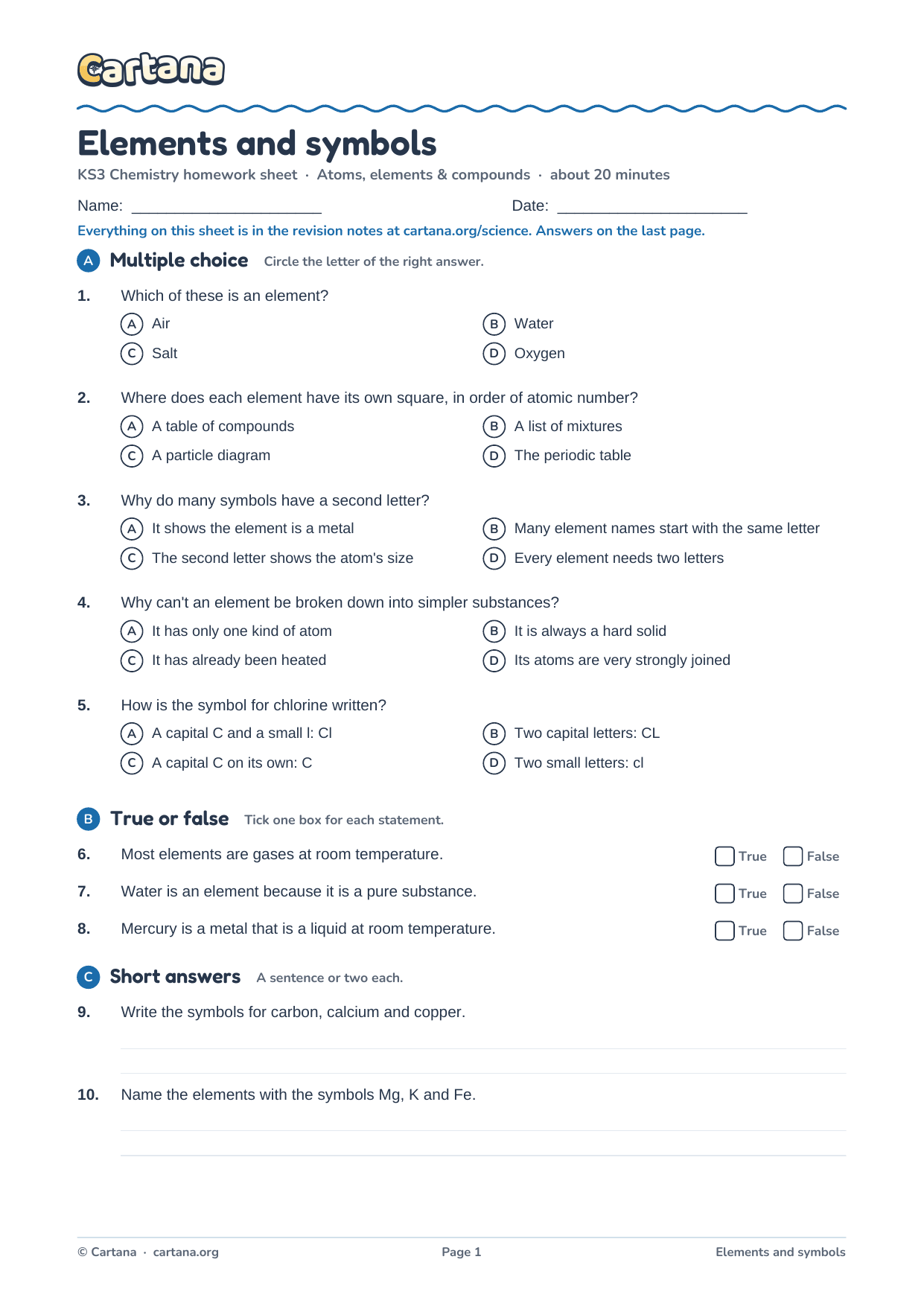
About twenty minutes. Everything on it is in the notes above; the answers are on the last page.
Free homework sheet
Elements and symbols homework sheet
17 questions, about twenty minutes, with the answers on the last page: multiple choice, true or false, short answers, key words to define and one to explain in full.
KS3 Atoms, elements & compounds
Revised the whole unit?
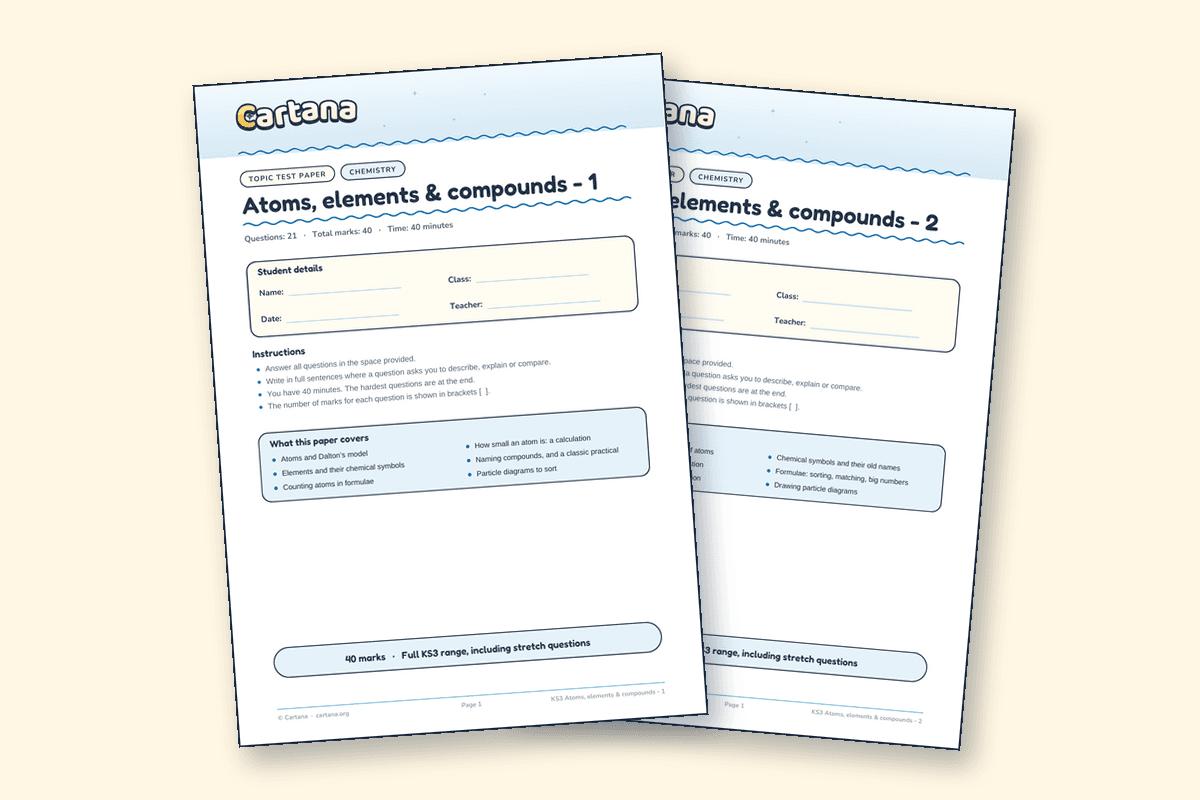
When every topic in atoms, elements & compounds is done, two different papers test the whole unit, each with its own mark scheme.


 Watch the trailer · 1:06
New from Cartana · Beta test 1–31 December
Revision that feels like an adventure
Cartana is our KS3 learning adventure: sail between islands, answer quick-fire questions and battle bosses. It starts with science, with maths on the way, and launches in 2027. This December a small group of testers gets to play it first.
In the Cartana adventure, every science unit is an island to explore. The island for atoms, elements & compounds is being built.
- Play the game before its official release
- Help us build it with your feedback
- Earn exclusive in-game items in return
More in this unit