
KS3 Chemistry · The periodic table
Groups and periods
- Groups (the columns) and periods (the rows), and what a square shows: name, symbol and atomic number
- Where the metals and non-metals are, and the symbols that come from Latin names, such as Na, K and Fe
- How Mendeleev laid out his cards in 1869, left gaps and predicted the missing elements
- Why his table was accepted: gallium and germanium matched his predictions
- 3 min read
- 5 quick questions
- Free homework sheet
- Years 7 to 9
Revision notes
The periodic table lists every element, one square each. Today there are 118 elements, in order of atomic number: the whole number on each square, from hydrogen (1) to oganesson (118). Each square shows the element’s name, its symbol and its atomic number.
Groups and periods. The columns are groups. Elements in the same group have similar properties and react in similar ways, so if you know how one behaves you can predict the others. The main groups are numbered 1 to 7, and the last column is Group 0; the wide block in the middle is the transition metals. The rows are periods. To find an element from its group and period, go down its group’s column to the right row: Group 2, period 3 is magnesium.
Metals and non-metals. Most elements are metals: they are on the left and in the middle. The non-metals are on the right, beyond the stepped line. Hydrogen sits at the top left, but it is a non-metal, a colourless gas.
| Symbol | Element | From |
|---|---|---|
| Na | Sodium | natrium |
| K | Potassium | kalium |
| Fe | Iron | ferrum (Latin) |
| Cu | Copper | cuprum (Latin) |
| Ag | Silver | argentum (Latin) |
| Au | Gold | aurum (Latin) |
| Pb | Lead | plumbum (Latin) |
Most symbols come from the English name (C for carbon, Ca for calcium). These seven come from older names.
Putting the elements in order. In the early 1800s chemists such as John Dalton worked out each element’s atomic weight: how heavy its atoms are compared with other atoms. In 1865 John Newlands listed the elements in order of atomic weight and noticed that every eighth element was alike, which he called the law of octaves. Other chemists laughed at it: he left no spaces, so the pattern broke down after calcium.
Mendeleev’s table, 1869. Dmitri Mendeleev wrote each element on a card with its atomic weight and its properties. About 63 elements were known then. He laid the cards out in order of atomic weight and started a new row whenever the properties began to repeat, so that similar elements lined up in columns. Where the next element did not fit the family in the column it would have joined, he left a gap for an element nobody had found yet, and he predicted that element’s properties from its neighbours. He also swapped a few pairs, such as tellurium and iodine, so that each element sat with its family.
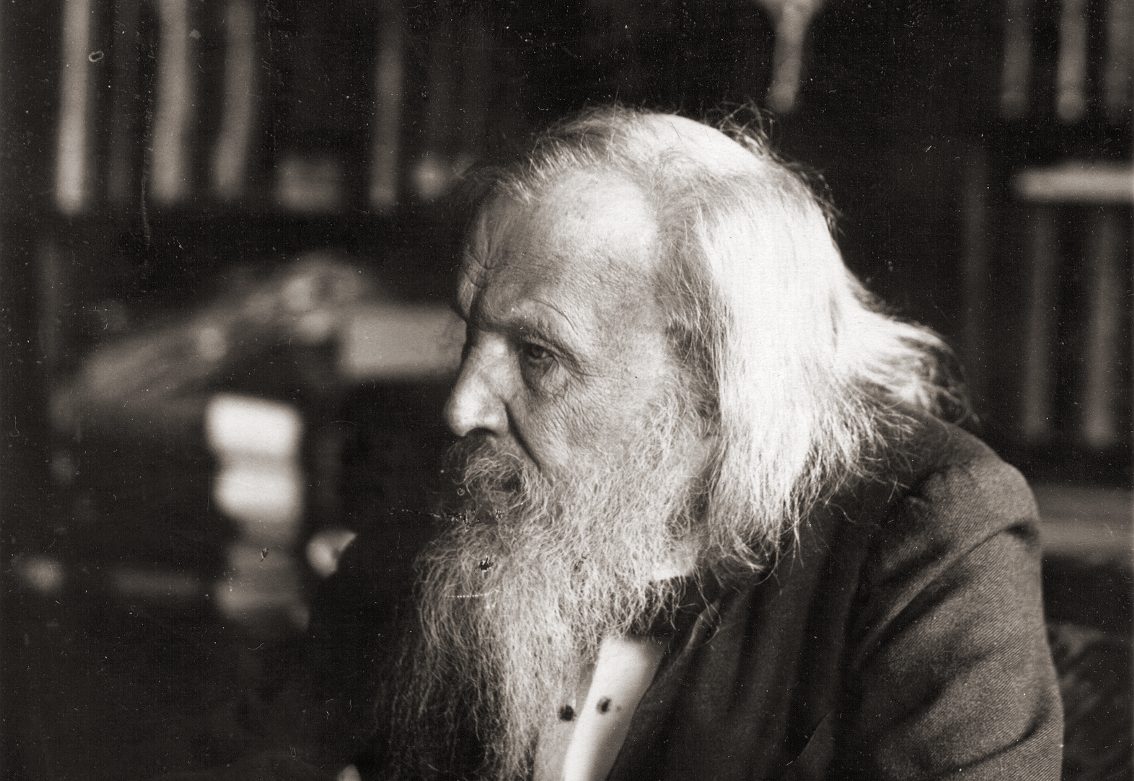
Why his table was accepted. The missing elements were found, and they matched his predictions: gallium (his eka-aluminium, below aluminium) in 1875, scandium in 1879 and germanium (his eka-silicon, below silicon) in 1886. A table that could predict new elements correctly was hard to argue with. The noble gases were not known in 1869; when they were found in the 1890s, a whole new group was added and the table still worked.
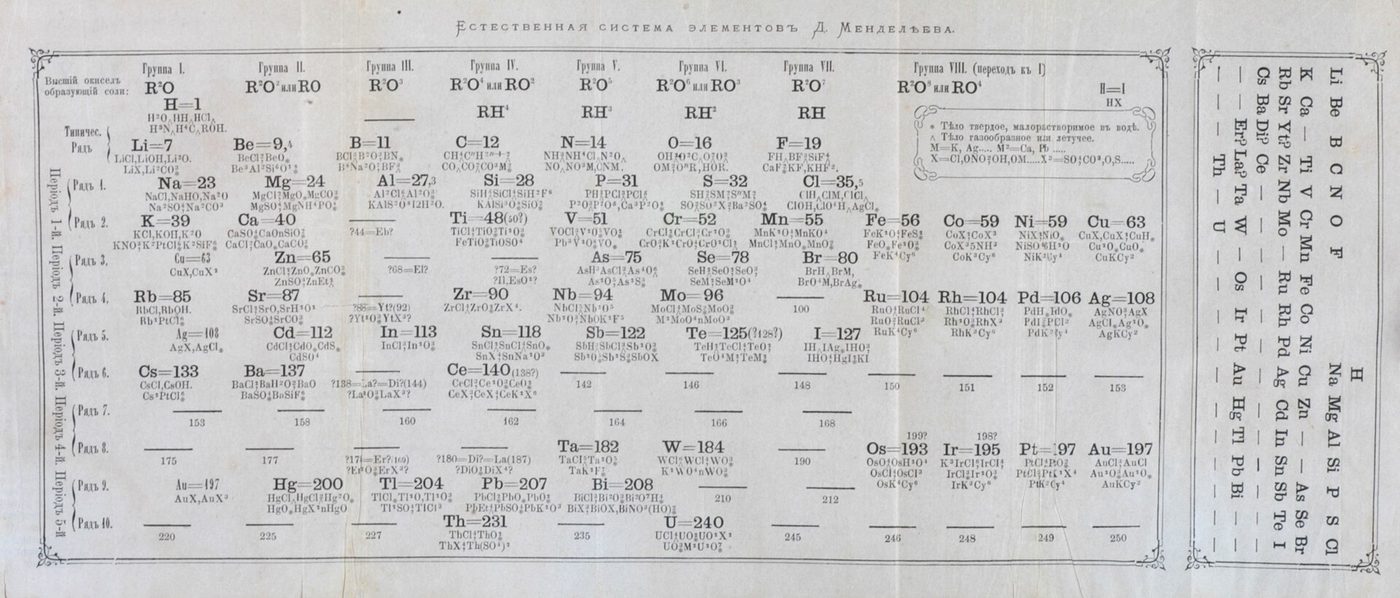
Stretch Today’s order, by atomic number, puts tellurium before iodine with no swapping, which shows Mendeleev was right to trust properties over weights. Before him, Johann Döbereiner noticed groups of three similar elements, such as lithium, sodium and potassium, in which the middle one’s atomic weight is close to the mean of the other two: (6.9 + 39.1) ÷ 2 = 23.0, and sodium’s is 23.0.
Written to the KS3 national curriculum. Last changed 12 November 2026.
Key words
Say them, spell them, use them in an answer.
- periodic table
- element
- atomic number
- group
- period
- symbol
- Mendeleev
- atomic weight
- prediction
Common misconception
Often said“Mendeleev filled in every space on his table.”
In factHe left gaps where no known element fitted, and predicted what would fill them. Gallium, scandium and germanium were found later and matched his predictions, which is why chemists came to trust his table.
Did you know?
Mendeleev’s gap card
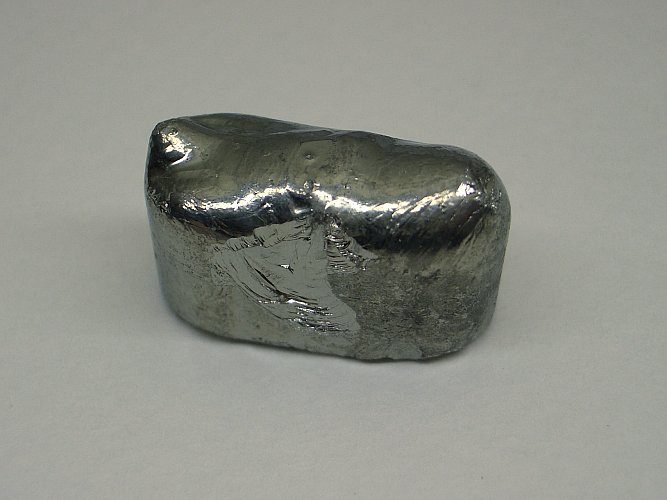
In 1871 Dmitri Mendeleev described an element nobody had found, in the gap below silicon. He called it eka-silicon and predicted a grey solid with an atomic weight of about 72 and a density of about 5.5 g/cm³. Clemens Winkler found germanium in 1886: grey, atomic weight 72.6, density 5.3 g/cm³. It matched.
Photo: W. Oelen, CC BY-SA 3.0, via Wikimedia Commons
Try 5 questions
Quick questions on groups and periods, marked as you go. Each one explains the answer.
Question 1 of 5
When did Mendeleev publish his periodic table?
Choose an answer. Each question explains itself.
The homework sheet
About twenty minutes. Everything on it is in the notes above; the answers are on the last page.
Free homework sheet
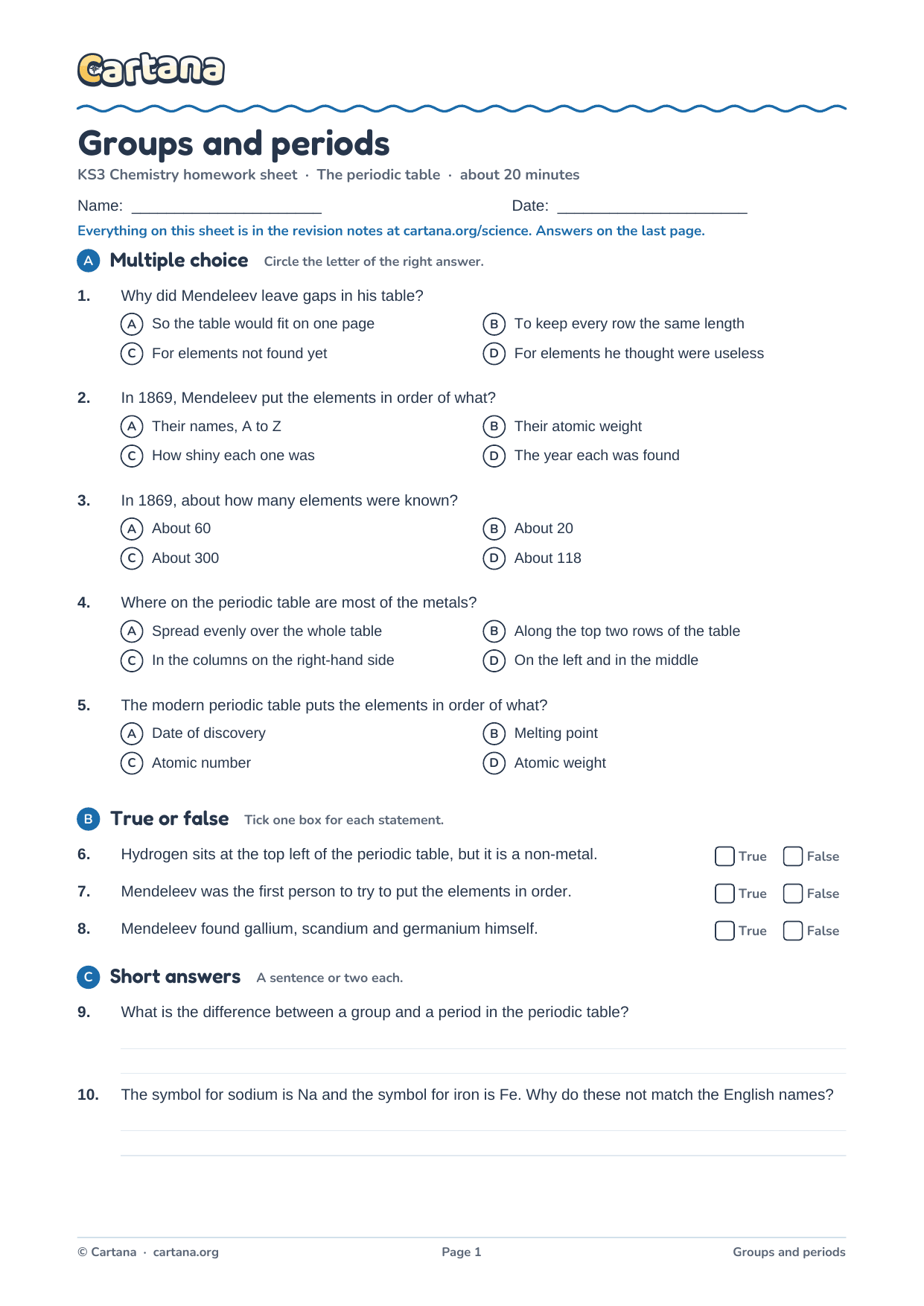
Groups and periods homework sheet
17 questions, about twenty minutes, with the answers on the last page: multiple choice, true or false, short answers, key words to define and one to explain in full.
KS3 The periodic table
Revised the whole unit?
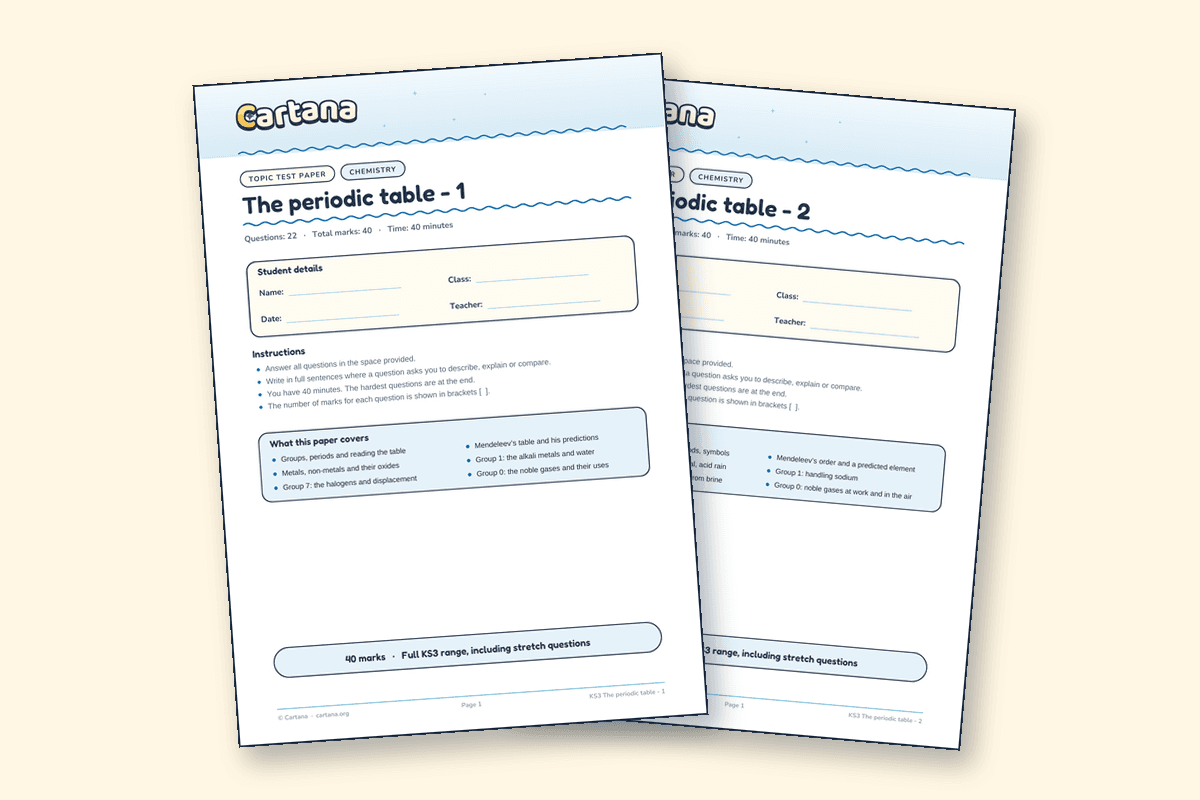
When every topic in the periodic table is done, two different papers test the whole unit, each with its own mark scheme.


 Watch the trailer · 1:06
New from Cartana · Beta test 1–31 December
Revision that feels like an adventure
Cartana is our KS3 learning adventure: sail between islands, answer quick-fire questions and battle bosses. It starts with science, with maths on the way, and launches in 2027. This December a small group of testers gets to play it first.
In the Cartana adventure, groups and periods is the Card Room, a district of the island Periodica.
- Play the game before its official release
- Help us build it with your feedback
- Earn exclusive in-game items in return
More in this unit