
KS3 Chemistry · Atoms, elements & compounds
Elements, compounds and mixtures
- Reading particle diagrams with a key
- Two questions that sort elements, compounds and mixtures
- Molecules of elements and of compounds
- Iron and sulfur: a mixture, then a compound
- 4 min read
- 5 quick questions
- Free homework sheet
- Years 7 to 9
Revision notes
Particle diagrams show whether a substance is an element, a compound or a mixture. An element has one kind of atom, a compound has different atoms joined together, and a mixture has different substances that are not joined.
How do you tell elements, compounds and mixtures apart?
In a particle diagram each ball is an atom, and the key tells you which element it is. Atoms drawn touching are joined together. Ask two questions, in this order:
- Are all the particles the same? If there are two or more different kinds of particle, it is a mixture.
- If they are all the same, what is in one particle? If every atom is the same kind, it is an element. If one particle has atoms of two or more different elements joined together, it is a compound.
A substance with only one kind of particle, an element or a compound, is called a pure substance.
What is a molecule?
A molecule is two or more atoms chemically joined together. A molecule can belong to an element, such as oxygen (O2) or nitrogen (N2), or to a compound, such as water (H2O) or carbon dioxide (CO2). So seeing molecules in a diagram does not tell you whether it is an element or a compound: look at the kinds of atom in one molecule.
Not every substance is made of separate molecules. In metals, and in compounds such as sodium chloride, the atoms are packed together in huge regular structures, so their diagrams show rows of touching atoms.
How is a mixture different from a compound?
In a mixture, the substances are mingled together but not chemically joined. Air is a mixture: mostly nitrogen and oxygen molecules, about 78% and 21%, with a little argon and carbon dioxide. Sea water is a mixture of water with salts dissolved in it.
| Mixture | Compound | |
|---|---|---|
| Joined? | No: the substances are just mixed | Yes: the atoms are chemically joined |
| Amounts | Any amounts | Always a fixed ratio |
| Properties | Each substance keeps its own | New properties of its own |
| Separating | By physical means: a magnet, filtering, distilling | Only by a chemical reaction |
| Making it | Just mix them: nothing new is made | A chemical reaction, often giving out heat |
What happens when iron and sulfur are mixed, then heated?
Stir iron filings and sulfur powder together and you have a mixture. You can use any amounts, you can still see yellow and grey bits, and a magnet pulls the iron straight out.
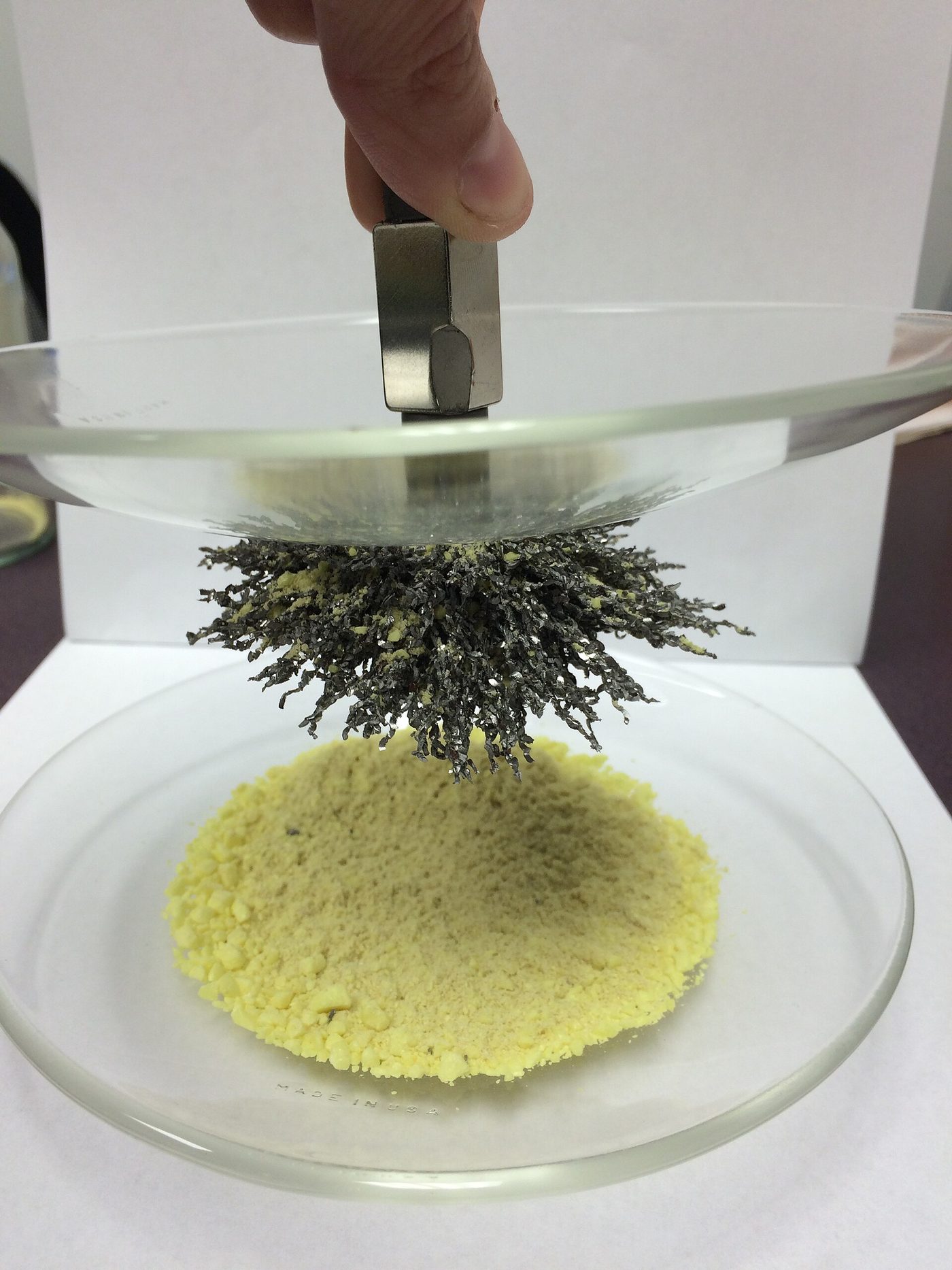
Heat the mixture and the two elements react to make a compound, iron sulfide (the compounds page describes the experiment). Now the iron and sulfur atoms are joined, one iron atom to each sulfur atom, so its formula is FeS. The product is a dark grey or black solid and a magnet does not pick it up.
If there is more iron than the one-to-one ratio needs, the extra iron does not join in. It is left over, mixed with the iron sulfide, and a magnet can still find it.
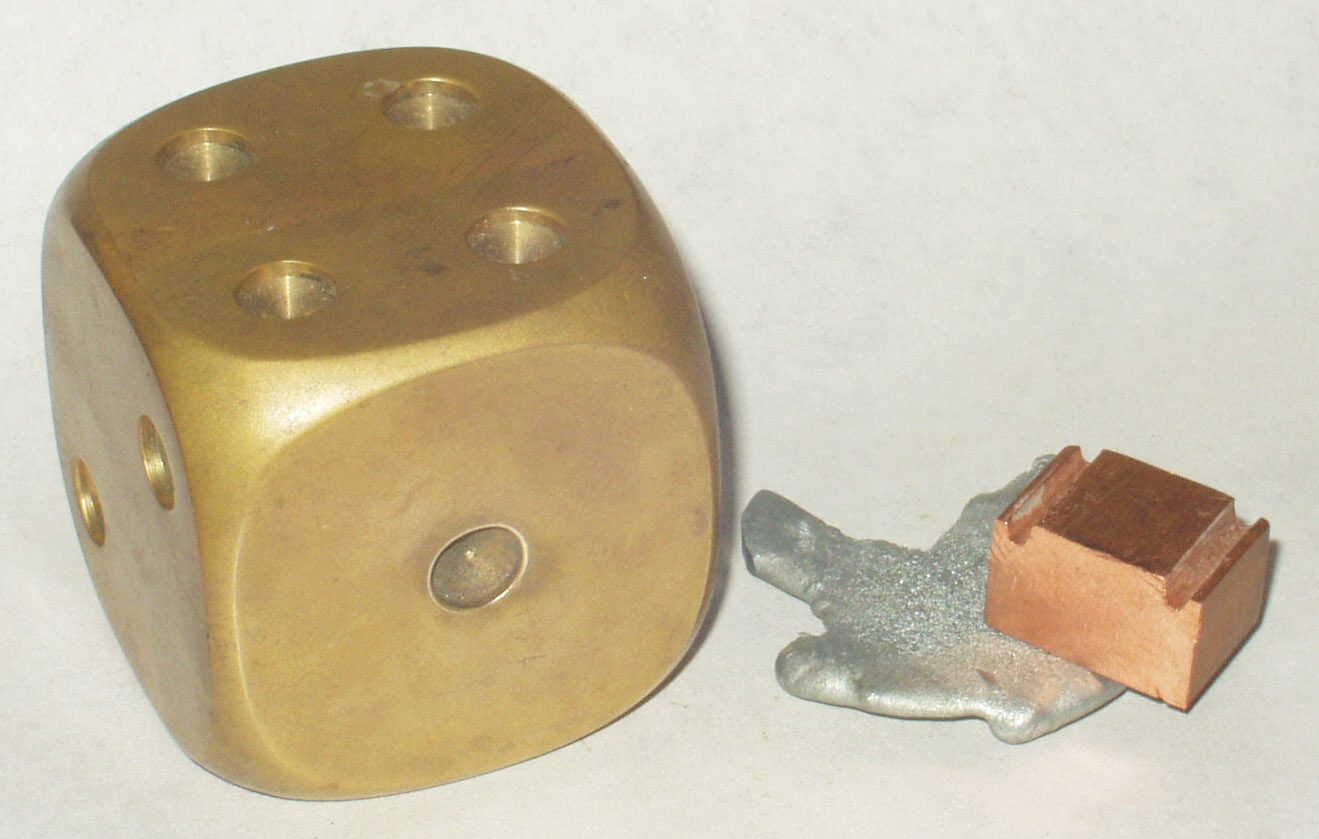
Stretch An alloy is a mixture of a metal with other elements, melted together. Brass is copper mixed with zinc, and steel is iron with a little carbon. Because an alloy is a mixture, not a compound, its make-up can change: brass can have more or less zinc in it, and changing the amounts changes its colour and how hard it is.
Written to the KS3 national curriculum. Last changed 13 November 2026.
Key words
Say them, spell them, use them in an answer.
- element
- compound
- mixture
- molecule
- particle diagram
- key
- pure substance
- iron sulfide
- alloy
Common misconception
Often said“Oxygen gas is made of molecules, so it must be a compound.”
In factA molecule is just two or more atoms joined. In an oxygen molecule both atoms are oxygen, so oxygen is an element. A compound needs atoms of different elements joined together, as in water or carbon dioxide.
Did you know?
Fool's gold
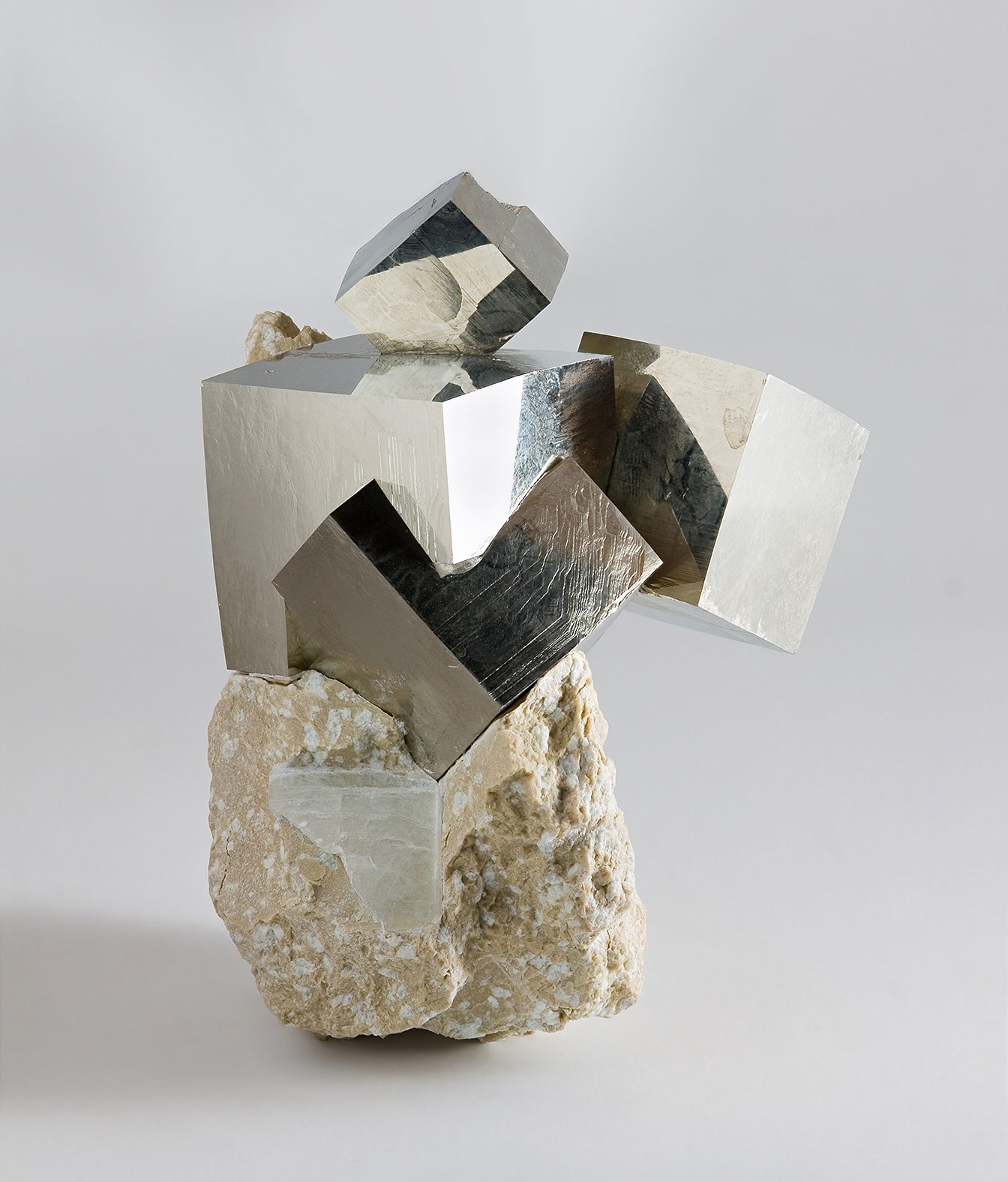
Pyrite forms shiny, brassy cubes that fooled many gold hunters, so it is called fool's gold. Gold is an element, but pyrite is a compound of iron and sulfur, FeS₂: the same two elements as iron sulfide, joined in a different fixed ratio.
Photo: JJ Harrison, CC BY-SA 3.0, via Wikimedia Commons
Try 5 questions
Quick questions on elements, compounds and mixtures, marked as you go. Each one explains the answer.
Question 1 of 5
A diagram with two different kinds of molecule shows a mixture.
Choose an answer. Each question explains itself.
The homework sheet
About twenty minutes. Everything on it is in the notes above; the answers are on the last page.
Free homework sheet
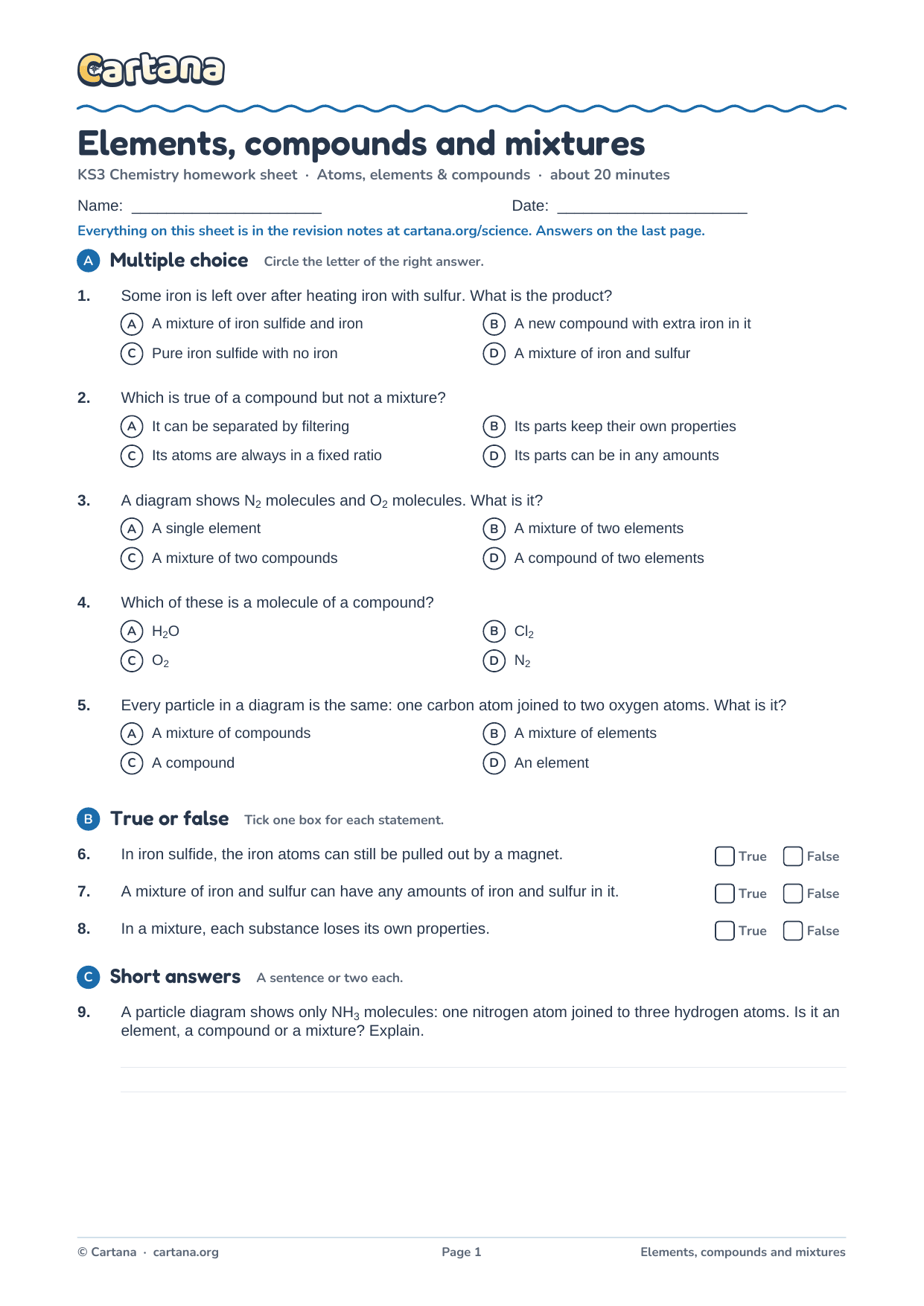
Elements, compounds and mixtures homework sheet
17 questions, about twenty minutes, with the answers on the last page: multiple choice, true or false, short answers, key words to define and one to explain in full.
KS3 Atoms, elements & compounds
Revised the whole unit?
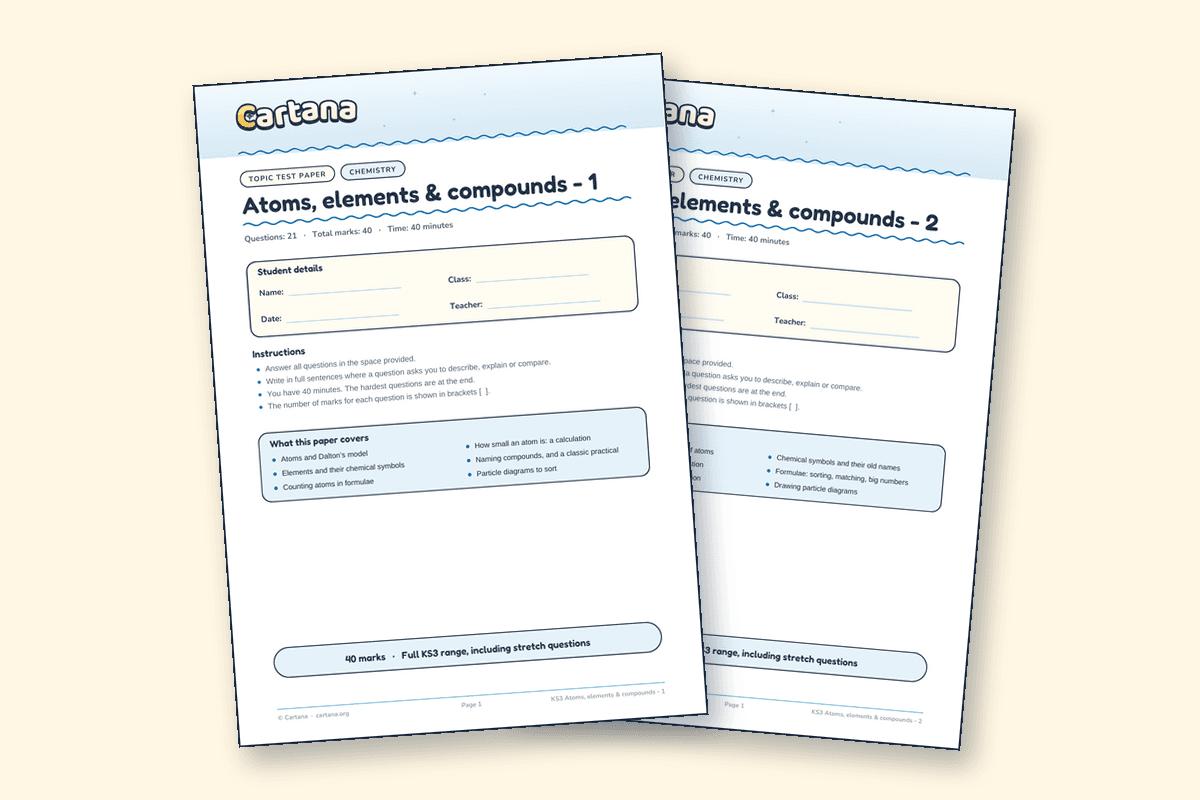
When every topic in atoms, elements & compounds is done, two different papers test the whole unit, each with its own mark scheme.


 Watch the trailer · 1:06
New from Cartana · Beta test 1–31 December
Revision that feels like an adventure
Cartana is our KS3 learning adventure: sail between islands, answer quick-fire questions and battle bosses. It starts with science, with maths on the way, and launches in 2027. This December a small group of testers gets to play it first.
In the Cartana adventure, every science unit is an island to explore. The island for atoms, elements & compounds is being built.
- Play the game before its official release
- Help us build it with your feedback
- Earn exclusive in-game items in return
More in this unit