
KS3 Chemistry · Atoms, elements & compounds
Atoms
- Everything is made of atoms, just over a hundred kinds
- Dalton's model: tiny solid spheres, one kind for each element
- How small an atom is, with a worked example
- Why it is a model, and what it leaves out
- 5 min read
- 5 quick questions
- Free homework sheet
- Years 7 to 9
Revision notes
An atom is the smallest particle of an element. Everything around you is made of atoms. In Dalton's simple model, each atom is a tiny solid sphere.
What is an atom?
Everything is made of tiny particles called atoms: the air, the sea, your desk and you. Atoms are far too small to see, even with the best light microscope, but they are the building blocks of all matter.
There are just over a hundred different kinds of atom, one kind for each element. Every substance is made from these: atoms on their own, atoms joined together, or different substances mixed.
Heating a substance does not change its atoms: they move faster and spread further apart, but each atom stays the same size. Solids, liquids and gases explains how the particles move.
What was Dalton's atomic model?
About 2,400 years ago the Greek thinker Democritus suggested that matter is made of tiny pieces that cannot be cut. He called them atomos, "uncuttable". It was only an idea, with no experiments behind it.
In 1808 John Dalton, a teacher in Manchester, used the results of real experiments to set out an atomic theory. Dalton's model says:
- All matter is made of atoms: tiny solid spheres that cannot be split, made or destroyed.
- All the atoms of one element are the same, with the same mass.
- Atoms of different elements are different, with different masses and sizes.
- Atoms join together in fixed whole numbers to make compounds.
- In a chemical reaction the atoms are rearranged. None are made and none are lost, which is why the total mass stays the same.
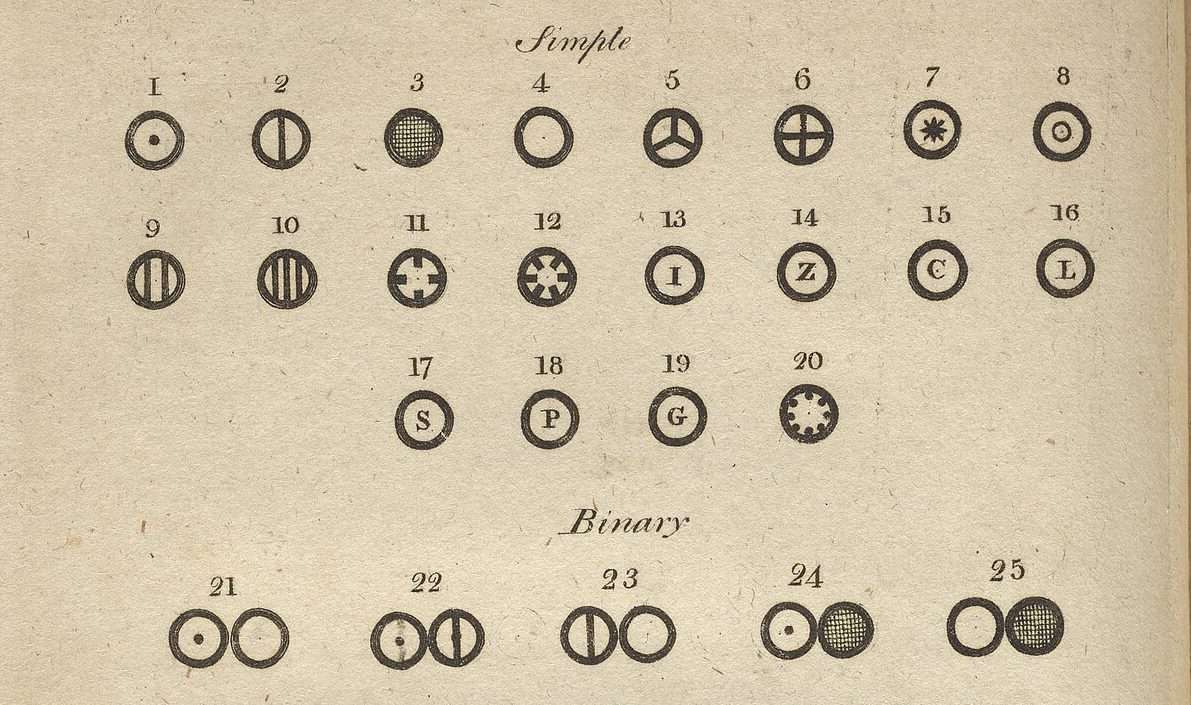
Dalton drew each kind of atom as a circle with its own mark, and worked out how heavy each kind was compared with a hydrogen atom.
How small is an atom?
A typical atom is about 0.1 to 0.5 nanometres (nm) across. A nanometre is a millionth of a millimetre, so an atom is roughly 0.000 000 1 to 0.000 000 5 mm wide. The width of a human hair is up to a million atoms side by side.
A copper atom is about 0.25 nm across. How many copper atoms, side by side, would make a row 1 mm long?
1 mm = 1,000,000 nm
number of atoms = 1,000,000 nm ÷ 0.25 nm = 4,000,000
Four million atoms make a row just 1 mm long.
A light microscope cannot show anything much smaller than a bacterium. Since the 1980s, special microscopes such as the scanning tunnelling microscope have made pictures of single atoms, and can even push them around one at a time.
Why is Dalton's idea called a model?
A scientific model is a simple picture of something we cannot see directly. A good model explains what we observe and lets us make predictions. Like any model, Dalton's leaves things out.
Why an element cannot be broken down, why a compound always has the same make-up, why mass does not change in a reaction, and how solids, liquids and gases differ.
Real atoms are not solid balls, and they can be split into smaller particles. The model does not explain why atoms join together, or why some elements react more than others.
When new evidence turns up, scientists improve the model. Dalton's is still the best place to start, and later models build on it.
Stretch Atoms can be split after all. In 1897 J. J. Thomson found the electron, a tiny particle with a negative charge that comes from inside atoms. In 1911 Ernest Rutherford showed that almost all an atom's mass is in a tiny centre, the nucleus, and later work showed the nucleus is made of protons and neutrons, with electrons moving around it. The number of protons is what makes an element: every carbon atom has 6, which is carbon's atomic number on the periodic table.
Written to the KS3 national curriculum. Last changed 13 November 2026.
Key words
Say them, spell them, use them in an answer.
- atom
- element
- Dalton's model
- solid sphere
- mass
- nanometre
- scientific model
- evidence
Common misconception
Often said“Copper atoms are orange and shiny, just like copper.”
In factColour, shine, hardness and melting are properties of huge numbers of atoms together, not of one atom. A single atom has no colour, and atoms do not melt or get bigger when they are heated: they move about faster and spread further apart.
Did you know?
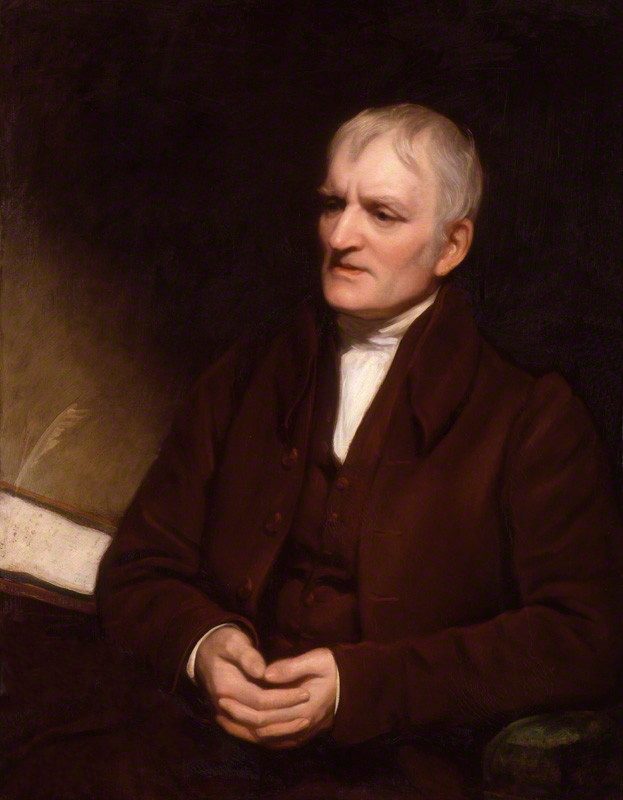
Dalton's eyes
John Dalton was colour-blind, and in 1794 he wrote one of the first scientific accounts of it, so red-green colour blindness is still sometimes called Daltonism. He asked for his eyes to be examined after his death, and they were kept. In 1995 scientists tested DNA from them and found he lacked the gene for the eye's green-sensitive pigment.
Photo: Thomas Phillips, Public domain, via Wikimedia Commons
Try 5 questions
Quick questions on atoms, marked as you go. Each one explains the answer.
Question 1 of 5
Roughly how wide is a typical atom?
Choose an answer. Each question explains itself.
The homework sheet
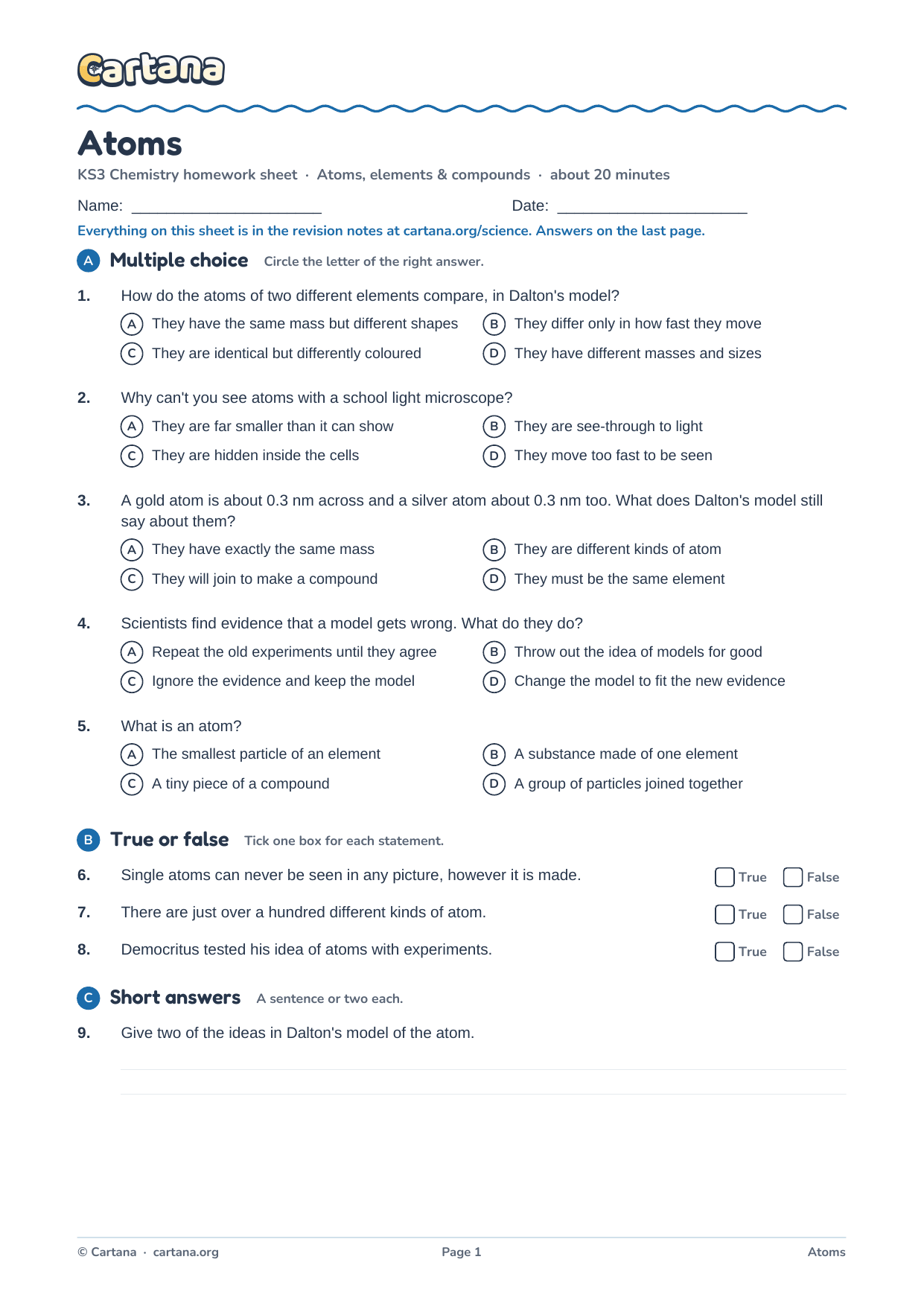
About twenty minutes. Everything on it is in the notes above; the answers are on the last page.
Free homework sheet
Atoms homework sheet
17 questions, about twenty minutes, with the answers on the last page: multiple choice, true or false, short answers, key words to define and one to explain in full.
KS3 Atoms, elements & compounds
Revised the whole unit?
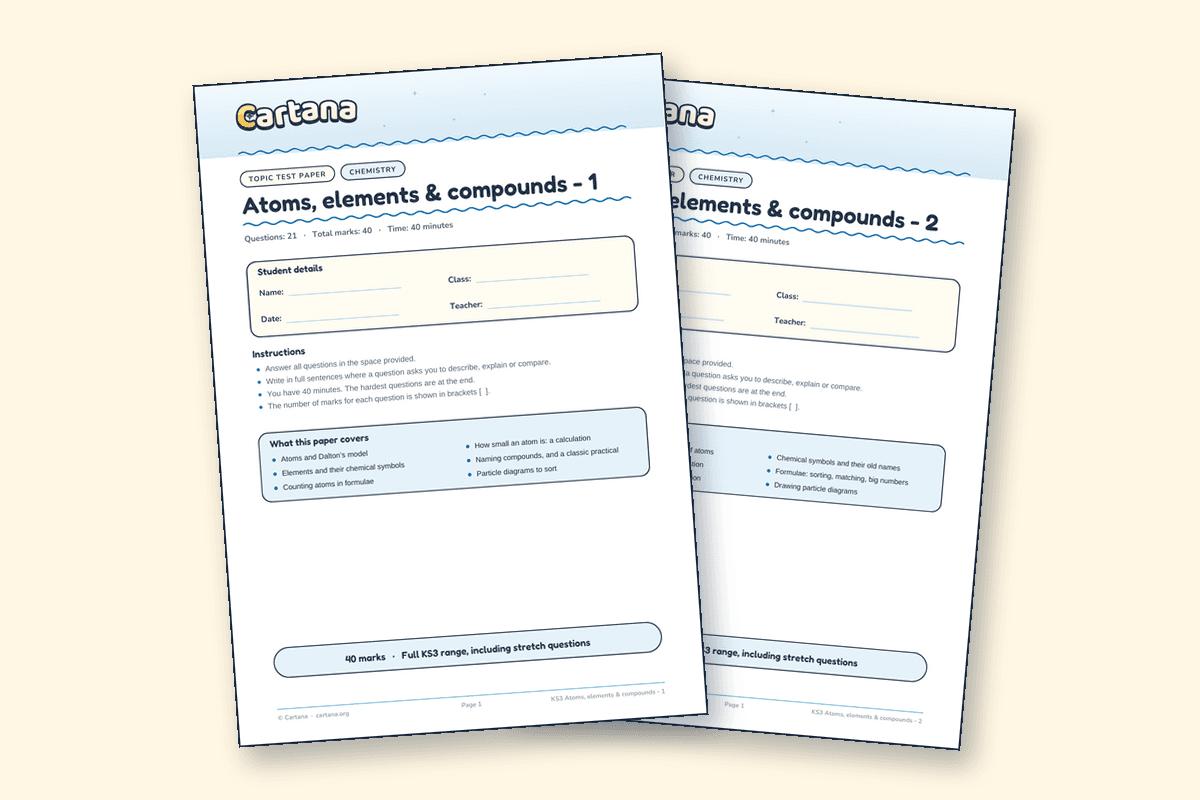
When every topic in atoms, elements & compounds is done, two different papers test the whole unit, each with its own mark scheme.


 Watch the trailer · 1:06
New from Cartana · Beta test 1–31 December
Revision that feels like an adventure
Cartana is our KS3 learning adventure: sail between islands, answer quick-fire questions and battle bosses. It starts with science, with maths on the way, and launches in 2027. This December a small group of testers gets to play it first.
In the Cartana adventure, every science unit is an island to explore. The island for atoms, elements & compounds is being built.
- Play the game before its official release
- Help us build it with your feedback
- Earn exclusive in-game items in return
More in this unit