
KS3 Physics · Space
Day, night and the seasons
- Day and night: the Earth spins on its axis once every 24 hours
- The 23.4° tilt of the axis, and why the hemispheres have opposite seasons
- Why summer is warmer: a higher Sun and longer days, with a torch demonstration
- How day length changes through the year in London, Sydney and at the equator
- 5 min read
- 5 quick questions
- Free homework sheet
- Years 7 to 9
Revision notes
Day and night happen because the Earth spins on its axis once every 24 hours. The seasons happen because that axis is tilted: as the Earth orbits the Sun each year, each half of the Earth leans towards the Sun for part of the year and away from it for the rest.
Why do we have day and night?
The Earth spins on its axis, an imaginary line through the North and South Poles. One spin takes 24 hours: one day. At any moment the half of the Earth facing the Sun has daytime, and the half facing away has night.
The Earth spins from west to east, so the Sun seems to rise in the east, climb across the southern sky (seen from the UK) and set in the west. The Sun is not moving round us: we are turning.
What is the Earth’s tilt?
The Earth orbits the Sun once every 365¼ days: one year. Every four years the quarter-days add up to the extra day of a leap year. The Earth’s axis is not upright: it is tilted at 23.4°. It always points the same way in space, towards the Pole Star. The equator is the imaginary line round the middle of the Earth, halfway between the poles. The northern hemisphere is the half north of it, where the UK is; the southern hemisphere is the half south of it, where Australia is.
- June: the northern hemisphere leans towards the Sun. It is summer in the UK and winter in Australia.
- December: the northern hemisphere leans away from the Sun. It is winter in the UK and summer in Australia.
- March and September: neither hemisphere leans towards the Sun, so day and night are about 12 hours each everywhere. These dates are the equinoxes.
The two hemispheres always have opposite seasons.
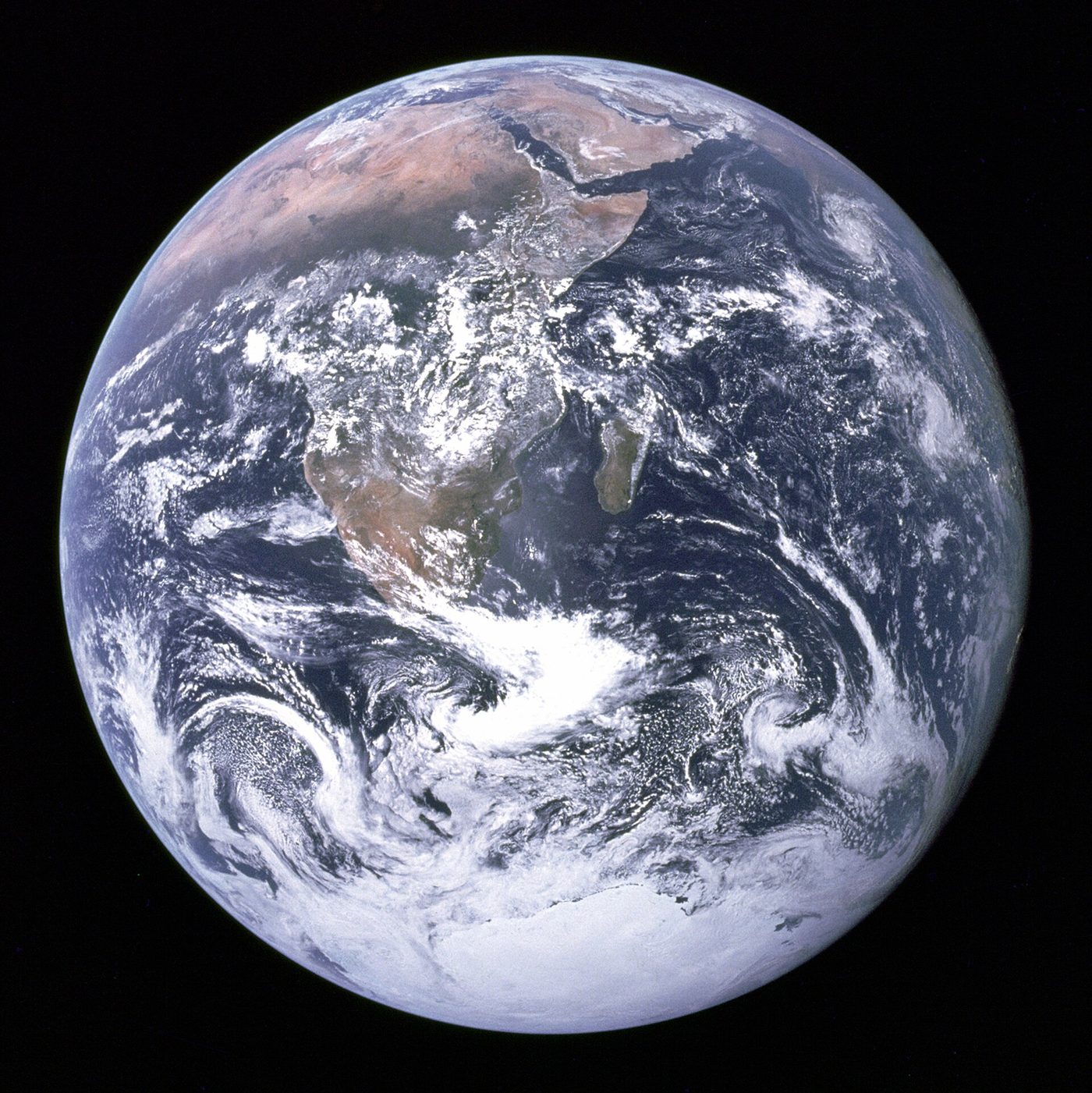
Why is summer warmer than winter?
Two reasons, both caused by the tilt:
- The Sun climbs higher in the sky. In London the midday Sun is about 62° above the horizon in late June but only about 15° in late December. High sunlight strikes the ground more directly, so its energy is concentrated on a smaller area and heats it more. Low winter sunlight is spread over a bigger area. It also makes long shadows: your midday shadow is much longer in winter than in summer.
- The days are longer. More hours of daylight mean more hours of heating and fewer hours of cooling at night.
A demonstration with a torch:
- Shine a torch straight down onto squared paper and draw round the bright patch.
- Tilt the torch so the light hits the paper at a low angle, keeping it the same distance away. Draw round the patch again.
- The second patch covers more squares and looks dimmer: the same light is spread over a bigger area, so each square gets less. That is low winter sunlight.
It is not about distance from the Sun. The Earth is actually closest to the Sun in early January, in the middle of the northern winter.
How does day length change through the year?
As the Earth spins, a place in the hemisphere leaning towards the Sun spends more than half of each turn on the sunlit side, so its days are longer than its nights.
| Place | Daylight in late June | Daylight in late December |
|---|---|---|
| London | About 16½ hours | Under 8 hours |
| Sydney | About 10 hours | About 14½ hours |
| The equator | About 12 hours | About 12 hours |
| The North Pole | 24 hours | None: dark all day |
A place as far south of the equator as London is north has London’s year the other way round: its longest days come in December, and in June it gets under 8 hours of daylight.
The longest day of the year is the summer solstice, about 21 June in the northern hemisphere; the shortest is the winter solstice, about 21 December. Near the equator the Sun is high all year and day length hardly changes, so summer and winter are much alike.
Stretch At an equinox, the midday Sun’s height above the horizon is 90° minus your latitude. London is at about 51.5° north, so the Sun reaches 90° − 51.5° = 38.5°. At the June solstice add the tilt: 38.5° + 23.4° ≈ 62°. In December take it away: 38.5° − 23.4° ≈ 15°.
Written to the KS3 national curriculum. Last changed 14 November 2026.
Key words
Say them, spell them, use them in an answer.
- axis
- day
- year
- tilt
- equator
- northern hemisphere
- southern hemisphere
- season
- equinox
- solstice
Common misconception
Often said“It is summer when the Earth is closer to the Sun.”
In factThe Earth is actually closest to the Sun in early January, in the middle of the UK’s winter, and its distance changes by only about 3% in a year. The seasons come from the 23.4° tilt of the Earth’s axis. If distance caused them, both hemispheres would have summer at the same time, but their seasons are opposite.
Did you know?
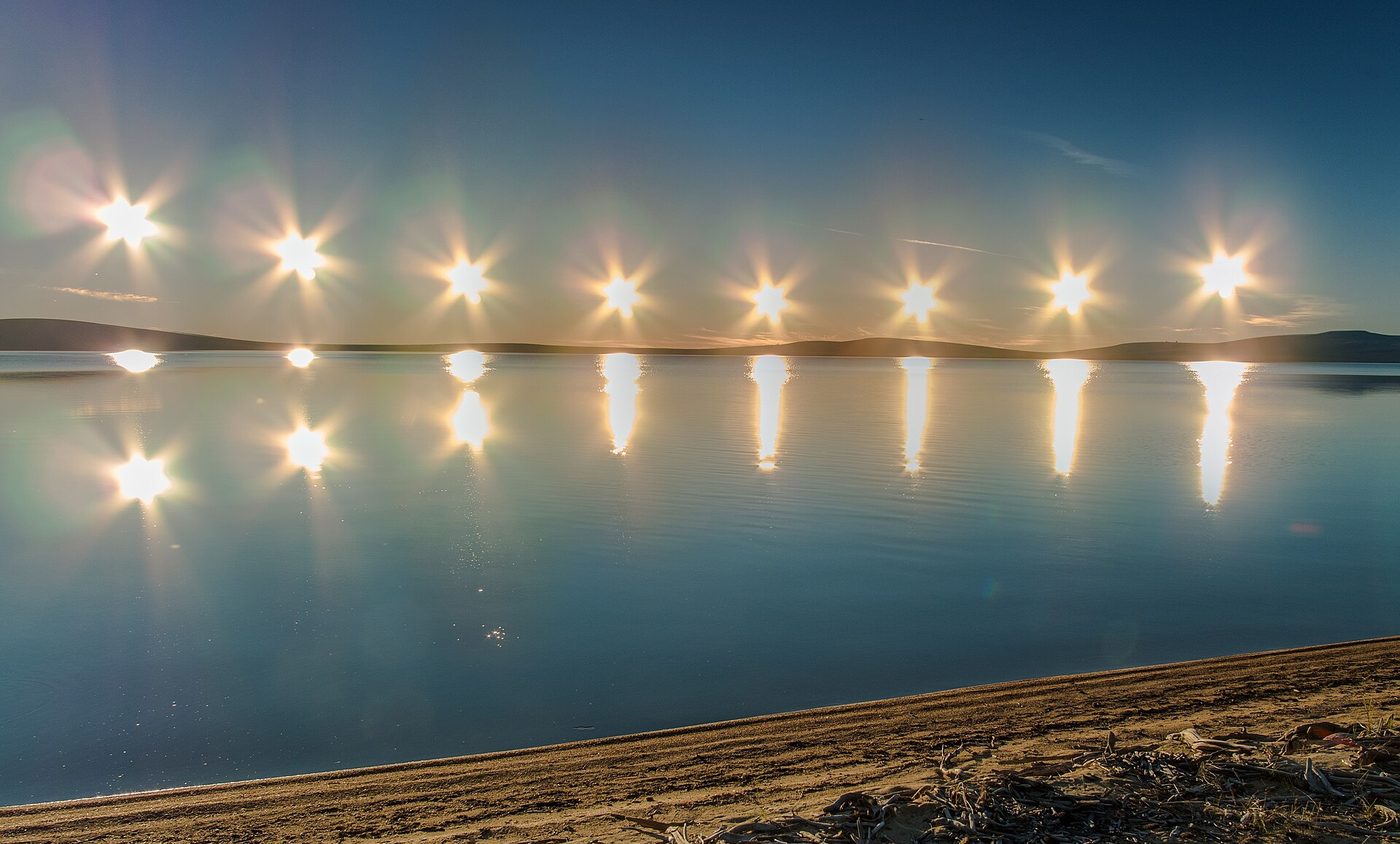
The midnight sun
North of the Arctic Circle the Sun does not set at all for at least one day around midsummer. At the North Pole it stays up for about six months, then stays down for about six months.
Photo: Viktor Gabyshev, CC BY-SA 4.0, via Wikimedia Commons
Try 5 questions
Quick questions on day, night and the seasons, marked as you go. Each one explains the answer.
Question 1 of 5
By how much is the Earth’s axis tilted?
Choose an answer. Each question explains itself.
The homework sheet
About twenty minutes. Everything on it is in the notes above; the answers are on the last page.
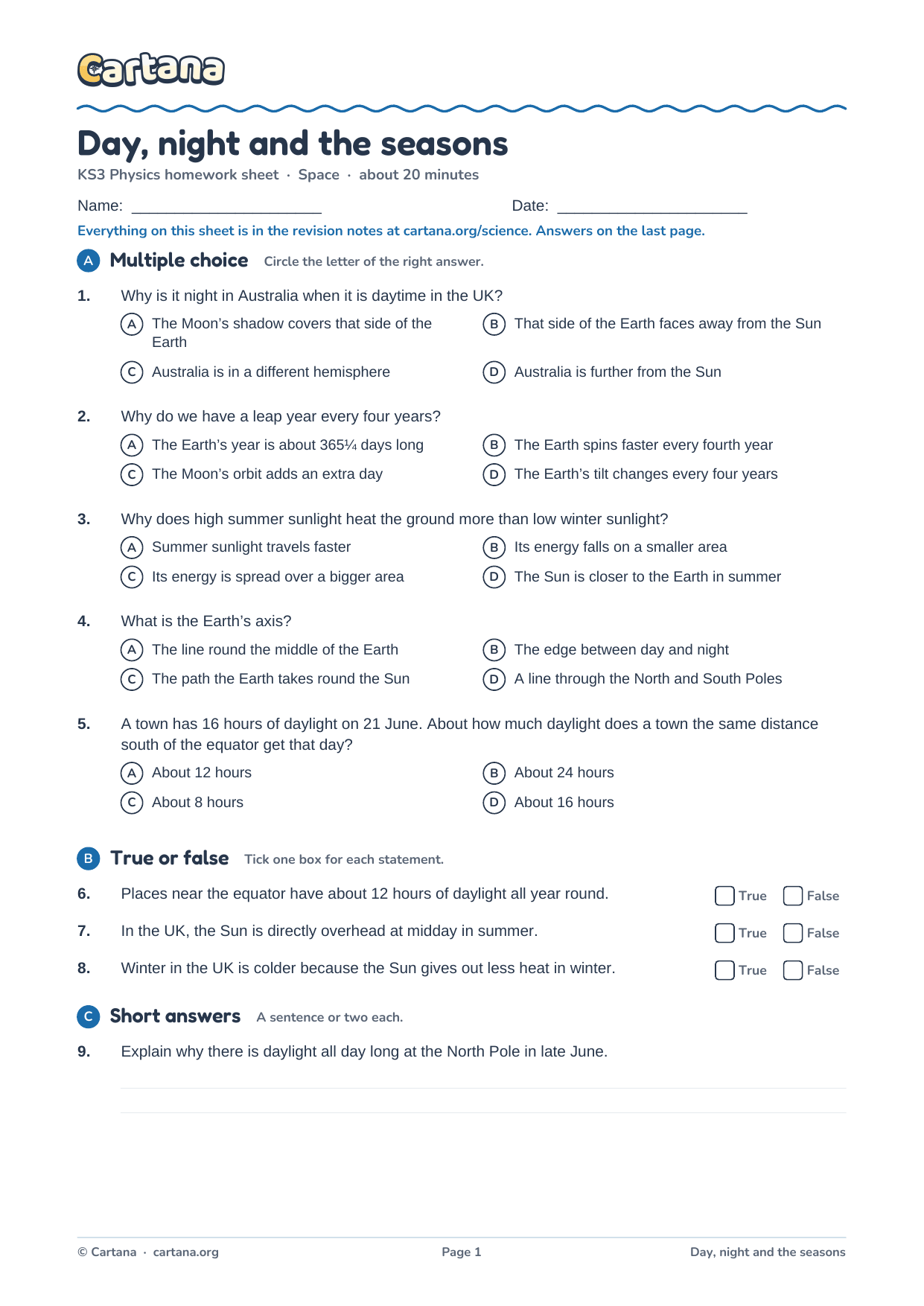
Free homework sheet
Day, night and the seasons homework sheet
17 questions, about twenty minutes, with the answers on the last page: multiple choice, true or false, short answers, key words to define and one to explain in full.
KS3 Space
Revised the whole unit?
When every topic in space is done, two different papers test the whole unit, each with its own mark scheme.


 Watch the trailer · 1:06
New from Cartana · Beta test 1–31 December
Revision that feels like an adventure
Cartana is our KS3 learning adventure: sail between islands, answer quick-fire questions and battle bosses. It starts with science, with maths on the way, and launches in 2027. This December a small group of testers gets to play it first.
In the Cartana adventure, every science unit is an island to explore. The island for space is being built.
- Play the game before its official release
- Help us build it with your feedback
- Earn exclusive in-game items in return
More in this unit
Space
- 1The Solar SystemThe Sun, the eight planets in order, moons, dwarf planets, asteroids and comets, rocky planets and gas giants, orbits and the scale of the Solar System
- 3The MoonNextThe Moon’s orbit, why we see one face, the phases of the Moon, solar and lunar eclipses, and the tides
- 4Gravity in spaceGravity between any two masses, how gravity keeps moons and planets in orbit, the Earth and Moon and the Earth and Sun, g on other planets, and weight calculations
- 5Stars and galaxiesThe Sun as a star, other stars, the Milky Way and other galaxies, the light year as a distance, and why looking out is looking back in time