
KS3 Physics · Space
Gravity in space
- Gravity between any two masses: what makes it stronger or weaker
- How gravity and speed together keep the Moon and planets in orbit
- Gravitational field strength on the Moon, the planets and the Sun
- Working out weight on other planets with weight = mass × g
- 5 min read
- 5 quick questions
- Free homework sheet
- Years 7 to 9
Revision notes
Gravity is a force of attraction between any two objects that have mass. In space it holds the Moon in orbit round the Earth and the planets in orbit round the Sun, and it is why your weight would be different on every planet.
This page builds on gravity, mass and weight, where mass, weight and weight = mass × g are first explained.
What decides how strong gravity is?
Every object with mass pulls on every other object. The pull is stronger when:
- the masses are bigger: the Sun, with 333,000 times the Earth’s mass, pulls far harder than any planet
- the objects are closer together: the pull gets weaker with distance
Gravity acts across empty space: it needs no air and no contact. Two people pull on each other, but far too weakly to notice. The Earth’s gravity gets weaker the further you go from it, but it never stops completely. At the height of the International Space Station, about 400 km up, it is still about 90% as strong as on the ground. Astronauts float there because they and the station are falling round the Earth together, not because gravity has gone.
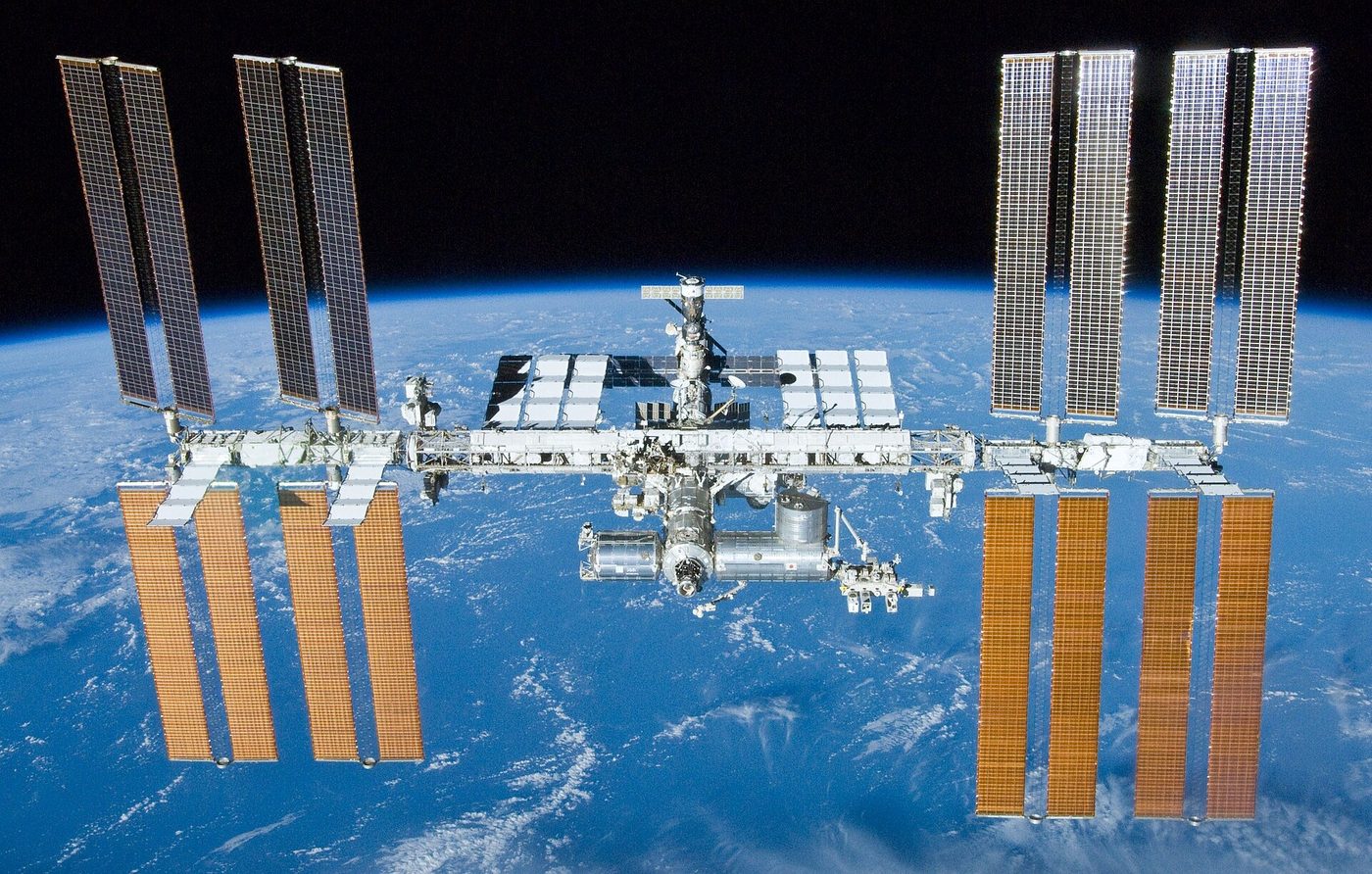
How does gravity keep the Moon and planets in orbit?
The Earth’s gravity pulls the Moon towards the centre of the Earth. At the same time the Moon is moving fast, about 1 km every second, sideways. With no gravity it would carry on in a straight line out into space; with no speed it would fall straight towards the Earth. Together the pull and the speed bend its path into a curve that goes round and round the Earth: an orbit.
Isaac Newton pictured a cannon on a very tall mountain, firing sideways:
The pull works both ways. The Earth pulls the Moon, and the Moon pulls the Earth with a force of the same size in the opposite direction: an interaction pair (see what is a force?). The Moon’s pull on the Earth’s oceans raises the tides. In the same way, the Sun’s gravity keeps the Earth and all the other planets in orbit round it, even Neptune, 4,500 million km away.
What is g on other planets?
Gravitational field strength, g, is the force of gravity on each kilogram of mass, in newtons per kilogram (N/kg). It is different on every planet, moon and star, depending on its mass and size. The table gives g at the surface and the weight of an astronaut of mass 60 kg.
| Place | Gravitational field strength | The astronaut’s weight |
|---|---|---|
| The Moon | 1.6 N/kg | 96 N |
| Mars | 3.7 N/kg | 222 N |
| Venus | 8.9 N/kg | 534 N |
| Earth | 10 N/kg | 600 N |
| Jupiter | 25 N/kg | 1,500 N |
| The Sun | 274 N/kg | 16,440 N |
Jupiter has no solid surface, so its value is at the top of its clouds. On Earth, g is 9.8 N/kg more exactly; 10 N/kg is used in calculations.
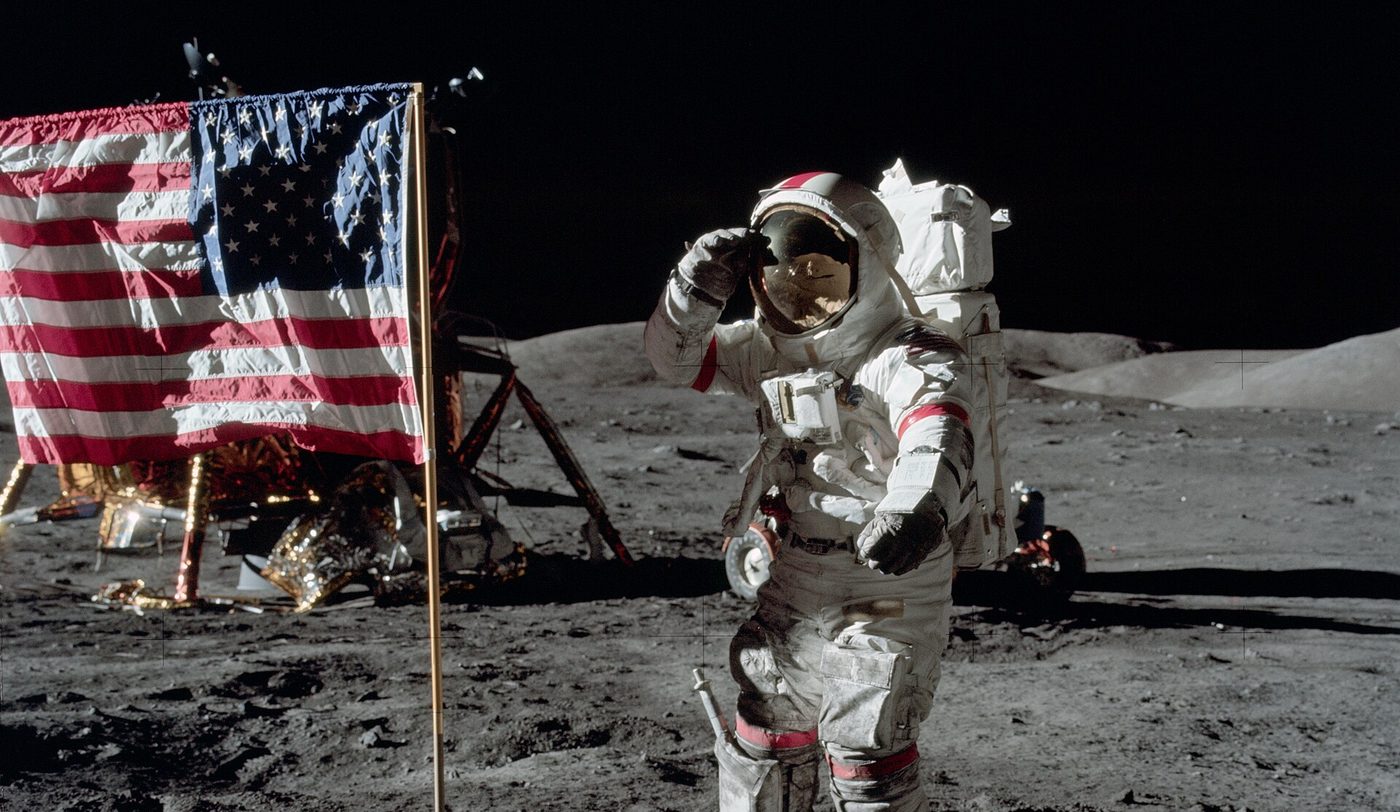
How do you work out your weight on another planet?
Weight in newtons (N), mass in kilograms (kg), gravitational field strength in newtons per kilogram (N/kg). Mass, the amount of matter in an object, stays the same wherever it goes. Weight, the force of gravity on it, changes from place to place.
A Mars rover has a mass of 900 kg. What is its weight on Mars, where g = 3.7 N/kg?
weight = mass × g
weight = 900 kg × 3.7 N/kg = 3,330 N
On Earth it weighs 900 × 10 = 9,000 N. Its mass is 900 kg in both places.
An astronaut weighs 128 N on the Moon (g = 1.6 N/kg). What is her mass, and what does she weigh on Earth?
mass = weight ÷ g = 128 N ÷ 1.6 N/kg = 80 kg
weight on Earth = 80 kg × 10 N/kg = 800 N
Stretch Saturn has 95 times the Earth’s mass, yet g at its cloud tops is about the same as on the Earth. Gravity depends on distance as well as mass, and Saturn is so wide that its cloud tops are about 9 times further from its centre than we are from the Earth’s. Double the distance from a planet’s centre and its pull falls to a quarter.
Written to the KS3 national curriculum. Last changed 14 November 2026.
Key words
Say them, spell them, use them in an answer.
- gravity
- mass
- weight
- orbit
- interaction pair
- gravitational field strength
- newtons per kilogram
Common misconception
Often said“There is no gravity in space. That is why astronauts float.”
In factGravity reaches out through space without end, getting weaker with distance: it holds the Moon round the Earth and the Earth round the Sun. On the International Space Station gravity is still about 90% as strong as on the ground. The astronauts float because they and the station are falling round the Earth together.
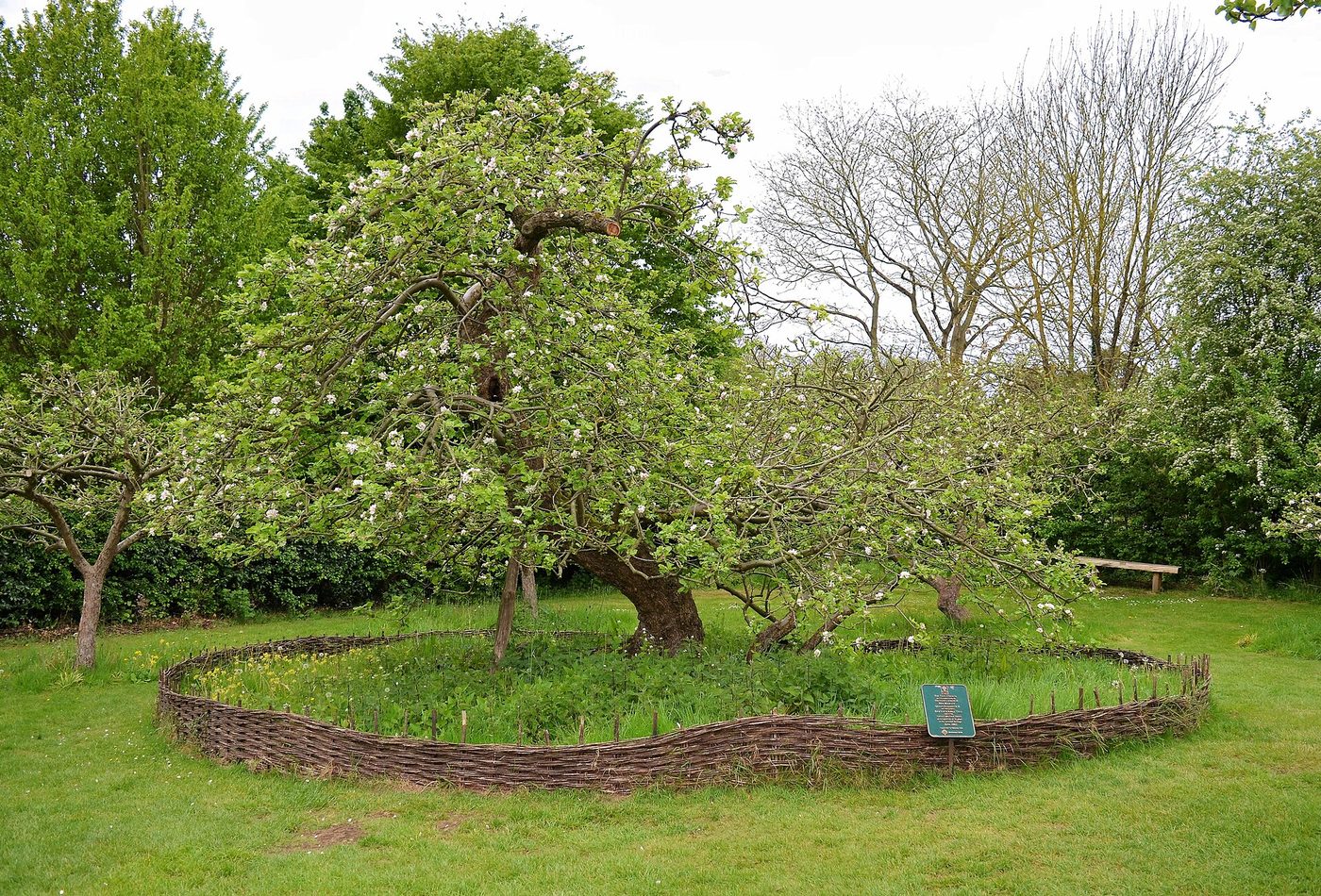
Did you know?
Newton’s apple tree
An apple tree at Woolsthorpe Manor in Lincolnshire, where Isaac Newton grew up, is said to be the one whose falling apple set him thinking about gravity in about 1666. It blew down in a storm in about 1816 but grew again from its roots, and it is still growing there.
Photo: It's No Game from Leicestershire, UK, CC BY 2.0, via Wikimedia Commons
Try 5 questions
Quick questions on gravity in space, marked as you go. Each one explains the answer.
Question 1 of 5
Gravitational field strength is the same on every planet.
Choose an answer. Each question explains itself.
The homework sheet
About twenty minutes. Everything on it is in the notes above; the answers are on the last page.
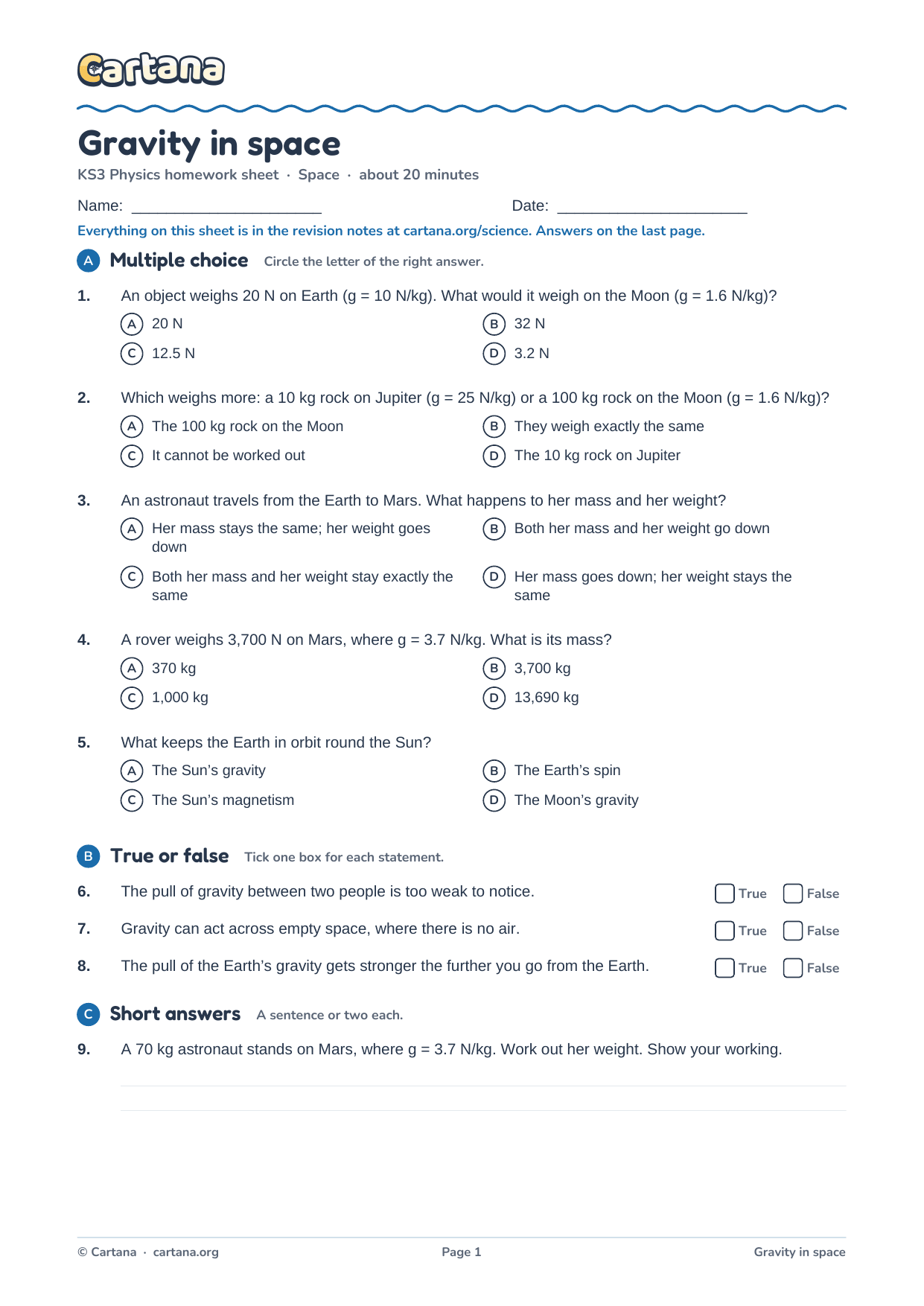
Free homework sheet
Gravity in space homework sheet
17 questions, about twenty minutes, with the answers on the last page: multiple choice, true or false, short answers, key words to define and one to explain in full.
KS3 Space
Revised the whole unit?
When every topic in space is done, two different papers test the whole unit, each with its own mark scheme.


 Watch the trailer · 1:06
New from Cartana · Beta test 1–31 December
Revision that feels like an adventure
Cartana is our KS3 learning adventure: sail between islands, answer quick-fire questions and battle bosses. It starts with science, with maths on the way, and launches in 2027. This December a small group of testers gets to play it first.
In the Cartana adventure, every science unit is an island to explore. The island for space is being built.
- Play the game before its official release
- Help us build it with your feedback
- Earn exclusive in-game items in return
More in this unit
Space
- 1The Solar SystemThe Sun, the eight planets in order, moons, dwarf planets, asteroids and comets, rocky planets and gas giants, orbits and the scale of the Solar System
- 2Day, night and the seasonsThe Earth’s spin and day and night, its orbit and the year, the tilt of the axis, why summer is warmer, the two hemispheres and day length
- 3The MoonThe Moon’s orbit, why we see one face, the phases of the Moon, solar and lunar eclipses, and the tides
- 5Stars and galaxiesNextThe Sun as a star, other stars, the Milky Way and other galaxies, the light year as a distance, and why looking out is looking back in time