
KS3 Physics · Space
The Solar System
- The Sun, the eight planets in order, moons, dwarf planets, asteroids and comets
- Rocky planets and gas giants compared, with a table of distances and years
- What an orbit is, and why comets grow tails that point away from the Sun
- How big the Solar System really is, in a scale drawing and a football model
- 5 min read
- 5 quick questions
- Free homework sheet
- Years 7 to 9
Revision notes
The Solar System is the Sun and everything that travels round it: eight planets and their moons, dwarf planets, asteroids and comets. The Sun’s gravity holds the whole family together.
What is in the Solar System?
- The Sun: a star at the centre, holding 99.8% of all the mass in the Solar System. It is the only body in the Solar System that shines by its own light.
- Eight planets: large, round bodies that orbit the Sun and have cleared their path of other objects.
- Moons: natural satellites, bodies that orbit a planet. The Earth has one; Mercury and Venus have none; Jupiter and Saturn each have more than 90.
- Dwarf planets: round bodies that orbit the Sun but are too small to have cleared their path. Pluto, a planet until 2006, is one; Ceres is another.
- Asteroids: lumps of rock and metal, most of them in the asteroid belt between Mars and Jupiter.
- Comets: lumps of ice and dust on long, stretched orbits.
The planets, moons, asteroids and comets give out no light of their own. We see them because they reflect sunlight.
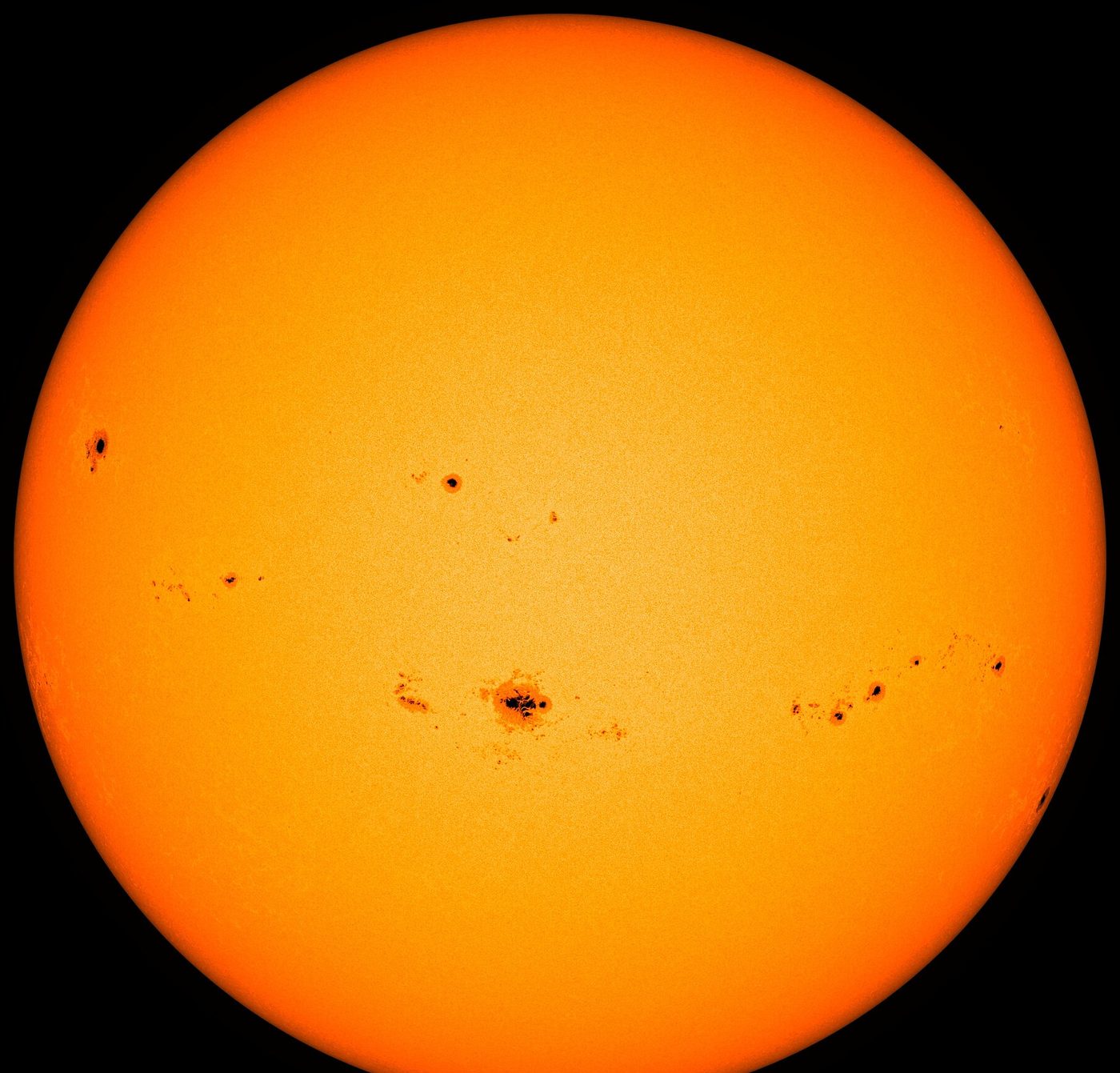
What order are the planets in?
Moving out from the Sun: Mercury, Venus, Earth, Mars, Jupiter, Saturn, Uranus, Neptune. A sentence can help you remember the order: My Very Easy Method Just Speeds Up Naming. The distances below are averages, in millions of kilometres.
| Planet | Type | Distance from the Sun | Time to orbit the Sun |
|---|---|---|---|
| Mercury | Rocky | 58 million km | 88 days |
| Venus | Rocky | 108 million km | 225 days |
| Earth | Rocky | 150 million km | 365 days |
| Mars | Rocky | 228 million km | 687 days |
| Jupiter | Gas giant | 780 million km | 12 years |
| Saturn | Gas giant | 1,430 million km | 29 years |
| Uranus | Gas giant | 2,870 million km | 84 years |
| Neptune | Gas giant | 4,500 million km | 165 years |
What is the difference between rocky planets and gas giants?
Mercury, Venus, Earth and Mars, the four nearest the Sun. Small, made of rock and metal, with a solid surface. Few or no moons, and no rings.
Jupiter, Saturn, Uranus and Neptune, the four furthest out. Huge, made mostly of gas and liquid, with no solid surface to stand on. Many moons, and rings round all four.
Jupiter, the largest planet, is about 11 times as wide as the Earth, which is 12,756 km across. Venus is the hottest planet, hotter even than Mercury, because its thick atmosphere of carbon dioxide traps the Sun’s heat.
What is an orbit?
An orbit is the curved path one object takes round another. The planets orbit the Sun in almost circular paths, all in the same direction and in nearly the same flat plane. The Sun’s gravity keeps them in orbit: more in gravity in space. A planet’s year is the time it takes to orbit the Sun once. The further out a planet is, the longer its path and the more slowly it moves, so the longer its year.
A comet’s orbit is a long, stretched loop. It spends most of its time far out in the cold, then swings in close to the Sun. There some of its ice turns to gas, and a fuzzy head and a tail of gas and dust stream out, always pointing away from the Sun. Halley’s Comet comes back about every 76 years.
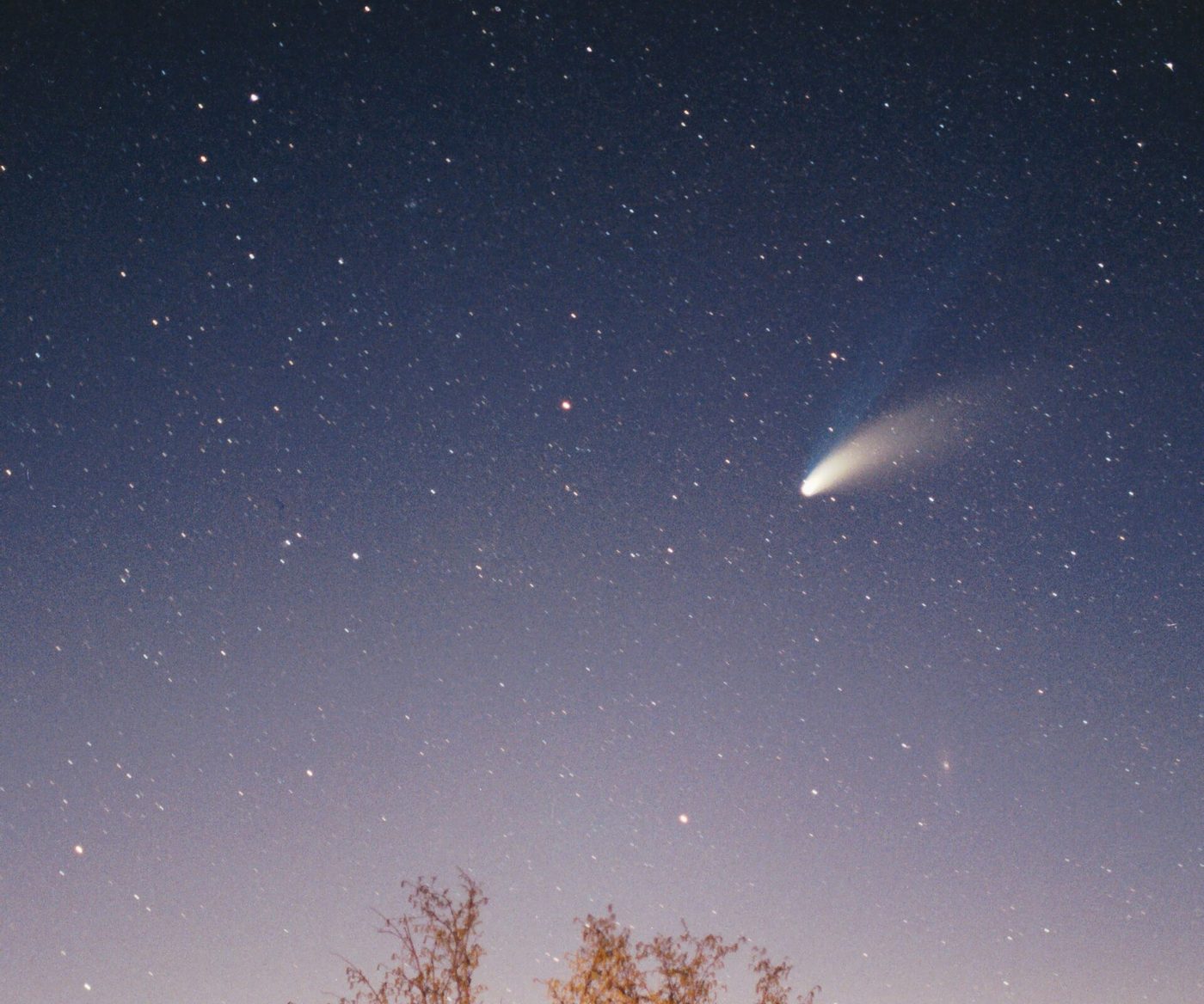
How big is the Solar System?
Far bigger than pictures suggest: a drawing that fits all eight planets on one page cannot show their sizes and the gaps between them to the same scale. Imagine the Sun as a football 22 cm across. On that scale the Earth is a peppercorn 2 mm across, 24 m away, and Neptune is a bead under 1 cm across, about 700 m away. Light, the fastest thing there is, takes about 8 minutes to reach the Earth from the Sun and about 4 hours to reach Neptune.
Stretch Astronomers often measure distances in the Solar System in astronomical units (AU). One AU is the Earth’s average distance from the Sun, about 150 million km. Jupiter is about 5.2 AU from the Sun and Neptune about 30 AU: 4,500 ÷ 150 = 30.
Written to the KS3 national curriculum. Last changed 14 November 2026.
Key words
Say them, spell them, use them in an answer.
- Solar System
- Sun
- planet
- moon
- dwarf planet
- asteroid
- asteroid belt
- comet
- orbit
- rocky planet
- gas giant
- year
Common misconception
Often said“The planets are quite close together, like in the pictures of the Solar System.”
In factPictures squash the gaps to fit everything on a page. The Earth is 12,756 km across but 150 million km from the Sun, and Neptune is 30 times further out still. If the Sun were a football, the Earth would be a peppercorn 24 m away.
Did you know?
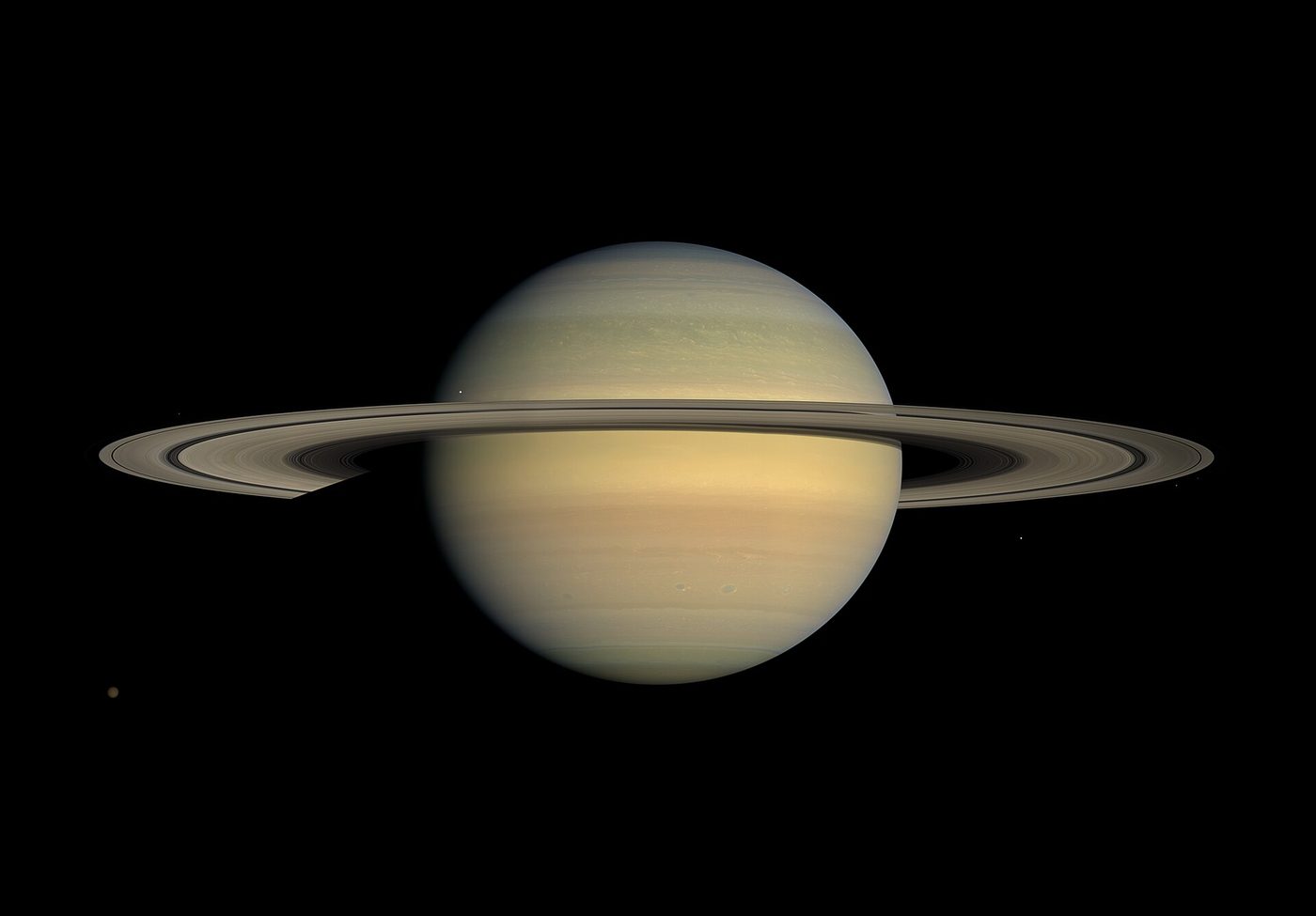
Saturn’s rings
Saturn’s main rings measure about 270,000 km from one edge to the other, more than 20 times the width of the Earth, yet in most places they are only about 10 metres thick. They are made of countless pieces of ice and rock.
Photo: NASA / JPL / Space Science Institute, Public domain, via Wikimedia Commons
Try 5 questions
Quick questions on the Solar System, marked as you go. Each one explains the answer.
Question 1 of 5
Saturn is the only planet with rings.
Choose an answer. Each question explains itself.
The homework sheet
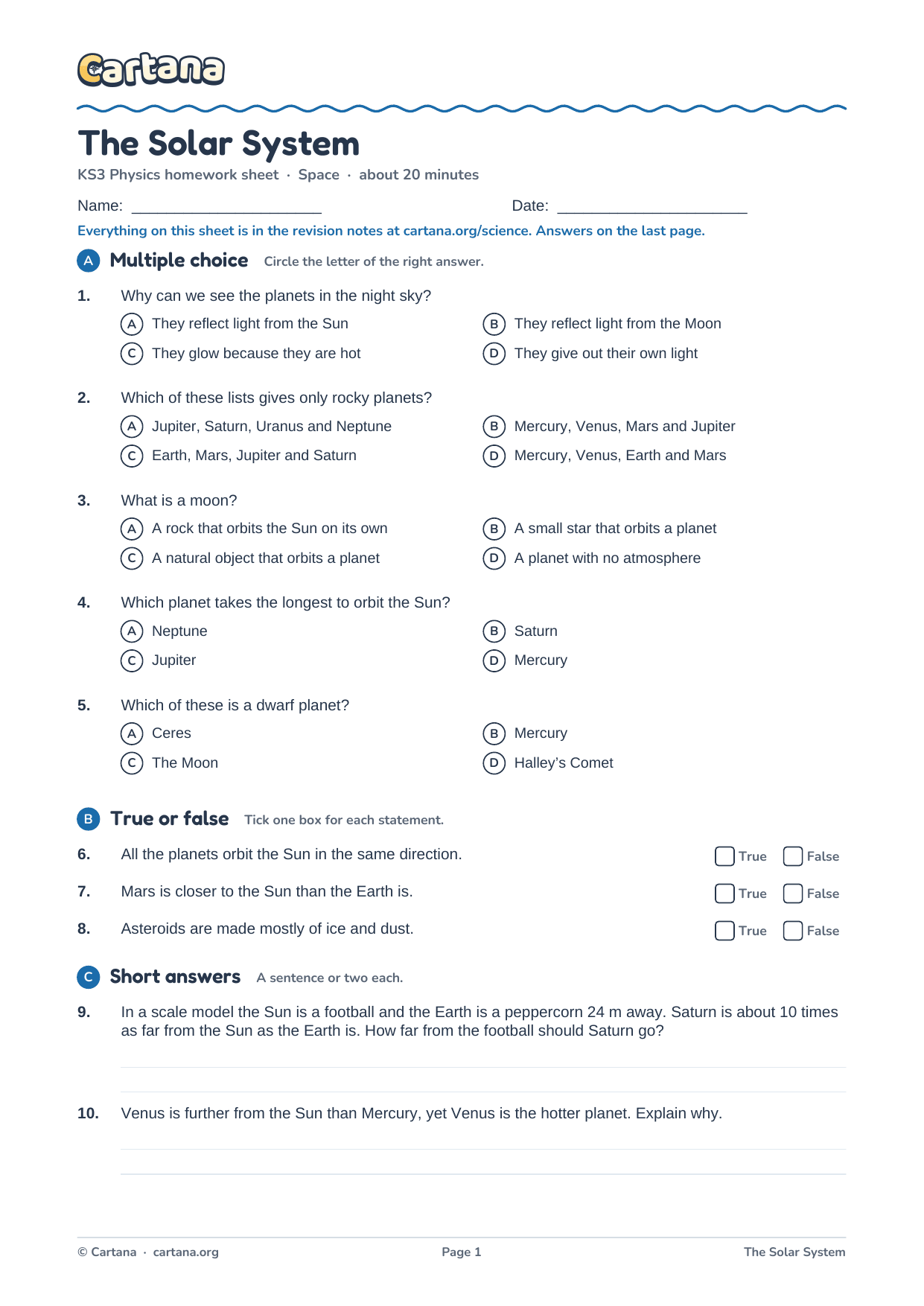
About twenty minutes. Everything on it is in the notes above; the answers are on the last page.
Free homework sheet
The Solar System homework sheet
17 questions, about twenty minutes, with the answers on the last page: multiple choice, true or false, short answers, key words to define and one to explain in full.
KS3 Space
Revised the whole unit?
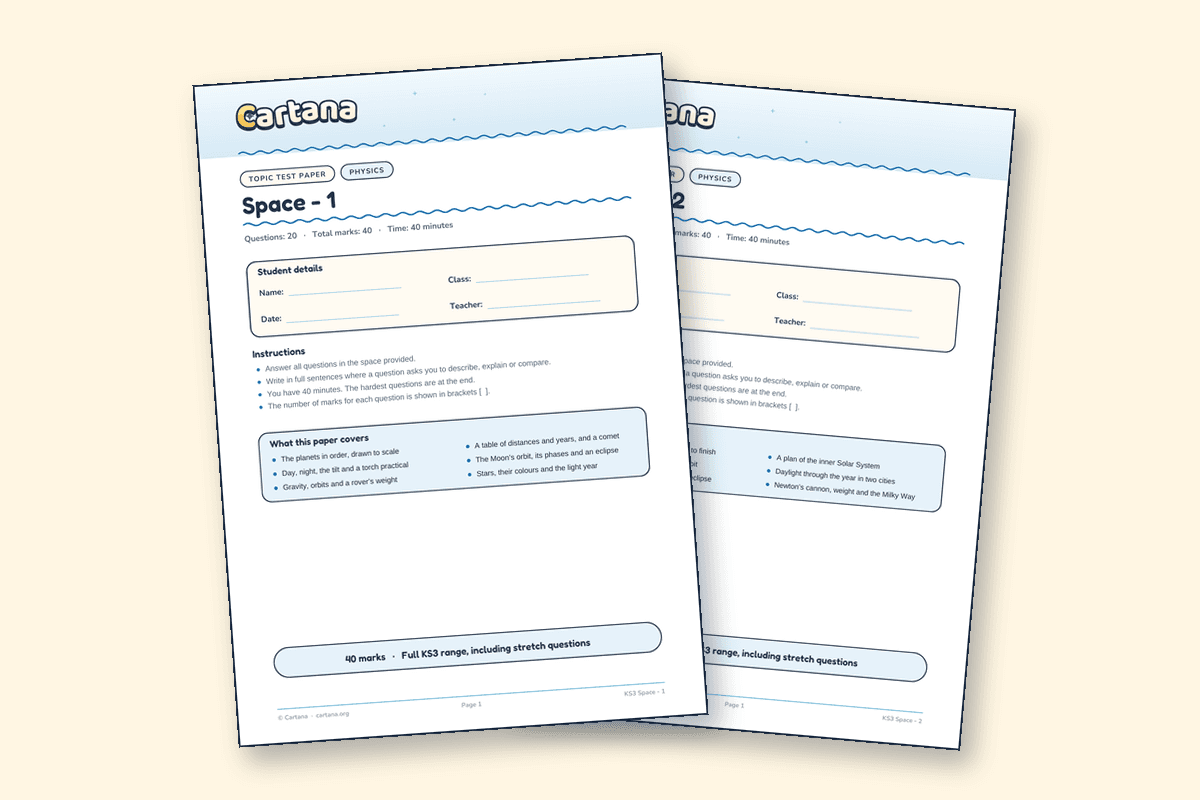
When every topic in space is done, two different papers test the whole unit, each with its own mark scheme.


 Watch the trailer · 1:06
New from Cartana · Beta test 1–31 December
Revision that feels like an adventure
Cartana is our KS3 learning adventure: sail between islands, answer quick-fire questions and battle bosses. It starts with science, with maths on the way, and launches in 2027. This December a small group of testers gets to play it first.
In the Cartana adventure, every science unit is an island to explore. The island for space is being built.
- Play the game before its official release
- Help us build it with your feedback
- Earn exclusive in-game items in return
More in this unit
Space
- 2Day, night and the seasonsNextThe Earth’s spin and day and night, its orbit and the year, the tilt of the axis, why summer is warmer, the two hemispheres and day length
- 3The MoonThe Moon’s orbit, why we see one face, the phases of the Moon, solar and lunar eclipses, and the tides
- 4Gravity in spaceGravity between any two masses, how gravity keeps moons and planets in orbit, the Earth and Moon and the Earth and Sun, g on other planets, and weight calculations
- 5Stars and galaxiesThe Sun as a star, other stars, the Milky Way and other galaxies, the light year as a distance, and why looking out is looking back in time