
KS3 Physics · Space
Stars and galaxies
- The Sun as a star, and how stars differ in size, colour and temperature
- The Milky Way, our spiral galaxy, and other galaxies such as Andromeda
- The light year as a distance, worked out in kilometres
- Why looking into space is looking back in time
- 5 min read
- 5 quick questions
- Free homework sheet
- Years 7 to 9
Revision notes
A star is a huge ball of hot gas that gives out its own light. The Sun is our nearest star, one of hundreds of billions in our galaxy, the Milky Way, which is itself one of billions of galaxies in the universe.
Is the Sun a star?
Yes: the Sun is a fairly ordinary, medium-sized star. It looks far bigger and brighter than the stars at night only because it is so much closer. The Sun is 150 million km away; the next nearest star, Proxima Centauri, is about 40 million million km away. The other stars look like tiny points because they are so far off, not because they are small.
Deep in the Sun’s core, at about 15 million °C, nuclear reactions join hydrogen into helium and release huge amounts of energy, which reaches us as light and heat. The Sun is not burning like a fire.
| Star | Planet | |
|---|---|---|
| What it is | A huge ball of hot gas | A large body that orbits a star |
| Its light | Makes its own | Reflects light from its star |
| Examples | The Sun, Sirius, Proxima Centauri | Earth, Mars, Jupiter |
Stars come in different sizes and colours. A star’s colour shows how hot its surface is: red stars are the coolest, yellow stars such as the Sun (about 5,500 °C on the surface) are hotter, and white and blue stars are the hottest. Proxima Centauri is a small, cool red star; Sirius, the brightest star in our night sky, is bigger than the Sun, hotter and white.
What is a galaxy?
A galaxy is an enormous group of stars, gas and dust, held together by gravity. Ours is the Milky Way, a spiral galaxy: a flat disc with arms of stars curling out from a bright centre. It holds between 100 and 400 billion stars and is about 100,000 light years across. The Sun is in one of the arms, about 26,000 light years from the centre. Every star you can see with your eyes alone is in the Milky Way.
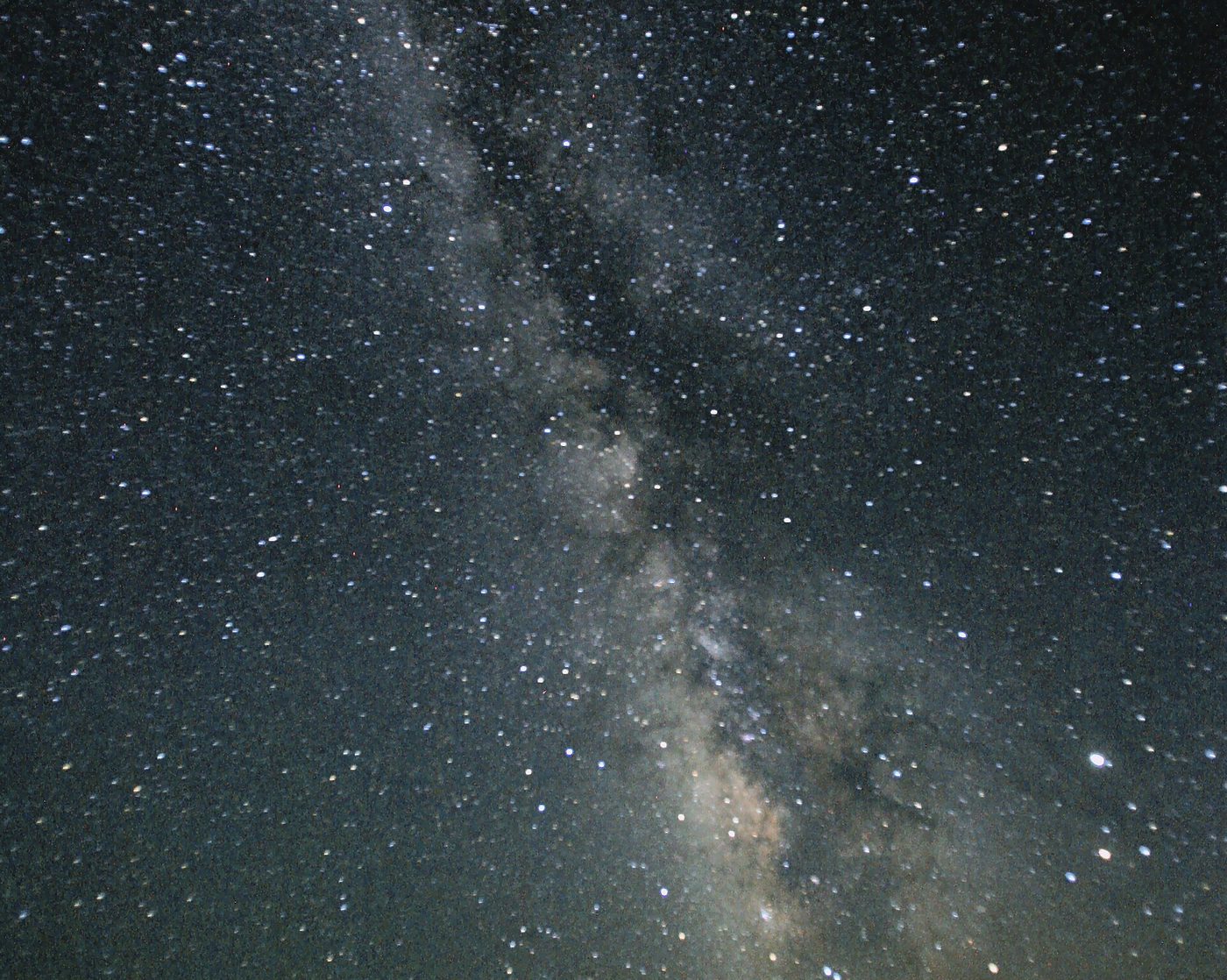
On a dark night away from street lights you can see the Milky Way as a faint, misty band across the sky. It is the disc of our own galaxy, seen from inside: millions of distant stars too faint to see one by one.
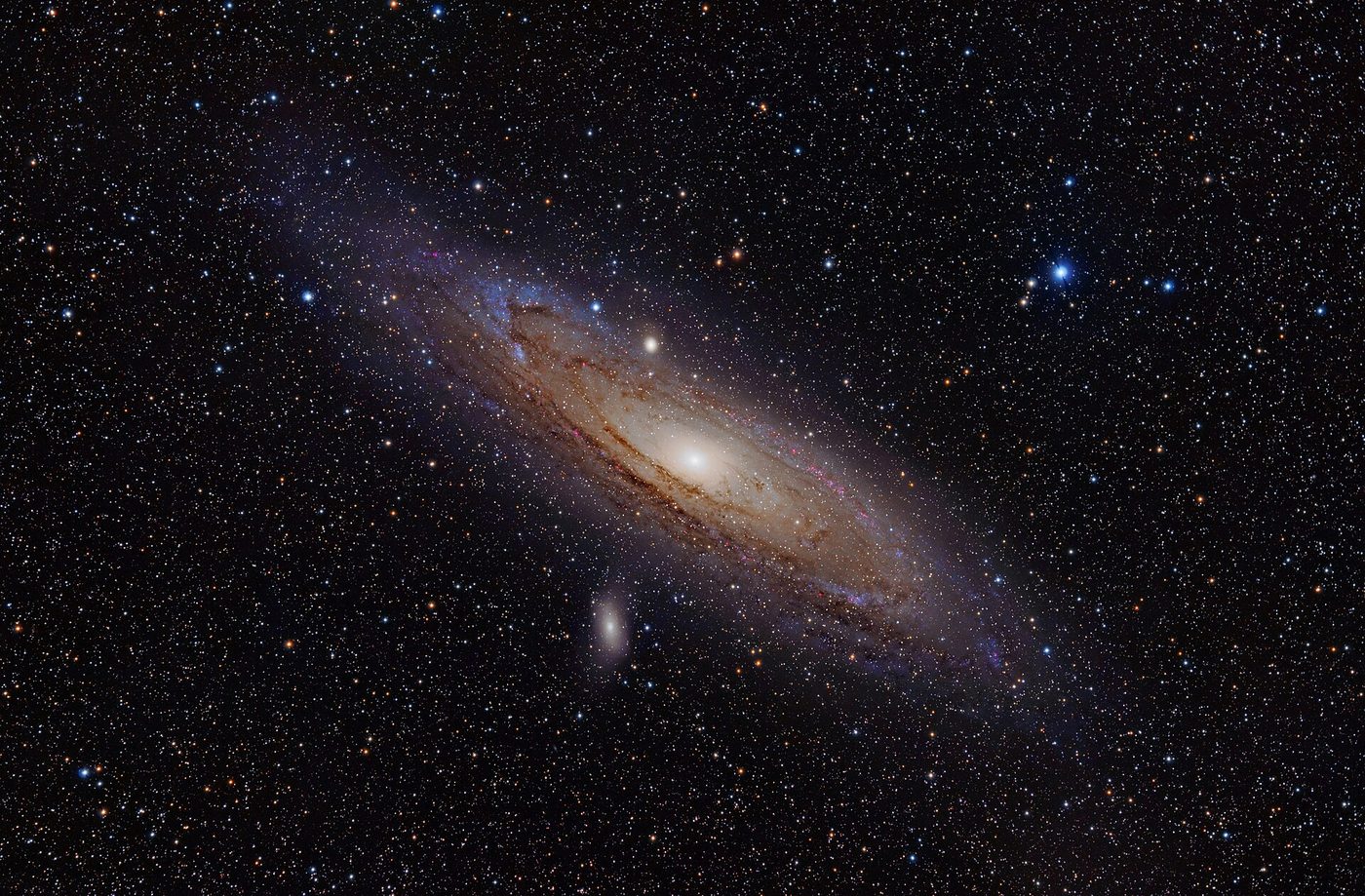
Beyond the Milky Way are billions of other galaxies. The nearest large one, the Andromeda Galaxy, is about 2.5 million light years away. The universe is everything that exists: all the galaxies and the space between them.
What is a light year?
Distances to the stars are so huge that kilometres become awkward, so astronomers use the light year: the distance light travels in one year. Light travels at 300,000 km every second.
How far is a light year in kilometres?
seconds in a year = 365 × 24 × 60 × 60 = 31,536,000 s
distance = speed × time = 300,000 km/s × 31,536,000 s
distance = 9,460,800,000,000 km: about 9.5 million million km
Despite its name, a light year is a distance, not a time. Proxima Centauri is 4.2 light years away: about 4.2 × 9.5 million million ≈ 40 million million km.
Why is looking into space looking back in time?
Light takes time to reach us, so we always see things as they were when their light set off. Sunlight left the Sun about 8 minutes ago. We see Proxima Centauri as it was 4.2 years ago, and the Andromeda Galaxy as it was 2.5 million years ago, long before there were any modern humans. The further away something is, the further back in time we are seeing it.
Stretch The universe is about 13.8 billion years old. The James Webb Space Telescope has photographed galaxies whose light set off more than 13 billion years ago, so we see them as they were when the universe was young, long before the Sun and the Earth formed 4.6 billion years ago.
Written to the KS3 national curriculum. Last changed 14 November 2026.
Key words
Say them, spell them, use them in an answer.
- star
- Sun
- galaxy
- Milky Way
- spiral galaxy
- Andromeda Galaxy
- universe
- light year
Common misconception
Often said“A light year is a measure of time.”
In factA light year is a distance: how far light travels in one year, about 9.5 million million km. Saying a star is 4 light years away tells you how far it is, and also that its light took 4 years to reach us.
Did you know?
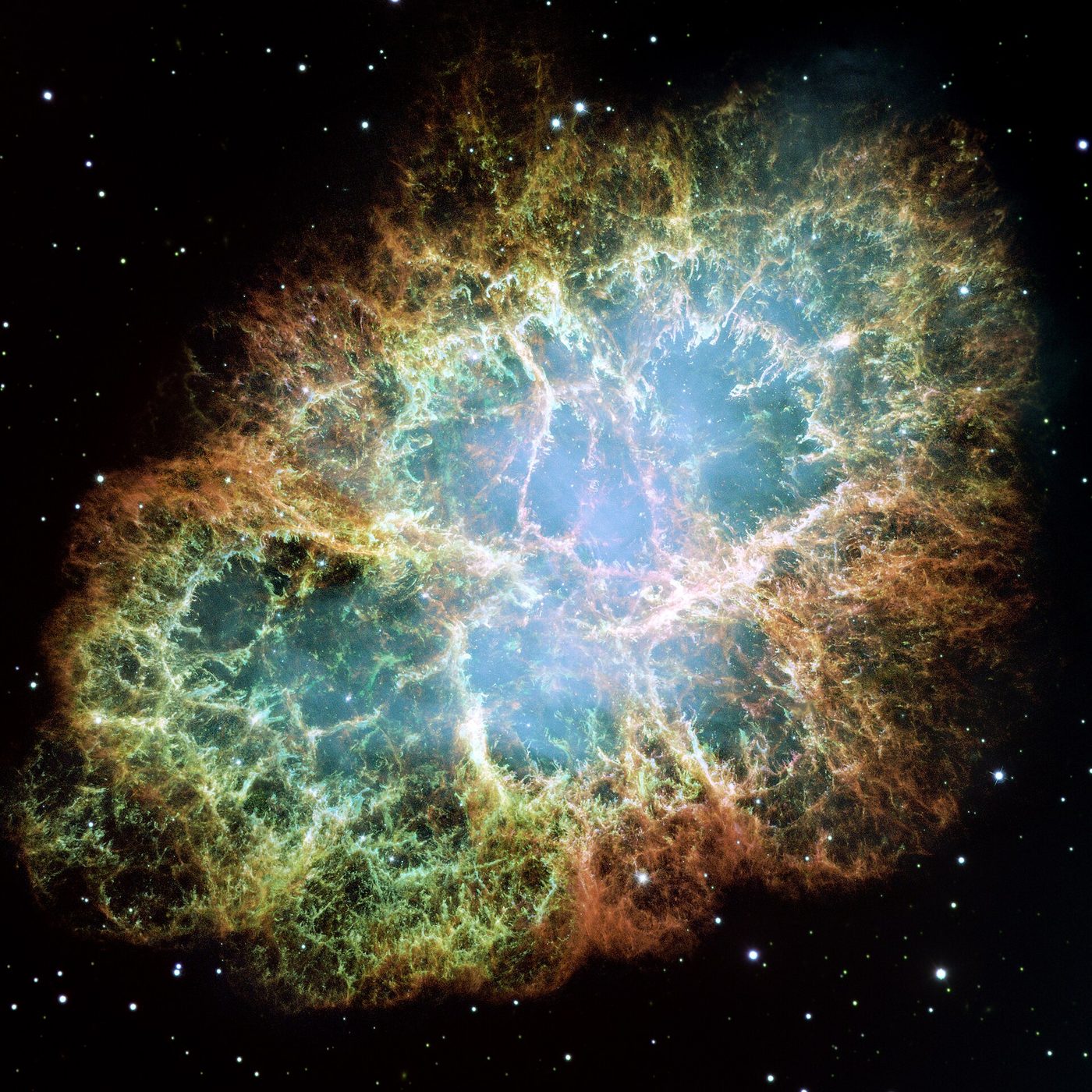
The Crab Nebula
In 1054 astronomers in China recorded a new star so bright that it could be seen in daylight for 23 days. It was a star exploding. The Crab Nebula is the cloud left behind, about 6,500 light years away, so the explosion really happened about 6,500 years before they saw it.
Photo: NASA, ESA, J. Hester and A. Loll (Arizona State University), Public domain, via Wikimedia Commons
Try 5 questions
Quick questions on stars and galaxies, marked as you go. Each one explains the answer.
Question 1 of 5
Which list goes from smallest to largest?
Choose an answer. Each question explains itself.
The homework sheet
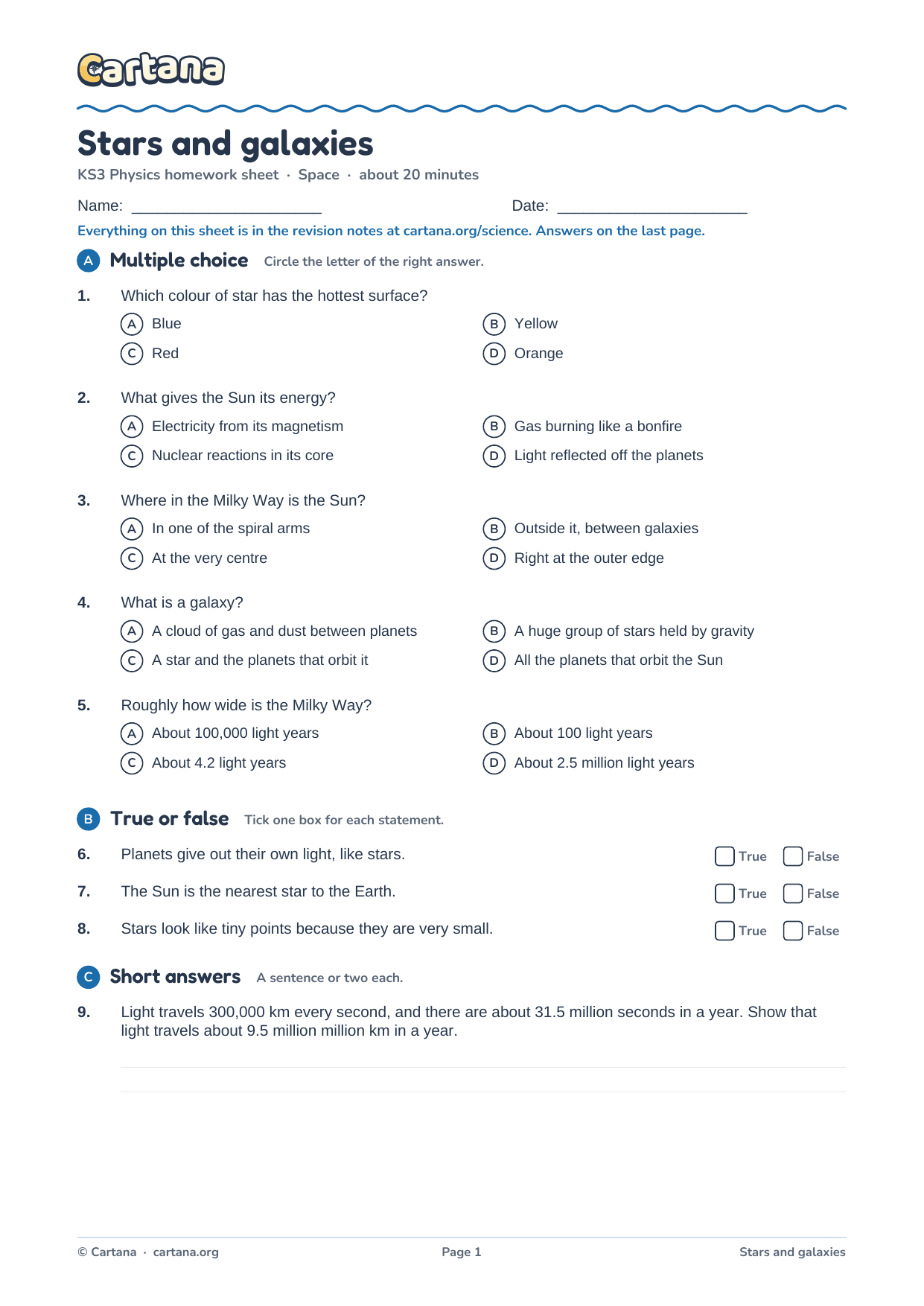
About twenty minutes. Everything on it is in the notes above; the answers are on the last page.
Free homework sheet
Stars and galaxies homework sheet
17 questions, about twenty minutes, with the answers on the last page: multiple choice, true or false, short answers, key words to define and one to explain in full.
KS3 Space
Revised the whole unit?
When every topic in space is done, two different papers test the whole unit, each with its own mark scheme.


 Watch the trailer · 1:06
New from Cartana · Beta test 1–31 December
Revision that feels like an adventure
Cartana is our KS3 learning adventure: sail between islands, answer quick-fire questions and battle bosses. It starts with science, with maths on the way, and launches in 2027. This December a small group of testers gets to play it first.
In the Cartana adventure, every science unit is an island to explore. The island for space is being built.
- Play the game before its official release
- Help us build it with your feedback
- Earn exclusive in-game items in return
More in this unit
Space
- 1The Solar SystemThe Sun, the eight planets in order, moons, dwarf planets, asteroids and comets, rocky planets and gas giants, orbits and the scale of the Solar System
- 2Day, night and the seasonsThe Earth’s spin and day and night, its orbit and the year, the tilt of the axis, why summer is warmer, the two hemispheres and day length
- 3The MoonThe Moon’s orbit, why we see one face, the phases of the Moon, solar and lunar eclipses, and the tides
- 4Gravity in spaceGravity between any two masses, how gravity keeps moons and planets in orbit, the Earth and Moon and the Earth and Sun, g on other planets, and weight calculations